Social media maturity for a multi-brand portfolio is not a measure of how many followers you have or the "vibes" of your grid. It is the literal delta between a brand being connected to an API and being operational in its day-to-day cadence. The fastest way to audit a fifty-brand portfolio is to treat "Setup Progress" - verified profile connections, uploaded brand assets, and active automation workflows - as your primary maturity KPI. By using a standardized checklist like Mydrop's Quick Start model, you can eliminate "ghost brands" and identify invisible coordination debt before it stalls your next campaign.
Managing a massive brand portfolio often feels like a game of high-stakes whack-a-mole. You suspect half your workspaces are dark - profiles are technically linked, but nothing is actually moving - yet finding the time to manually audit every single one is a full-time job. We get it; when you scale, the foundational setup is usually the first thing to rot. It is the part that isn't "fun" or "creative," so it gets skipped in the rush to publish, leaving you with a collection of zombie accounts that look active on paper but are dead in reality. No one enjoys chasing approvals at 6 p.m. only to find out the brand logo in the library is three years out of date.
The operating problem this solves

When you manage three brands, you can keep the details in your head. When you manage thirty, your brain runs out of RAM. This is where Fragmented Quality starts to eat your team's efficiency. You assume every brand is following the same standards, but without a uniform measurement model, you are actually running thirty different versions of "the process."
The real danger here is the Hidden Cost of Ghost Brands. Most agencies and enterprise teams pay for "zombie" workspaces that are connected to platforms but have 0% operational readiness. This isn't just a waste of seat costs; it is a massive liability. A brand that is connected but lacks a defined workflow or uploaded assets is a brand that will miss a PR crisis or fail to respond to a customer because the "pipes" weren't actually finished.
Operator rule: A brand isn't launched until its first content loop is verified. Until then, it is just a billable seat with a logo.
At Mydrop, we have seen this across thousands of workflows. Teams often mistake "access" for "maturity." Just because a junior manager has the password doesn't mean the brand is mature. Maturity requires a verified setup state that anyone on the team can audit in seconds.
| Maturity Level | Technical Trigger (Quick Start Milestone) | Operational Status | Decision Rule |
|---|---|---|---|
| Level 1 | Profile Auth 100% | Ad-hoc: "The Pilot" | Stop here if the client hasn't signed off on creative assets. |
| Level 2 | Assets + First Post Done | Functional: "The Engine" | Scale only if the approval latency is under 24 hours. |
| Level 3 | Automations + AI Tried | Optimized: "The Machine" | 100% checklist completion required for official hand-off. |
If you cannot see these three levels at a glance across your whole portfolio, you aren't managing a strategy; you're just supervising a mess. Standardizing your audit around live setup data turns a subjective "gut feeling" about brand health into a hard metric you can report to stakeholders.
The minimum system that works

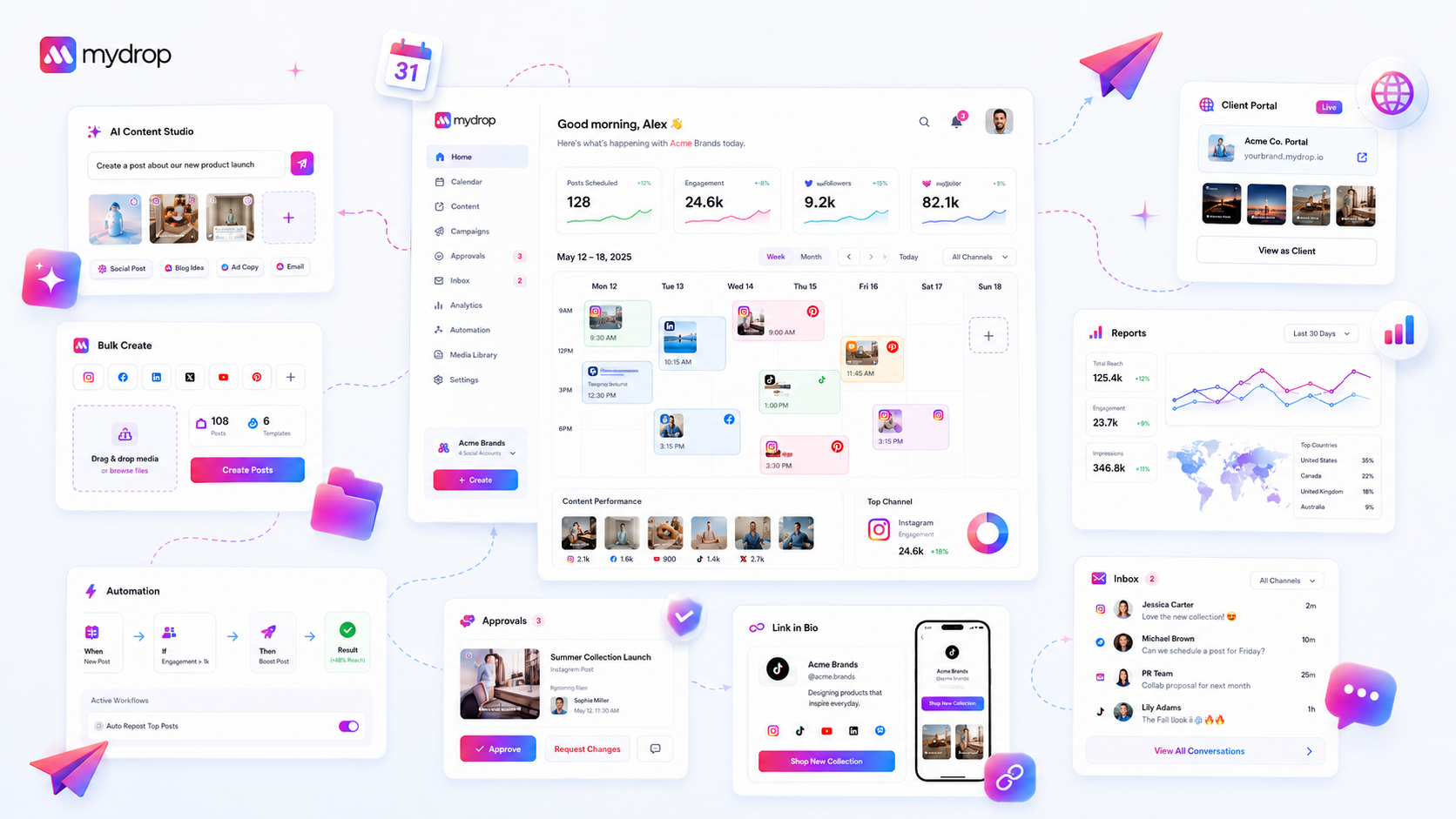
The fastest way to kill the "ghost brand" problem is to replace subjective surveys with a binary maturity model. You don't need to ask a brand manager if they feel "ready" to post; you need to know if the technical pipes are actually open. At Mydrop, we suggest using the Quick Start Checklist as your source of truth because it tracks what is actually happening in the database, not what people say is happening in a meeting.
This isn't about micromanagement; it's about visibility. When you are managing 30 brand workspaces, you can't manually check every profile every morning. You need a system that flags the delta between "the client signed the contract" and "the team has actually uploaded their logo and connected their LinkedIn."
The following scorecard turns those invisible setup steps into a standardized KPI you can use to audit an entire portfolio in a single afternoon.
The Brand Operational Maturity Scorecard
| Maturity Level | Milestone | Mydrop Data Signal | Operational Meaning |
|---|---|---|---|
| Level 1: Ad-hoc | Profile Auth | profileConnections > 0 |
The lights are on, but nobody is home. The API is connected, but no work has started. |
| Level 2: Functional | Brand Identity | brandAssetsUploaded = True |
The workspace is customized. The team has moved in and uploaded their creative guardrails. |
| Level 3: Active | First Loop | nonSuggestionPosts > 1 |
The "first post" hurdle is cleared. The team has moved past the templates and is publishing original work. |
| Level 4: Integrated | AI-Assisted | triedAiPost = True |
The team is using the AI Assistant Agent to speed up production. They aren't just working; they are working efficiently. |
| Level 5: Optimized | Automation | activeAutomations > 0 |
Workflows are running in the background. Leads are being routed, and responses are being handled without manual touches. |
| Level 6: Mature | 100% Ready | quickStartDone = True |
Every milestone in the Quick Start Panel is green. The brand is fully onboarded and resilient to staff turnover. |
Decision check: A brand is not "launched" until it hits Level 3. Anything below that is just a liability on your billing statement.
By looking at the quickStartDone flag across your portfolio, you can instantly see which brands are stalling. If you see a brand stuck at Level 2 for three weeks, you don't have a "content" problem; you have an onboarding bottleneck. Maybe the client hasn't handed over the login credentials, or maybe the local team is overwhelmed. Either way, you now have the data to go in and fix it before the quarterly review turns into a crime scene.
Where teams overbuild the process
The most common mistake we see in enterprise teams is trying to solve setup friction with more documentation. We have all seen the 68-page "Social Media Playbook" PDF that sits in a shared drive, unread and unloved, while the actual brand profiles languish in a half-configured state.
Stop building audit decks and start looking at live setup state.
When you overbuild the audit process, you create "coordination debt." This happens when the effort required to report on the work becomes greater than the effort required to do the work. If your team has to spend four hours a week filling out a spreadsheet to prove they set up their brands correctly, they have four fewer hours to actually engage with the community.
In our experience, teams that thrive at scale are the ones that lean on Guided Product Tours and automated checklists. Instead of a manual audit, they use the Quick Start Panel to route users directly to the missing step. If the "Profile Setup" step isn't done, the app shows them exactly where to click. It’s the difference between giving someone a map and giving them a GPS with turn-by-turn directions.
The truth about scale: You don't need a more complex process; you need a more visible foundation.
If you find yourself chasing "onboarding status" in Slack threads at 6 p.m. on a Friday, you’ve overbuilt the wrong thing. You've built a culture of checking-in rather than a culture of checking-off. Shift the focus back to the Quick Start milestones. If the dashboard says the brand is 100% done, trust the data and move on to the actual strategy. Your time is too valuable to spend it acting as a human progress bar.
How to run the cadence
Establishing a maturity model is one thing; actually checking it without losing your Tuesday is another. If you are managing twenty or fifty brands, you cannot afford to spend hours digging through every individual workspace to see if the team finally uploaded their logos or connected their LinkedIn profiles.
We recommend a Monthly Maturity Audit. It sounds formal, but it really only takes about thirty minutes if you are looking at the right signals. Instead of asking for a status report (where everyone says "we're almost there"), you look at the raw setup data. In our experience, teams that treat setup as a one-time chore usually end up with "zombie brands" -- accounts that are technically connected but haven't seen a post or a login in three months.
Here is the three-step workflow to keep your portfolio healthy:
- The Metadata Sweep: Look for the
quickStartDoneflag across your brands. This is your binary "Yes/No" on whether the foundation exists. If a brand has been in your system for thirty days and this isn't checked, that's your red flag. - The AI Pulse Check: Check the
triedAiPostsignal. This is the best proxy for whether a team is actually exploring the modern workflow or if they are still stuck in a manual, high-friction loop that eventually leads to burnout. - The "Show Me" Intervention: For the brands that are stalling, don't send a long email. Use the Quick Start panel to trigger a "Show Me" tour for the specific stakeholder who is stuck. Sometimes they just need to see the profile connection flow one more time to realize it only takes sixty seconds.
Workflow check: If a brand hasn't reached 100% Quick Start completion within 14 days of onboarding, it’s not an "active" brand -- it’s a project risk. Treat it as a bottleneck, not a "work in progress."
The proof that the habit is working
How do you know if this standardization is actually paying off? You’ll see it in the "Time to First Value" (TTFV). In a mature portfolio, a new brand shouldn't take three weeks to find its legs. It should be operational in forty-eight hours because the checklist provides a clear, unmissable path.
When you move from subjective "vibes" to a data-backed maturity model, your internal conversations change. You stop asking "How are things going with Brand X?" and start asking "Why is Brand X stuck on Step 4 (Active Automations) of the Quick Start?"
Here is what a mature portfolio looks like in practice:
| Maturity Signal | Ad-hoc (Level 1) | Functional (Level 2) | Optimized (Level 3) |
|---|---|---|---|
| Profile Auth | 1 connection (often expired) | All core channels active | 100% Auth uptime; no dead links |
| Brand Assets | Empty media library | Logos and one template uploaded | Full asset library + active tags |
| Workflow | Manual scheduling only | First AI-assisted post tried | Active automations + lead flows |
| Team Health | One "owner" who is buried | Multiple users onboarded | Regular workspace history activity |
The "Zombie Brand" Count: The clearest proof of success is the steady decline of brands that have 0% operational readiness. When you make the Quick Start progress visible to leadership, teams naturally start to close those gaps. No one wants to be the brand manager with the "0% Done" badge on the monthly dashboard.
A baseline, not a ceiling
At the end of the day, social media maturity isn't about being "perfect" on every platform. It is about removing the invisible friction that makes scaling a nightmare. When you use a standardized checklist as your maturity model, you aren't just checking boxes; you are installing a repeatable operating system.
At Mydrop, we built the Quick Start panel and onboarding overlays specifically to solve this "scale rot." We’ve seen hundreds of teams realize that their biggest problem wasn't a lack of creative ideas -- it was a lack of a clear, verified foundation. Once the profiles are connected, the assets are in place, and the first AI post is out the door, the "scary" part of scaling is over.
The real goal isn't just to reach 100% on a checklist. The goal is to reach a state where your team can stop worrying about the "how" of the software and start focusing on the "what" of the brand. Maturity is simply the point where the tools get out of the way and the work starts to flow. Stop guessing which brands are ready and start looking at the data. Your portfolio (and your Tuesday afternoon) will thank you.