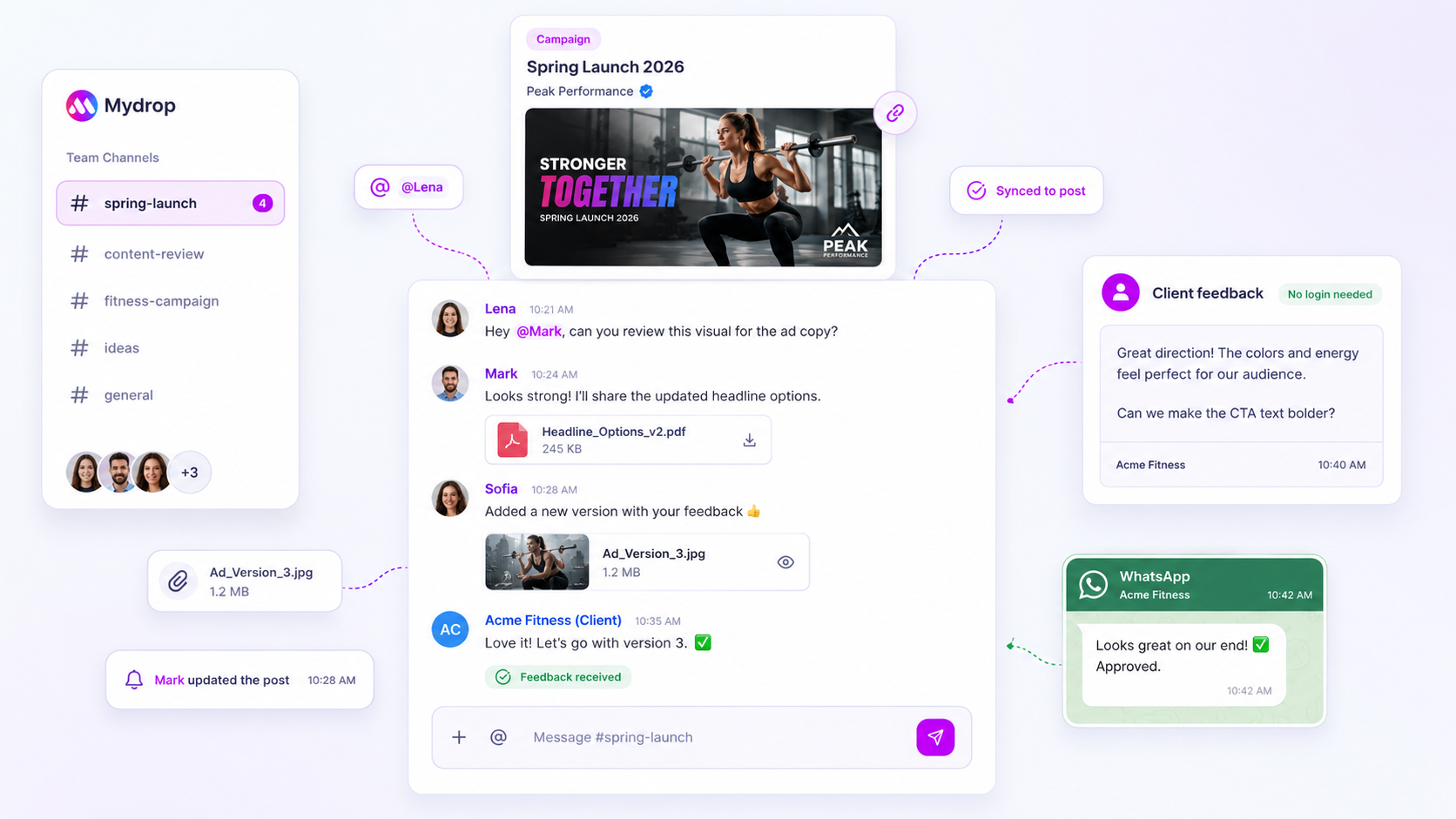
The secret to shortening your campaign cycles is simple: treat every comment thread like a line item on a budget. You are likely not losing time to creative blocks or bad ideas; you are losing it to scattered communication that never actually settles into a clear decision.
We have all been there. A post sits in the queue for four days while half a dozen people chime in over email, chat apps, and project management tickets. By the time it finally hits the publish button, you have spent more time managing the noise than you did creating the content. It is exhausting, and it is entirely avoidable once you start measuring the actual friction behind the scenes. You need to pull your collaboration out of the dark and into a model where you can see exactly where the bottlenecks form.
The decision each metric should trigger

Once you have your data, you need a clear operating habit for how to use it. A metric without an action is just a vanity project, and for a team managing hundreds of brand profiles, that is a luxury you cannot afford. When you start tracking your Resolution Velocity, use these thresholds to decide exactly when to stop typing and start talking.
| Metric | Threshold | Triggered Action |
|---|---|---|
| Thread Volume | > 10 messages | Move the conversation to a live 10-minute huddle. |
| Resolution Speed | > 48 hours | Audit the workflow; identify if a specific stakeholder is causing the stall. |
| Feedback Density | > 75% external | Implement a pre-review brief for clients to align on goals before drafting. |
When your team uses Mydrop, we see the most successful operations use Conversations to centralize this feedback. Instead of chasing a thread across email or messaging apps, the entire context-from the first suggested edit to the final sign-off-lives right next to the post. If a thread hits that 10-message limit, it is a clear signal that the team is spinning their wheels rather than resolving them. That is the moment to pull the team together and force a decision.
Operator rule: If you cannot link a comment to a specific, actionable asset change, it is not "collaboration." It is just noise, and you should treat it as an interruption to your workflow.
If you are seeing a high feedback density, it usually means your stakeholders are looking at the creative work without a clear rubric. We often find that moving the review process into a portal where clients can drop comments directly on the asset-rather than describing them in a separate document-drastically cuts down the back-and-forth. It keeps the feedback anchored to the work, removing the "did you mean this or that?" guessing game that kills your momentum.
Your goal isn't to stop people from talking. It is to make sure every conversation has a clear path toward being marked resolved.
The scorecard that keeps reporting useful

You need a living document that tracks the friction between your draft and the go-live button. If you are still relying on a post-mortem meeting to figure out why a campaign stalled, you are already too late.
We suggest a simple Feedback Efficiency Scorecard that your team reviews during a 15-minute weekly sync. It turns those messy, fragmented email and Slack chains into a clean set of operational signals.
| Asset Name | Total Messages | Feedback Loops | Resolution Time | Velocity Score (1-10) |
|---|---|---|---|---|
| Spring Campaign Video | 42 | 5 | 72 hours | 3 |
| Regional Q3 Recap | 8 | 1 | 4 hours | 9 |
| Influencer Launch Post | 24 | 3 | 24 hours | 6 |
How to interpret your scores:
- Velocity Score (1-10): Calculated by
10 - (Total Messages / 5). Anything below a 5 suggests your team is stuck in a repetitive loop rather than making progress. - Resolution Time: Track this from the first edit request to the final
Approvedstatus. If it spans multiple days, look for the specific stage where the asset sat idle. - Feedback Loops: This counts how many times a draft was sent back to creative. High numbers here usually point to missing clear briefs or too many stakeholders without decision authority.
At Mydrop, we see teams struggle most when feedback is fragmented across different apps. When a team uses our Conversations feature to centralize comments directly on the asset-whether it is from an internal editor or an external client via an approval portal-the message count drops. The goal is to move the conversation out of hidden email threads and into a space where everyone sees the same history, preventing the same question from being asked three times.
What to stop measuring by default
Stop tracking "total hours spent" per campaign. It is a vanity metric that hides the real problem.
In most large organizations, the creative work is not the blocker; it is the waiting. You can spend 40 hours creating a video, but if it takes 90 hours for the brand manager to review it, you have a broken pipeline. Measuring time spent on production gives you a false sense of efficiency. It tells you how long the person was working, but it says nothing about why the asset wasn't published.
Decision check: If you cannot link a comment to a specific asset change, it is not collaboration; it is noise.
Stop counting "total messages" as a measure of engagement. In the context of a campaign cycle, a high volume of messages is a warning sign, not a success metric. It signifies that your team is negotiating instead of iterating.
Finally, stop measuring "number of approvals" as a sign of progress. A post can have five approvals and still be a failure if it took three weeks to gather them. Instead, focus strictly on time-to-resolution. If you keep your eyes on how fast a draft moves from Drafting to Finalized, you will naturally stop the behavior that creates those endless, unproductive back-and-forth threads. When the team knows the clock is ticking on resolution time, they tend to be more precise with their feedback the first time.
How to connect metrics to next actions
Tracking your resolution speed is just vanity unless it forces a change in behavior. If your Feedback Efficiency Scorecard shows a specific campaign asset lingering for days, you need an automatic trigger to move the conversation from text-based back-and-forth to a decisive resolution.
When a thread count crosses a set threshold, stop typing. We find that once an asset exceeds six comments, the chances of a clear resolution via chat plummet. At Mydrop, we see teams that solve this by routing those specific high-friction conversations directly into a live review sync.
Use this simple decision flow when your data signals a bottleneck:
- The 3-Comment Rule: If three comments pass without a clear "approved" or "edit confirmed," pause the text thread.
- The Pivot Point: Move that conversation into a dedicated review session. Use the context captured in your Conversations history to brief the team, ensuring no one repeats the same feedback twice.
- The Closure: Once the sync concludes, one person must post the final summary into the conversation thread to lock in the decision. This creates a clean audit trail without the "chat fatigue" that usually eats up your Tuesday afternoons.
If you are constantly hitting high thread volumes on every post, you have a structural problem-likely too many stakeholders with veto power.
The review cadence that makes the model stick
Data gets stale fast, and a report no one looks at is just digital clutter. You need a 15-minute Friction Audit at the end of every week. This isn't a deep dive into campaign performance; it is a rapid-fire review of your operational health.
Grab your team leads and look at the scorecard. Ask one question: Where did we waste the most time waiting for a sign-off?
Workflow check: If an asset's resolution time exceeds your campaign cycle target by more than 20 percent, it is an automatic agenda item for the audit.
By institutionalizing this check, you transform "the messy week" into a series of small, manageable course corrections. You aren't just shipping content; you are tuning the machine so it actually keeps up with your brand's demand.
Conclusion
At the end of the day, your creative work is only as fast as your slowest approval. You can stop chasing updates at 6 p.m. or guessing which stakeholder is holding up the go-live button by treating feedback as a quantifiable workflow item.
Start measuring your resolution speed this week. You will quickly find that the "creative process" is rarely the culprit. Most of the time, the work is already done-it is just stuck in a thread waiting for someone to hit reply. Stop letting the silence kill your momentum. Pinpoint the friction, clear the path, and get back to shipping.