The secret to consistent content performance isn't spotting the next viral trend first; it is identifying the recurring topic clusters that already signal high engagement within your specific industry niche. Most enterprise teams are currently stuck in a cycle of reactive imitation, manually scouring competitor feeds for inspiration while their own content backlogs grow stale. It is messy, exhausting, and leaves you guessing at what will resonate next.
You don't need another brainstorming session or a bigger spreadsheet of "interesting" posts. You need a way to stop chasing fleeting viral moments and start doubling down on the intent-based topic clusters that consistently move your audience. By shifting from manual trend-spotting to data-driven theme validation, you can replace the guessing game with a repeatable, evidence-backed strategy.
Where the handoff is actually breaking

The "trend-chasing trap" is the hidden cost of modern marketing. When you rely on anecdotal observations, your strategy becomes a game of follow-the-leader. You see a competitor use a specific hook, you rush to emulate it, and by the time your team clears the approval process, the market has already moved on. The real issue isn't that you lack ideas; it is that your data collection is decoupled from your execution.
At Mydrop, we often see teams with hundreds of brand profiles hitting a wall because they lack a unified view of what content is actually working. They spend hours every week on "intelligence" that amounts to little more than a collection of screenshots and gut feelings.
Here is how the drift typically manifests when you rely on manual tracking versus an integrated intelligence loop.
| The Manual Spreadsheet Drift | The AI Intelligence Loop |
|---|---|
| Input: Reactive, platform-specific browsing. | Input: Aggregated, cross-platform theme clusters. |
| Method: Manual entry of top posts into a tracker. | Method: AI-identified rising topic clusters. |
| Output: A list of "what" to copy next. | Output: A "winning recipe" for format and intent. |
| Cadence: Weekly, often behind the actual market. | Cadence: Real-time data freshness, automated alerts. |
| Risk: Copying noise instead of finding gaps. | Risk: Over-indexing on niche performance signals. |
Common mistake: Treating a single high-performing competitor post as a signal to pivot your entire strategy. A true "winning recipe" is a repeatable format within a cluster, not a one-off viral hit.
When the handoff between "what we see" and "what we produce" happens in a vacuum, you lose authority. You aren't building a brand; you are just participating in the noise. The goal is to move from mimicking specific posts to understanding the underlying demand-the themes your audience is actually searching for and responding to today.
The coordination debt checklist

Most enterprise teams don't have a content problem. They have a coordination problem. You aren't missing the "next big trend" because your creatives aren't talented; you're missing it because your best insights are trapped in disconnected spreadsheets, siloed team chats, and last-minute approval loops.
If your team is struggling to keep pace, run this 5-point audit. If you check three or more boxes, you are likely carrying heavy coordination debt.
| Audit Signal | The Hidden Cost |
|---|---|
| Manual Data Consolidation | Your team spends more time copy-pasting metrics than actually building strategy. |
| Reactive Scheduling | You are posting based on yesterday's inbox pressure, not tomorrow's data. |
| Fragmented Feedback | Stakeholders review assets across email, slack, and project tools, losing context. |
| Platform Blind Spots | You lack a shared, normalized view of what is working across Instagram, YouTube, and X. |
| Inconsistent Governance | Every team interprets "brand voice" differently because there is no central source of truth. |
Watch out: Trying to fix these gaps by adding more meetings. Meetings are the primary way coordination debt compounds. Instead of talking about the work, you need to change how the work flows.
How to move decisions closer to the work
The goal is to stop treating your social media intelligence as a static report and start treating it as a dynamic decision-making engine. In our experience, teams managing hundreds of brand profiles only break free from this cycle when they decentralize the insight while centralizing the governance.
To make this transition, you need a workflow where the data doesn't just sit in a dashboard; it dictates the next move.
- Adopt a shared "Winning Recipe" baseline. Instead of guessing what to post, force your teams to align on a specific format-like a "how-to" carousel or a short-form tutorial-that Mydrop identifies as a high-intent, rising cluster.
- Move from "Request for Approval" to "Request for Exception." Pre-approve your core content pillars. If a post follows an AI-validated theme, it shouldn't need a three-day review cycle. Reserve the bottleneck for the creative outliers that actually carry risk.
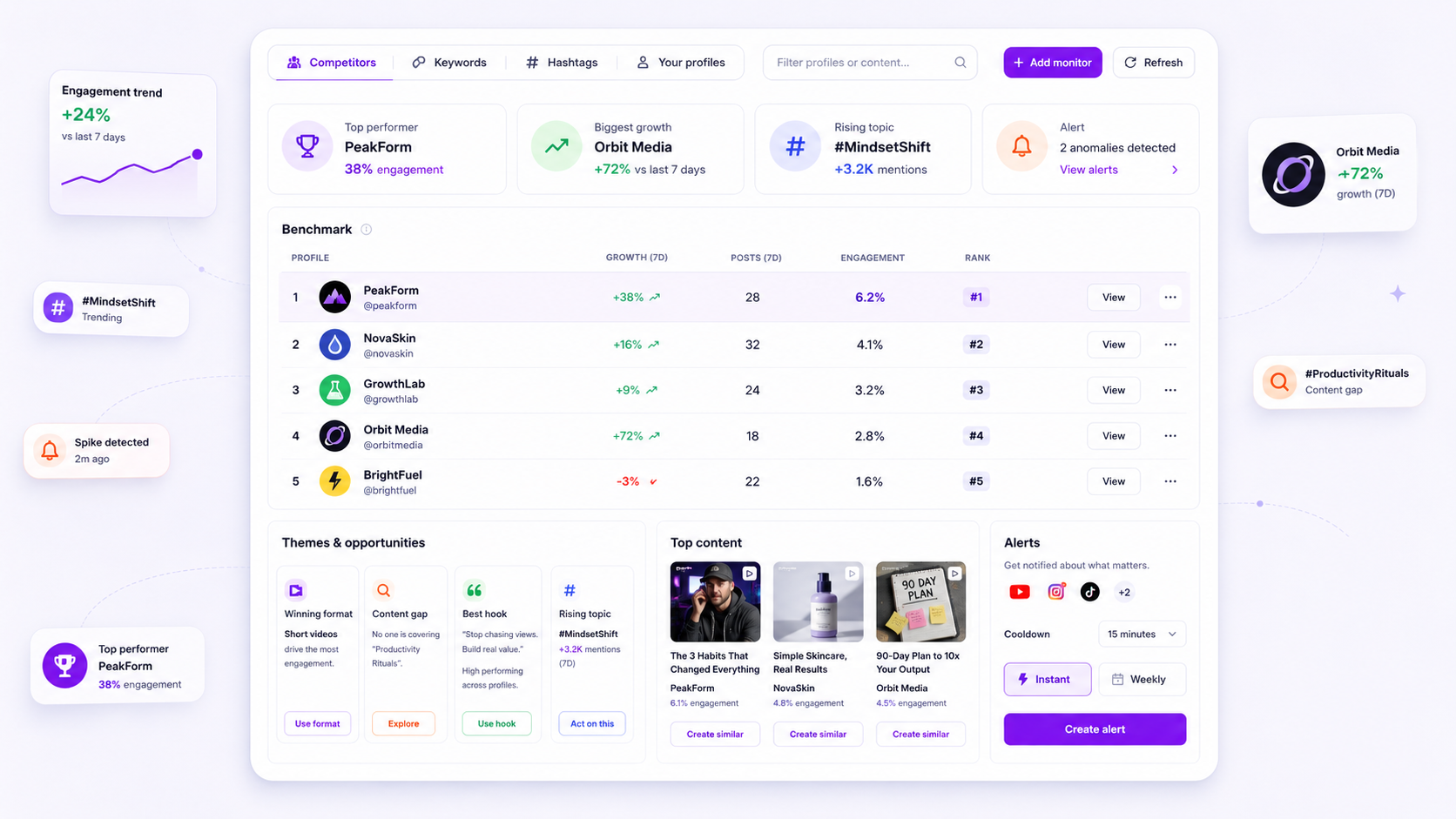
- Automate the intelligence loop. Don't wait for your Monday morning status meeting to see what happened last week. Use the Intelligence Dashboard to set up automated alerts so that when a competitor shifts their strategy or a topic cluster spikes, your team gets the signal in real-time.
At Mydrop, we see teams use this exact pivot to regain 10 to 15 hours of planning time per week. The secret isn't more effort; it is shifting your team from chasing noise to monitoring intent. Once you have a persistent, normalized view of your competitive landscape, you stop being a reactive content factory and start being a proactive market leader.
The roles and rules that reduce rework
The best enterprise teams treat content strategy like product development. They have clear roles, specific rules for engagement, and, most importantly, a shared understanding of what constitutes a "winning" theme. When you stop treating every post as a bespoke work of art and start viewing them as experiments within a cluster, your approval bottlenecks dissolve because the standards are objective, not personal.
Here is how to set those guardrails:
Operator rule: If a content theme hasn't been validated by at least two high-performing posts in the Intelligence Dashboard over the last 30 days, it is a hypothesis, not a pillar. Treat it as a test, not a mandate.
You need to assign someone the role of Thematic Editor. This person doesn't just check grammar; they review the week's output against the AI-suggested rising topics. They act as the firewall between reactive "let's try this" impulses and data-backed content plans.
The weekly habit that keeps the system honest
You can install all the software in the world, but if your weekly planning meeting is still a scramble for "what should we post next," you are losing. We have seen teams at scale shift from reactive chaos to proactive output by adopting this 60-minute intelligence cycle.
The Monday Morning Intelligence Loop
| Stage | Activity | Goal |
|---|---|---|
| 1. Digest Review | Audit the previous week's Intelligence alerts and top posts. | Identify if a "rising topic" actually took hold. |
| 2. Theme Update | Compare our content performance against benchmark competitors. | Spot where they are moving faster than us. |
| 3. Recipe Refresh | Review the "winning recipe" output for our core pillars. | Tweak hooks or formats to match current resonance. |
| 4. Gap Analysis | Identify one high-intent topic we are currently ignoring. | Ensure we aren't just echoing the room. |
| 5. Plan Commit | Finalize the next week's calendar based on the above. | Remove the "I feel like we should post..." debate. |
At Mydrop, we suggest keeping this session brutally focused on the Intelligence Dashboard. If a topic isn't surfacing in your cluster data, don't waste time debating it. Let the data act as the objective third party in the room.
Conclusion
Most social media operations fail because they try to be everything to everyone at all times. They burn out their teams chasing every fleeting trend, hoping that volume will eventually translate to authority.
The reality is much simpler: consistency beats intensity every time.
When you stop guessing and start monitoring the clusters that actually signal interest in your niche, you stop being a content factory and start being a publisher. You regain control of your schedule, you lower the friction of your approval loops, and you give your creative team the one thing they actually need to do their best work: a clear, data-validated objective.
Your goal isn't to be everywhere. Your goal is to be the most consistent answer to the questions your market is already asking.