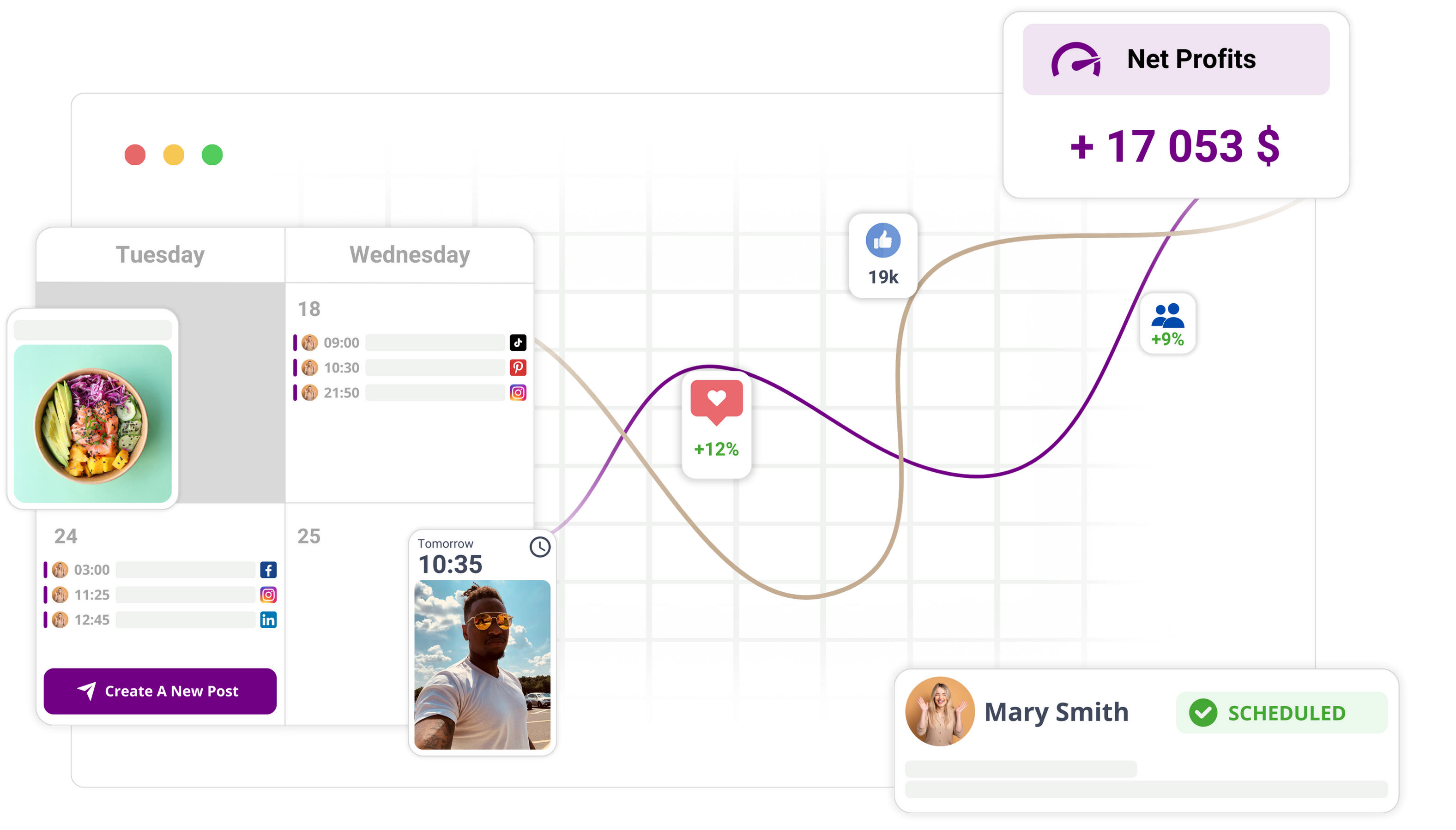
By the end you will have a completed campaign brief and a set of post drafts with captions, each either scheduled in Calendar or saved as reusable prompts/templates.
Before you start
Checklist
- Confirm workspace profile context and target social profiles are correct in Profiles. This ensures drafts and scheduling use the right accounts.
- Gather campaign dates and cadence (start date, end date, posting frequency, timezone). Accurate dates prevent scheduling errors.
- Prepare campaign objectives and key messages in one short paragraph. The assistant uses this to draft focused briefs and captions.
- Collect media you plan to use. Either Upload files or Pick from gallery so media is ready when converting drafts into posts.
- If you use a repeated format, open Calendar > Templates to pick or inspect any post templates to apply later.
Quick verification (one-minute)
- Open Profiles and confirm the intended profile(s) are marked active for this workspace. You should see the profile name and selected profile context.
- Open the Home screen and check the AI assistant is visible. The assistant shows recent session history and a conversation memory summary when available.
- Open Calendar > Templates and note any template you want to reuse. A template entry should show its name and a preview file or thumbnail.
Prepare media and assets
- If uploading new images or video, click Upload and follow the upload flow. After upload, confirm the media shows in the Workspace gallery inventory or as Applied media with the message Media Ready!.
- If using existing assets, choose Pick from gallery and confirm thumbnails appear in the selected media area.
- For each media file, check format and duration (for video). Unsupported formats will prevent scheduling during pre-publish validation.
Decide output types
- Scheduled posts: choose this when you want drafts placed on the Calendar immediately.
- Saved prompts/templates: choose this when you want reusable prompts, or to refine later with the team. Deciding now saves time when converting AI outputs.
Workspace context to provide to the assistant
- Workspace profiles and brands inventory: mention which brand or profile group the campaign targets.
- Current workspace plan: give one or two plan items that should influence tone or offers.
- Recent post strategy and cadence signals: state the posting rhythm and any recent performance signals to emulate.
What you should see before continuing
- Home shows the AI assistant and recent chat focus history or Conversation memory summary.
- Profiles show the correct selected profile context and Selected profile context label.
- Media you intend to use appears under Gallery or as Uploaded with thumbnails and the Applied state.
- If using a template, Calendar > Templates shows the template name and a Preview file or template thumbnail.
Common pre-start mistakes to avoid
- Leaving the wrong profile selected. This causes drafts to use the wrong identity and may fail during pre-publish validation.
- Not uploading media in advance. Missing media will block scheduling and force edits later.
- Entering incorrect dates or timezone. This causes posts to appear at the wrong time on the Calendar.
- Skipping Templates if you intend to reuse a format. You may lose standardized fields the team expects.
When this checklist is complete, move to Home and open or continue an AI assistant session. The assistant will use the confirmed profile context and available media to draft your campaign brief and post options.
You will open the Home AI assistant and set the campaign context so the assistant can draft a brief, generate post ideas, and produce caption variants tied to the correct profiles and dates.
Step 1: Open the feature
- From the app left-hand navigation, click Home to go to the Home screen.
- On Home, locate the AI assistant area. If you have an existing session, choose the session listed under recent conversations to continue. If not, start a new assistant session from the Home assistant entry point.
- After opening the session, check the top of the assistant pane for the conversation memory summary. This should show a short summary of recent interactions and workspace context.
- Confirm the active chat focus is visible. The assistant UI will display an active chat focus or recent chat focus history item that indicates what the session is currently building or discussing.
- If the assistant suggests workspace context or profiles, review that suggestion so the assistant uses the correct profile and brand information for outputs.
- Use the message input area to give a single-line prompt such as: Draft a campaign brief for [Campaign name] targeting [Profile or brand]. Do not send detailed media or dates yet if you plan to attach them in the next step.
- Send the prompt. The assistant should reply with an acknowledgement and a short plan or clarifying questions. Confirm the reply appears in the session history and that the message count or memory summary updates.
What you should see
- The assistant session opens on Home and displays a conversation memory summary and active chat focus.
- The assistant returns a short acknowledgement or clarifying prompts in the chat history.
- Workspace profile suggestions or a Selected profile context note appear if profiles are available.
Step 2: Set up the basics
Checklist
- Campaign name and objective.
- Campaign start and end dates, or single publish dates.
- Target social profiles or brand group selected.
- Cadence (for example: 3 posts/week or daily for 2 weeks).
In the open assistant session, tell the assistant the campaign name and objective in one message. Example text: Campaign name: Spring Launch. Objective: Awareness and sign-ups for new product.
- Why: Naming and an objective let the assistant focus the brief and post ideas on the right goal.
- Result: The assistant should update the session with a short campaign summary or ask clarifying questions.
Provide campaign dates and cadence in the next message. State start and end dates and preferred cadence. Example: Run from May 20 to June 3. Cadence: 3 posts per week on Monday/Wednesday/Friday.
- What to check: The assistant should echo the dates and cadence back in its next reply or in a confirmation block inside the chat.
Select target profiles or brand context for publishing. If the assistant shows workspace profile suggestions or a Selected profile context, confirm or correct them.
- How to choose: Click the suggested profile or type the profile names into the chat. If multiple profiles share the campaign, list them clearly.
- Result: The assistant should include the chosen profiles in its campaign brief and use them when suggesting post formats and scheduling.
Provide workspace plan details or reference an existing plan if relevant. Paste or summarize any constraints such as tone, required hashtags, or campaign landing pages.
- Why: These details keep post ideas aligned with your workspace plan and analytics goals.
- Result: The assistant may produce a short checklist or a revised brief that includes those constraints.
Add media availability and selection intent. State whether you will upload new media, pick from gallery, or use placeholder images. Example: I will upload product photos later; use placeholders for captions now.
- What to expect: The assistant will note media status in the brief and may prompt you to attach files or pick from gallery when ready.
Confirm the setup before asking for outputs. Send a message: Confirm: Campaign name, dates, profiles, cadence, and media plan above are correct.
- What to check: The assistant should reply with a clear confirmation and may begin drafting the campaign brief or ask to proceed with post ideas.
What you should see after setup
- The session history includes messages that list campaign name, dates, selected profiles, cadence, and media plan.
- The conversation memory summary or active chat focus reflects the campaign name or brief.
- The assistant is ready to generate the campaign brief and post drafts in the next step.
Verification tip
- If the assistant does not echo profiles, dates, or cadence, correct it now before moving to idea generation. Accurate context prevents scheduling and profile selection mistakes later.
Step 3: Add the content or settings
Outcome: Draft a campaign brief, generate post ideas and caption variants, attach media, then convert chosen drafts into scheduled posts or saved prompts.
Quick checklist before you start this section:
- Confirm selected profile context and target profiles are correct.
- Have campaign dates and cadence ready.
- Prepare media files or open the workspace gallery.
Ask the assistant for a campaign brief.
- In the open Home AI assistant session, type a clear request such as: "Draft a 2-week campaign brief for Product X running May 20 to June 2, targeting Instagram and Facebook, objective: awareness, cadence: 3 posts/week."
- Expect the assistant to return a short brief and suggested goals. Confirm the assistant references the workspace plan or selected profile context if available.
Request post ideas and caption variants.
- Follow the brief with: "Give 8 post ideas with one caption variant each, plus 2 alt caption styles per post (short and long)."
- Review the returned list inside the same AI session. Each idea should show a short concept and caption options.
Select or attach media for drafts.
- For each draft you want to advance, click Upload to attach new media or Pick from gallery to use workspace assets.
- If using the gallery, choose the item and confirm the selection shows as selected media for the draft.
- If Upload fails or the file is unsupported, Mydrop should show an error message or a disabled state for the submit button; retry with a supported format.
Convert chosen drafts into scheduled posts.
- For a draft you want to schedule: open the draft preview from the assistant output, then choose Convert to Post or Schedule (the assistant or session should offer this action).
- Select the target profile(s), confirm the post date and time, and set cadence if creating multiple instances.
- If you use a reusable setup, pick an existing template from Calendar > Templates or choose Save as Template before scheduling.
Save useful outputs as prompts or templates.
- If a caption, idea, or brief is likely to be reused, use Save Prompt or Save Template from the assistant output actions.
- Name the prompt/template clearly (campaign-name_caption-type) and choose the workspace or brand context if prompted.
- Verify the assistant confirms the saved prompt and it appears in the assistant session history.
Small checks while adding content.
- Confirm each scheduled post shows the selected profile and attached media in the draft preview.
- Check that dates match the campaign timeline and cadence you specified.
- If scheduling multiple posts at once, confirm the assistant applied the cadence evenly across the date range.
Step 4: Review the workflow
Outcome: Validate drafts, run pre-publish checks, confirm scheduled posts appear in Calendar, and ensure saved prompts/templates are discoverable.
Preview every scheduled post.
- Open each post in Calendar > New post preview or from the assistant session.
- Check caption, media, profile selection, date, and any platform-specific fields (thumbnails, duration, boards).
Run pre-publish validation.
- Use Calendar > New post pre-publish validation for each scheduled item.
- Resolve any validation warnings about profiles, media size, format, or missing fields before final scheduling.
Confirm scheduled posts in Calendar.
- Open Calendar and navigate to the campaign dates.
- Verify each scheduled post is visible on the correct date and attached to the correct profile.
- If a post is not visible, refresh the calendar or revisit the assistant session to re-run the Convert to Post action.
Verify saved prompts and templates.
- Open Calendar > Templates and look for templates saved from the assistant.
- In the Home AI assistant session history, confirm saved prompts appear in the conversation history or prompt library.
- Re-open one saved prompt to confirm it contains the expected brief, caption, or settings.
Final verification checklist.
- Scheduled posts are visible in Calendar on the expected dates.
- Each scheduled post passes pre-publish validation without unresolved warnings.
- Saved prompts or templates are listed under Templates or assistant history.
- Conversation memory summary or chat memory reflects the campaign context if you rely on session memory.
Common mistakes to avoid
- Wrong profile or brand selected when converting drafts to posts. Double-check profile context before scheduling.
- Missing or unsupported media. Upload supported formats or pick from the workspace gallery.
- Dates or time zones set incorrectly. Confirm the date, time, and local timezone in the post preview.
- Not saving reusable outputs. Save prompts or templates immediately if the idea should be reused.
Result check: After these steps you should see the completed campaign brief and post drafts in the AI session history, scheduled items in Calendar, and any saved prompts or templates in Calendar > Templates.
Troubleshooting and next steps
Outcome: have your campaign brief, post drafts, and either scheduled posts in Calendar or saved prompts in Templates. If something did not appear or behaved unexpectedly, follow these checks and fixes.
Quick verification checklist
- Calendar shows scheduled items for the campaign dates.
- Templates lists any saved prompts or post templates you created.
- Home assistant session shows the latest messages and any updated conversation memory summary.
- Target profiles are the ones you intended in Profiles and in each post preview.
If scheduled posts do not appear in Calendar
- Open Calendar and set the date range to include the campaign dates.
- Check filters: ensure the selected profile(s) or brand are not filtered out.
- If a post is missing, open the AI session history and confirm the draft was converted to a scheduled post or exported to Calendar.
- If conversion did not complete, repeat the conversion step from the assistant and confirm the confirmation message or preview appears before saving.
If saved prompts or templates are missing
- Open Calendar > Templates and refresh the page.
- Confirm you saved the output as a prompt or as a template from the assistant session. The assistant will show the saved item in the chat when complete.
- If saving failed, re-open the assistant output, click Save as template or Save prompt, provide a template name, and confirm the success message.
- If you still cannot save, verify you are in the correct workspace and using the intended brand or profile context.
If the assistant ignored workspace context or memory
- From Home, open the current assistant session and check the conversation memory summary or active chat focus at the top of the session.
- If the summary is empty or outdated, paste brief context: profiles, campaign objective, dates, and cadence into the chat and request the assistant regenerate the brief.
- Continue the session rather than starting a new chat to preserve memory and recent focus.
If media uploads fail or posts fail pre-publish validation
- Use Upload or Pick from gallery to re-add the media. Confirm the file appears in the assistant message or post preview.
- Check file format and size. If a file is large, compress or replace it with a supported size.
- Open Calendar > New post and run the pre-publish validation to get specific checks (profile selection, caption, media format, thumbnail).
- Fix any validation errors shown, then save or schedule again.
If profile, brand, or permissions are wrong
- Open Profiles and confirm the social accounts are connected and assigned to the correct brand.
- In the post preview, confirm the selected profile(s) match the intended targets.
- If an account is not connected, reconnect it before scheduling.
If times or time zones are incorrect
- Check the scheduled time in the post preview and compare with your local time zone.
- Edit the scheduled date/time in Calendar to correct the offset.
- Re-run the assistant if necessary to regenerate cadence-sensitive posts.
Next steps for a clean handoff
- Save useful prompts: from the assistant, convert polished prompts into Templates so teammates reuse the same brief or caption patterns.
- Create or apply a post template from Calendar > Templates for repeatable campaign formats.
- Use Automations to repeat parts of the campaign flow (for recurring posts or approval steps).
- After publishing, open Analytics to review performance and feed results back to the assistant in the workspace plan.
If problems persist
- Reproduce the issue: note the exact step, the profile and date used, and whether Upload or Pick from gallery was used.
- Retry the conversion or save action while remaining in the same assistant session.
- If issues continue, remove the media and try with a different file or create a minimal test post to isolate the problem.
Conclusion
You should now have a campaign brief and a set of post drafts with captions, each either scheduled in Calendar or saved as a reusable prompt or template. Use the verification checklist to confirm scheduled items in Calendar and saved items in Templates. When things go wrong, follow the numbered fixes above to correct profile, media, time, or context errors, then re-run the assistant in the same Home session to finalize the publishing plan.