
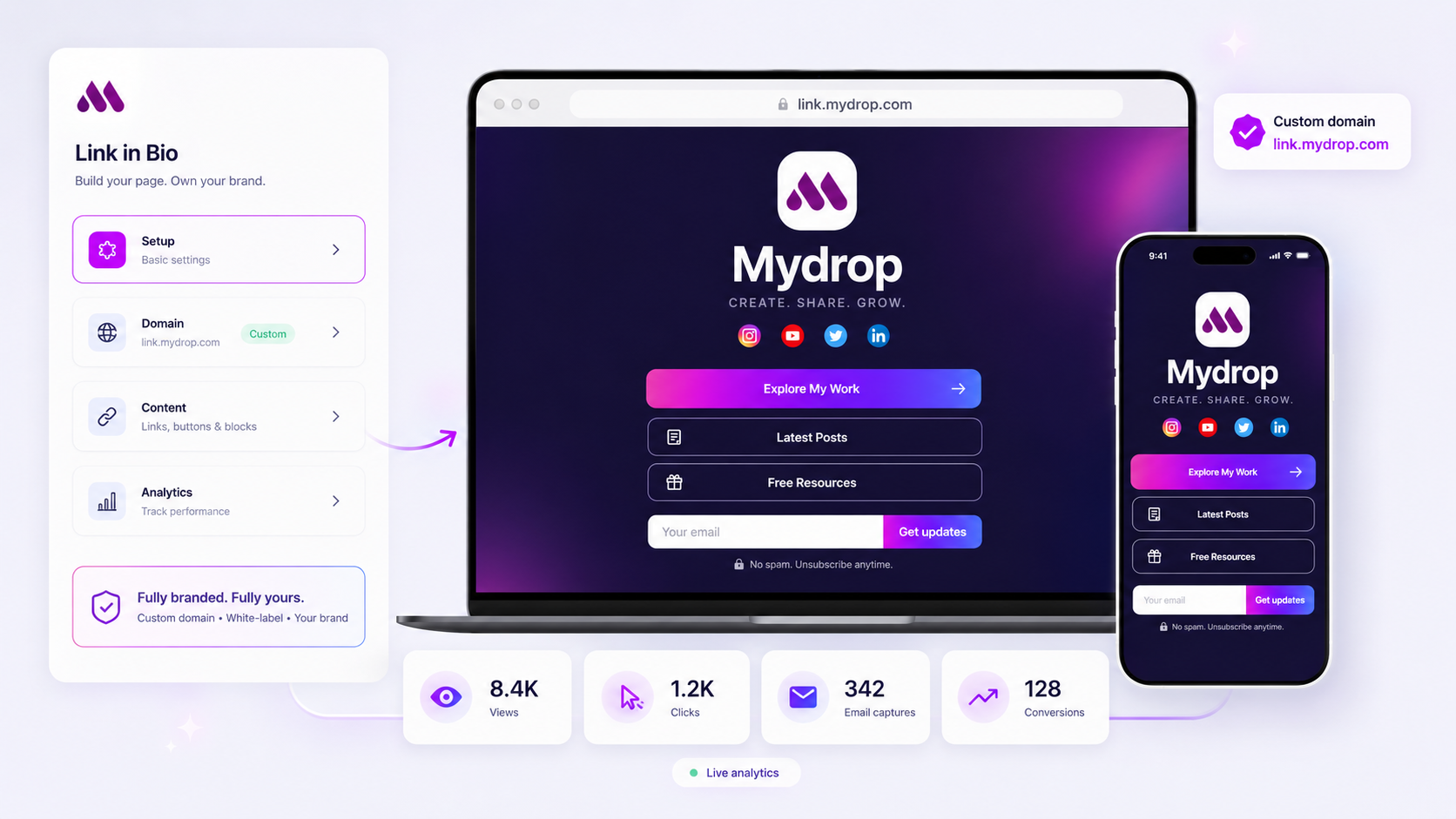
Your link-in-bio page should be a high-intent conversion surface, not a digital dumping ground for every link your brand has ever generated. If your current profile destination is just a static list of blue buttons, you aren't really managing a social channel; you are effectively hosting a graveyard for traffic you worked hard to earn.
We get it. You are juggling five active campaigns, an agency is asking for attribution data that feels impossible to pin down, and your social feed strategy feels like it is leaking visitors the moment they leave the main app. It is messy, fragmented, and exhausting to keep consistent when every department wants a piece of that prime real estate.
The operating problem this solves

Most enterprise teams suffer from navigation fatigue. You offer your visitors ten choices, they get overwhelmed, and they choose none. Every extra, non-essential link you add acts as a friction point, diluting your core campaign objectives.
At Mydrop, we see this pattern across thousands of profiles: as brands grow, their link-in-bio pages become bloated, unmeasured, and detached from their actual content calendar. When a page is treated as a utility rather than a strategic asset, you lose the ability to capture leads or route traffic with any precision.
To fix this, you have to stop thinking about your profile as a "link list" and start treating it as a client-owned landing page.
The Conversion Intent Scorecard
Use this to diagnose your current setup. If you are scoring below 12, your page is likely acting as a barrier to conversion rather than a conduit.
| Evaluation Metric | Passive Link List (1 Pt) | Mydrop Conversion Surface (5 Pts) |
|---|---|---|
| Primary Goal | Directs to general site home | Directs to specific campaign flow |
| Lead Capture | None; exit only | Integrated email/lead block |
| Content Sync | Static; never changes | Updates with active calendar assets |
| Attribution | Unmeasured or UTM-only | Built-in conversion tracking/events |
| Brand Identity | Default white-label generic | Fully branded; custom domain |
Operator rule: If a block on your page does not directly contribute to either data capture or primary campaign movement, remove it.
Your goal is to reduce the cognitive load on the visitor. A high-intent surface should guide them to one of two outcomes: they give you their contact information, or they move deeper into your funnel. Anything else is just noise that makes your social performance look weaker than it actually is.
The minimum system that works

If you are currently managing more than three active campaigns, stop trying to shove every single initiative into your profile link. A high-performing conversion surface is not a library; it is a focused funnel. When you give your audience a choice of ten different directions, you are effectively asking them to do the work of deciding which one matters. Most of the time, they will just choose to close the tab instead.
At Mydrop, we see teams achieve the best results when they stick to the Three-Block Rule. This isn't just about design; it is about cognitive load. Every visitor who hits your link-in-bio page should be able to identify exactly one primary action within two seconds.
The Conversion Block Stack
| Block Type | Role | Success Metric |
|---|---|---|
| Hero/Brand | Anchors the visual identity and context. | Page bounce rate |
| Primary CTA | The single high-intent destination (e.g., "Shop Latest Collection"). | Click-through rate |
| Email/Lead | Captures the visitor for long-term retention. | Conversion to lead |
If your page has more than six buttons, you are likely suffering from navigation fatigue. If you have no email capture block, you are treating your social traffic as one-time hits rather than building a sustainable audience.
Decision check: If an element does not directly contribute to a campaign goal or lead capture, it is bloat. Move it to a secondary page or delete it entirely.
Where teams overbuild the process
Here is where it gets messy. Teams often fall in love with "feature-rich" pages, burying their core objectives under custom HTML animations, massive social feeds that don't load, or excessive design elements that distract from the main offer. We have seen pages that look like works of art but fail to capture a single email address because the CTA is hidden under three layers of "aesthetic" styling.
This is the part most people underestimate: Complexity is the enemy of velocity. When your link-in-bio page becomes a bespoke mini-site that requires a developer to update, you lose the ability to sync with your actual content calendar.
The Overbuild Audit
Check your current page against these common pitfalls. If you hit two or more, you need to strip your setup back to basics.
- The "Everything" Feed: You are auto-populating every post from your feed. The reality: Visitors are there for a specific purpose, not to browse your archive. Limit feeds to the most recent high-intent content.
- Design Debt: You have added custom CSS or complex layout blocks that look great on desktop but break the experience on mobile. The reality: 95% of your traffic is on a phone. If it isn't lightning-fast on a 4G connection, you are losing traffic before the page finishes rendering.
- Approval Bottlenecks: You require a designer or a senior manager to approve every button change. The reality: If your link page takes 24 hours to update for a flash sale, your social team is effectively flying blind.
When you allow vanity features to dominate your conversion surface, you stop managing a brand channel and start maintaining a digital artifact. A lean, template-driven approach-where your team can swap a campaign CTA in thirty seconds without breaking the site structure-is almost always superior to a hand-coded, high-maintenance landing page.
The goal is to stop treating your bio link like a static website and start treating it like a live-updating campaign asset.
How to run the cadence
If your bio link page is still sitting in a browser tab gathering digital dust, you are losing the battle for attention. The most successful teams we see don't treat these pages as set-and-forget assets; they treat them as a sync-point in their weekly editorial calendar.
When your social content plan hits the "Final Polish" stage, your conversion surface should be the next item on the checklist. If you are promoting a new webinar on Tuesday, the primary button on your bio page needs to be live and tested by Monday at 4 p.m., not added as an afterthought on Wednesday morning.
Use this Conversion Sync Checklist to align your assets with your publishing volume:
- Weekly Asset Audit: Check your top-performing posts from the prior week. If a specific campaign is driving volume, does your bio page prioritize that objective?
- Redirect & Retire: Unpublish buttons for expired events or completed promotions. A cluttered page is a leaky funnel.
- Validate Path: Click every single link on your mobile device. If a lead capture form or a landing page is broken, you are burning paid and organic reach.
- Data Refresh: Briefly inspect your analytics. Are your top-performing buttons actually leading to conversions, or are they just vanity clicks?
At Mydrop, we see teams managing hundreds of brand profiles struggle when the bio page is treated as a separate, disconnected system. The habit that sticks is tying the bio page update directly to your primary scheduling tool. If you aren't updating the page while you are finalizing the post, you are essentially publishing an invitation to a party without telling anyone where the door is.
The proof that the habit is working
Most teams track vanity metrics like total clicks and stop there. That is a mistake. To know if your conversion surface is actually performing, you need to look at the ratio of visitors to meaningful interactions. If you have 1,000 visitors but only two email captures, your problem isn't traffic; it is the friction in your call-to-action.
Use this Conversion Performance Scorecard to move from guessing to measuring:
| Metric | Target (Active Campaign) | Why it matters |
|---|---|---|
| Click-Through Rate (CTR) | > 20% | Measures if your button copy aligns with the post that sent them there. |
| Conversion/Visitor Ratio | > 5% | Measures if the page delivers on the promise made in your social content. |
| Asset Abandonment | < 10% | Measures how many people open your link-in-bio but leave without engaging. |
Workflow check: If your conversion-to-visitor ratio drops below 3% for two consecutive weeks, stop adding new links. Audit your primary hero block and streamline your copy until the intent is unmistakable.
When you start tracking these specific points, the "marketing noise" fades away. You stop worrying about why a certain hashtag didn't land and start focusing on the fact that your email capture form is consistently generating 50 high-quality leads per day. That is the moment your bio page becomes a legitimate part of your revenue infrastructure.
Conclusion
Building a high-intent conversion surface is less about design prowess and more about surgical focus. You are not building a website; you are building a bridge between a momentary impulse on social media and a long-term relationship with your brand.
If you take only one thing away, make it this: every link on your page is a choice, and every choice you add is a potential exit for your visitor. Keep the path narrow, keep the call-to-action clear, and respect the fact that the person clicking has likely already given you enough of their time. Simplify the surface, tighten the cadence, and watch your conversion metrics start to actually mean something to the business.