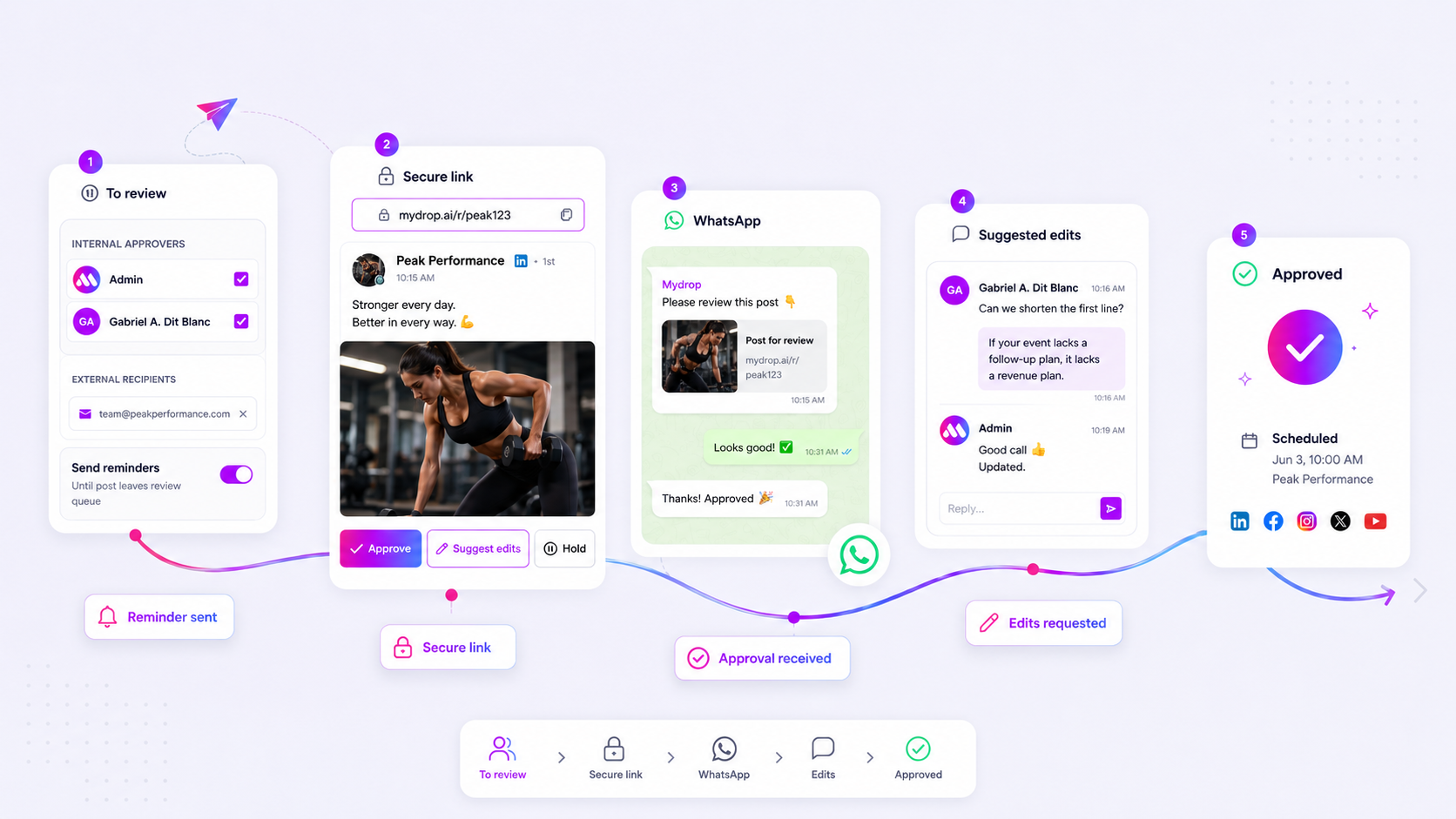
The secret to scaling agency output isn't hiring more managers to chase status updates; it is replacing manual email-thread approvals with automated, tokenized review portals that allow clients to action content in seconds, not hours.
We get it. You have spent more time chasing a thumbs up on an Instagram caption than actually crafting the campaign strategy. That back-and-forth isn't just annoying-it is a silent tax on your margins and your sanity. When you move from "chasing signatures" to an automated approval operating system, you stop being a project coordinator and start being a strategic partner.
The operating problem this solves

Most agencies treat client approval as a creative collaboration, but it is actually a logistics problem. When you stop treating feedback as a conversation and start treating it as a process, you stop the project scope creep dead in its tracks.
The real threat to your growth isn't a lack of creative ideas; it is coordination debt. This occurs when your team spends more time managing access, logins, and email notifications than actually producing high-performing content.
Here is where the typical manual process breaks down:
| Symptom | The Hidden Cost |
|---|---|
| Email Threads | Context is lost, attachments get versioned incorrectly, and approvals get buried in promotions tabs. |
| Login Friction | Asking a client to log into yet another portal is a barrier to review. If it takes more than two taps, they will ignore it until Friday at 5 PM. |
| Visibility Gaps | When approval feedback happens in Slack, Docs, and Email simultaneously, nobody knows who signed off on the final version. |
At Mydrop, we see this pattern across brands managing hundreds of profiles: teams eventually hit a wall where they cannot publish faster because they cannot get decisions faster. The irony is that the more "sophisticated" the approval platform, the more likely the client is to abandon the workflow entirely.
Operator rule: If your client needs a password to review your work, your workflow is the bottleneck.
A truly scalable system replaces the human "chase" with a automated tokenized review portal. This gives clients a single, secure link that opens directly to the post preview-no account required-and allows them to approve, request edits, or put a post on hold with one click. When you eliminate the friction of logging in, you shift the dynamic from "waiting for approval" to "managing by exception." You stop chasing people and start managing the exceptions where they actually need to weigh in.
The minimum system that works
You do not need a complex, multi-tiered bureaucracy to keep your social presence on brand. In fact, the most resilient teams we work with at Mydrop usually win by removing steps, not adding them. The goal is to move content from "draft" to "scheduled" with just enough friction to prevent errors, but not so much that you kill your team's momentum.
To build a system that actually holds up under pressure, focus on these three pillars:
- Tokenized Review: Give your clients or stakeholders a direct, secure link to the live preview. No logins, no password resets, no "I didn't get the email with the attachment." They open the link on their phone, they see exactly what will be posted, and they tap a button to proceed.
- Centralized Feedback: Stop taking "changes" via a stray text message or a Slack thread that gets buried. Ensure your review portal captures feedback directly on the post itself. When the conversation lives next to the asset, the context stays intact.
- Automated Reminders: Stop being a professional stalker. If a post is sitting in the "pending" state, the system should nudge the approver automatically. You have bigger problems to solve than reminding someone for the third time that they have a deadline.
This isn't about fancy software; it’s about shifting from an interrupt-driven workflow (where you ping people until they reply) to a state-driven workflow (where the system handles the pinging and holds the post until the condition-an approval-is met).
Where teams overbuild the process
Here is where we see even the most experienced agencies trip over their own feet: they build "checks" for things that don't actually require them.
Most teams assume that "more oversight" equals "fewer mistakes." In practice, adding more people to the chain just increases the probability that someone, somewhere, will be too busy to look closely. We often see teams implement a three-stage approval process (Junior -> Manager -> Client) for routine posts that are already covered by established templates.
You end up with Coordination Debt: a state where the overhead of managing the approval chain costs more in salary hours and missed timing than the value of the final post.
The "Overbuild" Diagnostic
Use this scorecard to see if your current approval process has become a bottleneck. If you score more than 2, you are likely overbuilding your process.
| Question | Score (1 pt if Yes) |
|---|---|
| Do your reviewers need to log into a separate tool to see the post? | |
| Does feedback consistently arrive via email or Slack instead of the campaign tool? | |
| Does a post on "Hold" require you to manually message someone to restart the workflow? | |
| Are more than 2 people required to sign off on routine daily social posts? | |
| Is there no automated reminder for stakeholders with pending tasks? |
Decision check: If your review process takes longer than 24 hours for a standard social post, you do not have a quality control problem; you have an accessibility problem.
The best teams we see treat approval like a checkout flow. They make it so easy and frictionless that the client actually wants to do it. When you reduce the effort required to approve a post, you stop the project from stalling. Remember, your job is to keep the content machine moving, and every extra click you force your stakeholders to make is a tax on your own sanity.
How to run the cadence
You have the tools, but a process is only as good as the rhythm it keeps. If you aren't disciplined about when things happen, your approval portal just becomes another place where content goes to die.
At Mydrop, we have seen teams managing hundreds of brand profiles struggle when they treat every post as a unique event. Instead, successful operators synchronize their review cycles to match the client's internal reality. If they have a Tuesday morning leadership stand-up, your submission deadline should be Monday at noon.
Here is a simple weekly rhythm to keep the momentum going:
- Draft & Tag: Creators upload posts and tag necessary internal/external stakeholders. If the creator lacks approval permissions, the post is automatically flagged as
pendingto ensure no one accidentally skips the queue. - Automated Hand-off: Once ready, send the tokenized review link. No one should have to log in. Whether they view it on a laptop or tap the approve button directly from a WhatsApp message, the path of least resistance is your best friend.
- The 24-Hour Nudge: If a post is sitting in
pendingfor more than a day, use automated reminders. You shouldn't be the one manually emailing "Checking in!" every few hours. Set the system to do the heavy lifting for you. - Actionable Feedback: If someone requests edits, do not let that turn into a long email chain. Use the approval feedback conversation to keep edits pinned directly to the post. It keeps the "why" and the "what" in one place.
Workflow check: Never leave a post in the
holdstate without a documented reason in the conversation thread. If a client puts it on hold, the system should stop the clock so the team doesn't accidentally publish an outdated campaign.
The proof that the habit is working
How do you know if you are actually winning? You should be looking for a shift in your "approval velocity"-the time between a post being submitted and it moving into the waiting or scheduled state.
If your team is spending more time managing the process than creating content, you have a coordination debt problem. Here is a simple scorecard to see if your new habit is actually saving your margins.
| Metric | The "Chaos" Signal | The "Cadence" Goal |
|---|---|---|
| Review Lead Time | 48+ hours (email threads) | < 12 hours (tokenized portals) |
| Stakeholder Friction | High (login issues, lost links) | Low (one-tap review) |
| Approval Feedback | Scattered (Slack, email, docs) | Centralized (on-post conversation) |
| Reminder Overhead | Manual "check-ins" | Zero (automated triggers) |
When you stop treating feedback as a conversation and start treating it as a process, you stop the project scope creep. The real test is the "Friday at 5 p.m." scenario: if a last-minute change comes through, can you route it, get it approved, and schedule it without anyone needing to open a spreadsheet or hunt for a password? If the answer is yes, you have built an operating system, not just a workflow.
Conclusion
The secret to scaling agency output isn't hiring more managers to chase status updates. It is replacing the manual grind of inbox-tag with an automated, friction-free environment that respects everyone’s time.
You do not need to over-engineer your governance. Just clear the path for your clients to say "yes" in two taps or less. When you remove the login barriers, simplify the feedback loop, and automate the reminders, you aren't just getting posts approved faster-you are buying back the creative headspace that your team needs to do their best work.
Stop chasing approvals and start building the machine that handles them for you. Your margins will thank you.