
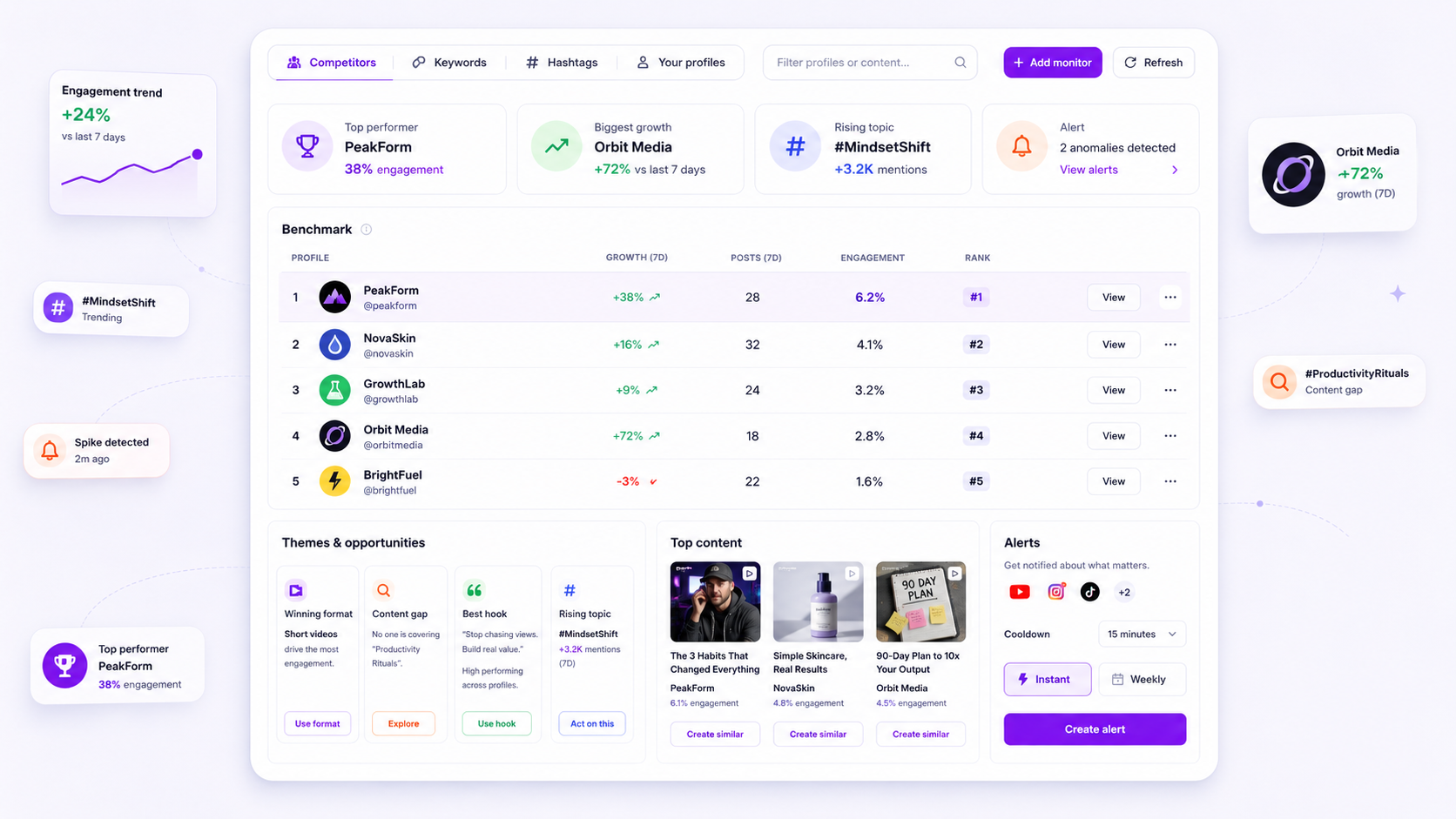
The best tool for auditing social media content gaps is one that maps your competitors' winning recipes-the specific mechanics of their hooks, formats, and posting cadences-rather than just listing keywords your team missed. While basic tools tell you what people are saying, enterprise-grade intelligence tells you how they are winning the attention you are currently losing.
We have all been there: staring at a competitor's post that looks like it was filmed on a calculator, yet it has 50k likes and a comment section full of your target customers. It is exhausting to play catch-up when you do not have the data to see the pattern behind their luck. You do not have a "lack of ideas" problem; you have an information gap that makes every strategy meeting feel like a post-mortem of why a campaign flopped.
At Mydrop, we have seen that the most successful teams stop chasing every trending sound and start identifying high-signal content themes that competitors are using to own the conversations you should be leading. This shift requires moving from manual scrolling to a systematic Intelligence Dashboard that benchmarks your profiles against the industry leaders in real-time.
What the best tools need to handle

For an audit to be useful, it has to move past the "Ingredients" (the topics) and analyze the "Recipe" (the execution). If your tool only shows you a list of popular hashtags, it is like being given a bag of flour and being told to "bake a cake." You are still missing the instructions.
A high-performance intelligence tool must normalize data across platforms like YouTube, Instagram, and X so your team is not constantly switching tabs and losing the big picture. You need to see how a theme performing on YouTube Shorts translates to an Instagram Reel, and whether that same topic is even worth a thread on X.
Beyond just cross-platform visibility, a professional setup requires 90-day historical monitoring. Most gap tools only look at the last week of data, which is how teams end up chasing trends that have already peaked. To find a sustainable recipe, you need to see if a competitor has hit a one-off viral fluke or if they have found a repeatable content cluster that has been growing for months.
Operator rule: A content gap is often a missing delivery method, not just a missing subject. Audit the hook, not just the headline.
The Recipe Audit Matrix
Use this framework to evaluate whether your current auditing process is catching the "why" behind competitor wins or just the "what."
| Audit Factor | The Ingredient Approach (Basic) | The Recipe Approach (Intelligence) |
|---|---|---|
| Primary Focus | Subject matter (e.g., "SaaS tips") | Winning Recipe (e.g., "Problem-Solution hook + 15s POV video") |
| Data Scope | Last 5-10 recent posts | 90-day trend view to find repeatable content clusters |
| Team Workflow | Manual profile-hopping and spreadsheets | Normalized Intelligence Dashboard with platform-specific tabs |
| Typical Outcome | "We should post more about AI." | "We need a 3-part video series using this specific tension-based hook." |
If your current tool leaves you guessing at the "why," you are not auditing-you are just watching. The goal is to move from reactive observation to predictive execution.
Where basic tools start to break

Most entry-level social tools suffer from what we call "The Top Post Trap." They give you a leaderboard of your competitor's most liked content from the last week and call it a day. But for an enterprise marketing team, a single viral post is just noise. It doesn't tell you if that post was a lucky fluke or the start of a massive strategic pivot.
Basic tools usually break down in three specific areas:
- The Context Gap: Seeing a post with 50,000 likes is useless if you don't know it was backed by a heavy ad spend or part of a 12-week "winning recipe" the competitor has been perfecting. Basic tools show you the "what" but leave your team to guess the "how."
- Manual Drift: When your team has to manually add every single competitor handle and hashtag across three different platforms, things get missed. If you aren't monitoring the "hidden" leaders in your niche, your audit is already obsolete.
- The 48-Hour Lag: Many lightweight tools rely on cached data that can be days old. In a world where a content theme can rise and peak in 72 hours, being two days late means you are just archiving history, not making strategy.
At Mydrop, we've noticed that the most successful audits don't start with a blank screen. They start with a baseline of historical trends. If your tool can't show you at least 90 days of history, you aren't auditing a strategy; you are just looking at a digital scrapbook.
The buying criteria that matter
When you are evaluating a tool for a serious marketing organization, you need to look past the pretty charts and focus on the operational plumbing. You need a system that detects shifts in the landscape before they become common knowledge in your industry.
Here is the "Secret Sauce" checklist for your next intelligence tool:
- Cross-Platform Normalization: Can you compare a YouTube Short's performance directly against an Instagram Reel using the same "winning recipe" logic? If the data isn't normalized, your team will spend hours in spreadsheets trying to make sense of different metrics.
- AI-Powered Discovery: You shouldn't have to know every competitor by name. Tools like Mydrop Intelligence Monitoring bridge that gap by suggesting industry leaders you didn't even know were stealing your share of voice based on your workspace profile and brand pillars.
- Format and Theme Breakdown: The tool should automatically cluster posts into "themes" (e.g., Behind the Scenes, Product Demo, Educational) so you can see the missing gaps in your own calendar at a glance.
- Automated Alerts: You shouldn't have to log in to find out a competitor just doubled their posting frequency or shifted from 16:9 to 9:16 video. The tool should tell you when the "recipe" changes.
Decision check: If a tool doesn't allow you to track "public profiles" without owning the credentials, it isn't an intelligence tool. It is just an analytics dashboard.
To help your team move from "guessing" to "executing," use a framework that evaluates the mechanics of the content, not just the vanity metrics.
The Recipe Audit Matrix: Identifying the Gap
| Component | Basic Audit (Ingredients) | Intelligence Audit (The Recipe) | Decision Rule |
|---|---|---|---|
| Hook Type | "They used a question." | "Visual hook: Text overlay in first 1.5 seconds." | If 70% of top posts use visual hooks, move production budget there. |
| Format | "It's a video." | "9:16 Lo-fi vertical video, 12-15 seconds." | If competitors shifted to <15s, stop producing 60s clips. |
| Theme | "Productivity tips." | "Counter-intuitive industry myths." | Identify the theme with the highest "Save" rate vs. "Like" rate. |
| Cadence | "They post a lot." | "3x daily bursts during peak GMT hours." | Match the frequency if your share of voice is dropping >5%. |
| Engagement | "Lots of comments." | "High sentiment score on 'Pricing' keywords." | Audit the comments to find unanswered questions you can turn into content. |
The goal of this audit isn't to copy what others are doing. It is to find the "Winning Recipe" that is working for your shared audience and then apply your brand's unique "Ingredients" to it. This moves your team from a reactive state of "Why did they go viral?" to a proactive state of "We know exactly which format and theme to use for our next launch."
When you stop treating content gaps as a list of missing keywords and start treating them as missing mechanical advantages, your strategy becomes much harder for competitors to replicate. You aren't just filling a hole; you are building a better machine.
The shift from manual scrolling to automated intelligence transforms a content gap audit from a guessing game into a surgical strike. Instead of wondering why a competitor's video worked, you can see the exact pattern--the hook, the theme, and the timing--that triggered their growth.
We have all been there: staring at a competitor's profile, trying to figure out why a post that took them ten minutes is outperforming your campaign that took three weeks. It is the kind of annoyance that makes you want to close your laptop and call it a day. But the reality is, they are not just lucky. They have found a recipe that your team hasn't decoded yet.
How Mydrop supports this workflow
At Mydrop, we built the Intelligence Monitoring suite specifically for teams that have outgrown the "manual check-in." We treat competitive intelligence as a living dashboard, not a static report you run once a quarter and then forget in a shared folder.
The Intelligence Dashboard acts as your central nervous system for what's working right now. It normalizes data across YouTube, Instagram, and X, so you are not comparing apples to oranges. When you see a "rising topic" on the dashboard, it is not just a guess; it is based on daily snapshots that track how specific content themes are performing across your entire monitored niche.
One of the most practical features for large teams is Inspiration Suggestions. If you are managing multiple brands, you cannot possibly know every emerging leader in every sub-niche. Our AI analyzes your workspace profile and suggests industry leaders you should be monitoring. You can add these suggested profiles with a single click, immediately pulling in their historical trends to see where they are outperforming your current strategy.
To solve the "coordination debt" of keeping everyone informed, Mydrop uses Intelligence Alerts and Digests. Instead of your team having to remember to check the dashboard, we push the "winning recipes" directly to your inbox. If a competitor sees a material change in their growth or a specific hashtag starts trending in your industry, you get an alert. It turns your team from reactive observers into proactive strategists.
A simple shortlist checklist
Before you commit to a new intelligence tool, use this scorecard to see if it can actually identify "winning recipes" or if it's just a glorified view-counter.
The Content Gap Diagnostic Matrix
| Diagnostic Area | What to Audit | The "Gap" Signal | Priority Level |
|---|---|---|---|
| Hook Mechanics | First 3 seconds of top posts | Competitors use "Question" hooks; you use "Logo-first" | Critical |
| Theme Density | Post volume per topic cluster | 50% of their growth comes from "Tutorials" | High |
| Format Mix | Ratio of Reels vs. Carousels | They are 80% video; you are 80% static images | Critical |
| Posting Cadence | Time of day and weekly frequency | They own the "Sunday 6 PM" slot while you are dark | Medium |
| Engagement Type | Shares vs. Likes ratio | Their content is "Highly Shareable" advice; yours is "Likeable" fluff | High |
Workflow check: A gap is only a gap if it is working for someone else. Do not try to fill every "missing" topic. Only fill the ones that are currently driving benchmarks for your competitors.
Your 15-Minute Weekly Audit Workflow:
- Open the Intelligence Dashboard: Filter by your top 3 competitors.
- Review the "Opportunities" section: Look for content themes where they have high engagement but you have zero posts.
- Check the Inspiration row: See if any new suggested leaders have popped up in your niche.
- Identify one "Winning Recipe": Pick one high-performing format (e.g., a 15-second "day in the life" reel) and add it to next week's production queue.
Conclusion
The biggest mistake marketing leaders make is treating content gaps as a creative problem. It is usually a visibility problem. When you cannot see the 90-day trend of what is actually moving the needle for your peers, you are forced to rely on "gut feel," which is a dangerous way to spend a six-figure production budget.
Effective social media operations are built on the ability to see a winning recipe, decode its mechanics, and adapt it for your brand before the trend becomes a commodity. Stop chasing every new keyword and start monitoring the mechanics of the leaders in your space. Once you have a systematic way to spot the gaps, the "what should we post next?" meeting becomes the easiest 20 minutes of your week.