
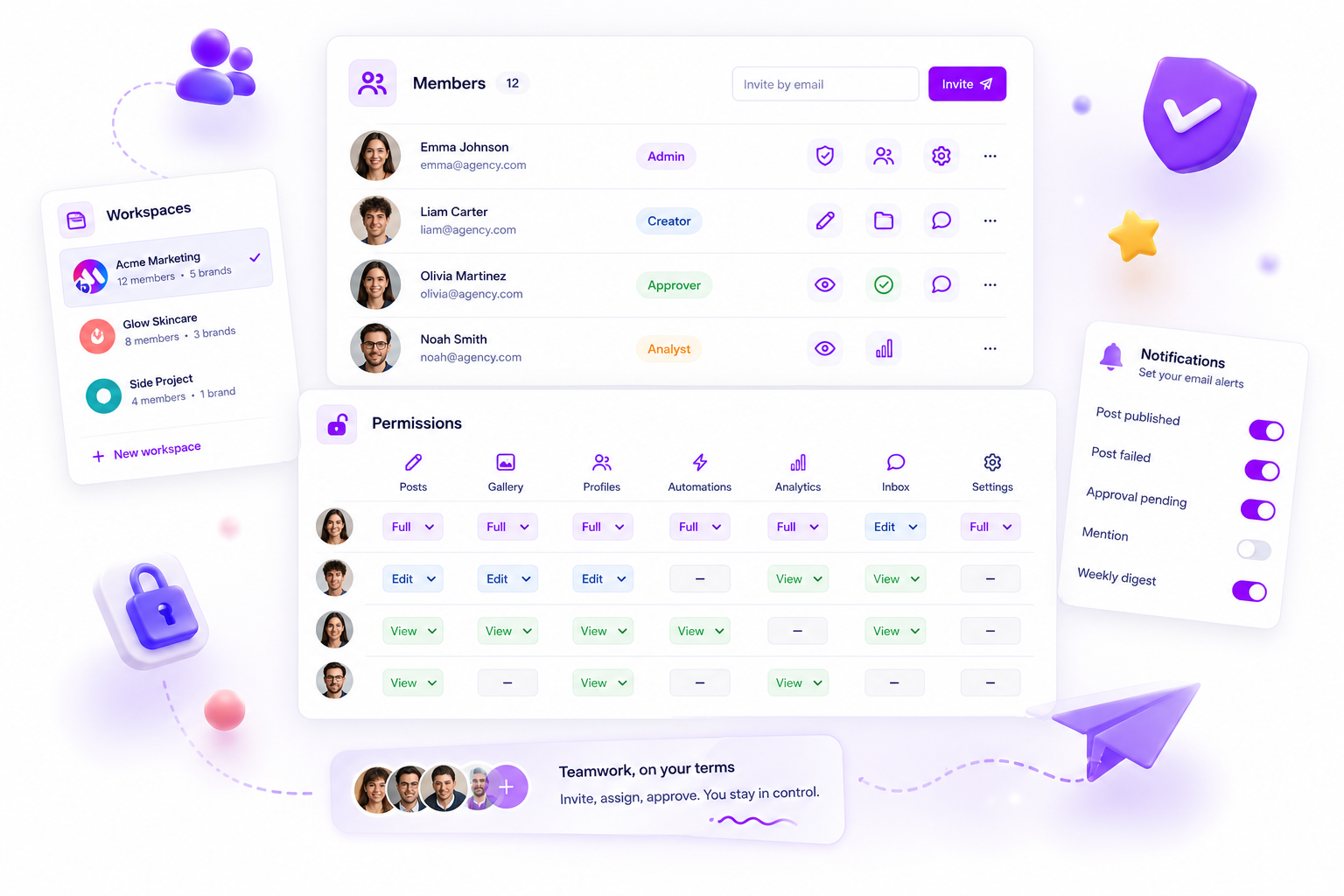
When your social media team is drowning in alerts, you are not lacking focus; you are lacking granular, role-based notification control. The solution is not to turn everything off, but to move from a broadcast model to a role-based one. If your platform notifies everyone about every draft, approval request, and analytics report, you are training your team to ignore your most critical alerts. The right tools let you define who sees what, at what frequency, and for which specific resource types. This shifts the team from reactive fire-fighting to focused execution, ensuring that the legal team only sees compliance queues and the community managers only receive inbox threads they can actually handle.
We get it. It is exhausting to watch high-performers spend their morning clearing notification debt instead of doing actual work. You did not sign up to manage a digital panic room. When the 'urgent' flag loses all meaning because it is attached to every minor change, you have already lost.
What the best tools need to handle

Most platforms treat notifications as an all-or-nothing system. This creates a coordination debt that grows exponentially as you add more brands, channels, and stakeholders. As you scale beyond a few profiles, you need a system that maps alerts to functional roles, not just user accounts.
A tool that merely pumps alerts is a liability. You need a system that functions as a filter.
Notification Capability Matrix
| Requirement | The "Noise" Approach | The "Signal" Approach |
|---|---|---|
| Role Scope | All members see everything | Alerts target specific roles |
| Resource Filtering | Global toggle for all events | Per-user, per-resource control |
| Actionability | "Activity occurred" notification | Direct link to approval/task |
| Delivery Cadence | Real-time push | Event-specific or digest |
When we built Mydrop, we saw how often teams fell into the transparency trap, the mistaken belief that everyone needs to see everything to be "aligned." In our experience, alignment is actually about ensuring each person gets the right information to perform their specific role.
If your current tool forces a senior analyst to receive every inbox notification just because they are in the workspace, you are forcing them to ignore your alerts entirely. This is why we built notification settings at the member level. At Mydrop, we believe permission management should enable focus, not just restrict access. You should be able to toggle categories, like approval requests, inbox activity, or profile expiry, directly within your member profile. If a user is not authorized to approve a post, they should not be bothered by the approval notification.
The most important indicator of a healthy social media operation is not how fast you react, but how rarely you are surprised. If your team is constantly reacting, you are running a service desk, not a marketing strategy. Stop treating notifications as a side effect and start treating them as part of your team's architecture. If the tool you are using cannot help you reduce that noise, it is not helping you manage the scale of your operation; it is just adding to it.
Where basic tools start to break

Most social media management tools were designed when the team was you. When you scale to a team managing dozens of brand profiles and hundreds of active conversations, that design choice becomes a massive liability.
Here is the uncomfortable truth: if your tool relies on global notification settings, you have already lost. In our experience, teams dealing with high-velocity publishing fall into the transparency trap. The thinking is that if everyone sees every alert, everyone stays "in the loop." In practice, all you have done is create a shared inbox of noise where the most important tasks-like an urgent compliance approval-get buried under automated platform pings that nobody needed to see in the first place.
This isn't a culture issue. It is an operational failure. When an enterprise team grows, you need the tool to filter information based on the user's actual functional scope. If a regional manager for the US market is getting notifications for a European campaign's analytics delivery, that isn't transparency-it is just a distraction.
We see teams constantly struggle with this. At Mydrop, we approach this by decoupling access from noise. We use granular notificationSettings linked directly to member roles. If someone is an editor, they need pings for draft comments and approval requests. If they are an analyst, they need delivery notifications for monthly reports. They do not need to be alerted every time a post is scheduled or an image is updated in the gallery if they are not responsible for those specific workflows.
When the notification system isn't mapped to the role-based permission map, you end up with coordination debt. People stop trusting their inbox. They start ignoring pings, and suddenly, the "urgent" flag has lost all meaning. It is not that your team doesn't care; it is that the signal-to-noise ratio has made it impossible to care about the right things.
The buying criteria that matter
When evaluating your next social media management stack, move past the feature list and audit the notification architecture. If the tool forces you to choose between "all alerts" and "no alerts," or if it treats every stakeholder as a full administrator, walk away. You need a system that respects the boundaries of your roles.
Use this scorecard to stress-test any prospective tool. If they cannot meet the "Enterprise Operational Standard" in the table below, you are buying your team a future headache.
| Requirement | Enterprise Standard | What to Avoid |
|---|---|---|
| Granularity | Per-user, per-resource, per-event | Global workspace-wide switches |
| Role Mapping | Permissions dictate notification flow | All members get same notification sets |
| Actionability | Alerts link to specific task/resource | Vague "activity occurred" pings |
| Digest Option | Scheduled reports vs. real-time | Only real-time (push) for everything |
Decision check: Ask the vendor: "If I add a legal stakeholder, can I limit them only to approval notifications without them seeing inbox activity or analytics?" If they answer "not without adding them as a full member," you have your answer.
A robust notification system shouldn't just tell you something happened; it should tell you what you need to do about it. When you support hundreds of profiles across multiple markets, your goal isn't to be "in the loop"-it is to have the absolute clarity needed to make the right decision at the right time. Your tool should be the conduit for that clarity, not the source of your daily operational fatigue.
How Mydrop supports this workflow
At Mydrop, we approach notification management as a form of operational hygiene. After seeing thousands of workflows across high-velocity teams, we realized that the "one-size-fits-all" alert model is essentially a design bug. If every team member is alerted to every comment, draft, or approval, your team isn't informed-they're just interrupted.
Our approach is built on a granular resource-to-role map. Instead of global settings, you define exactly which events-like a pending post approval or an incoming inbox thread-trigger a notification for specific members based on their functional scope.
Operator rule: If a team member doesn't have the authority to act on a resource, they shouldn't be notified about its status.
When you configure Member Permissions, you aren't just setting access controls; you are defining the "scope of awareness" for that user. A content creator might only receive notifications for their own drafts, while a manager gets alerted to pending approvals across specific brand profiles. This creates a natural filter where noise is reduced by default, and focus is preserved by design.
A simple shortlist checklist
If you are auditing your current tools, use this checklist to ensure they can actually reduce coordination debt rather than just adding to it. A tool is only as good as its ability to keep your team working on the right things at the right time.
- Role-based granularity: Can you toggle alerts per-user, and restrict them to specific resources (e.g., only inbox threads for brand X, not analytics reports for the whole workspace)?
- Action-linked alerts: Does a notification direct the user to the exact task, or just tell them "activity happened"? Avoid the latter; it just triggers curiosity-driven distraction.
- Digest vs. Real-time: Can stakeholders opt into a daily digest for low-priority updates, reserving real-time pings for urgent tasks like crisis management or immediate approvals?
- Permission sync: Do notification settings automatically respect the user's role and permission mapping? If you update a user’s access, their alerts should update without manual reconfiguration.
Conclusion
The goal of your notification strategy shouldn't be "transparency"-it should be functional clarity. You want your team to be aware of what they need to fix, approve, or create, and absolutely nothing else.
If your team is exhausted by digital noise, stop trying to fix the culture and start fixing the configuration. Auditing your notification landscape takes an afternoon, but the resulting focus can pay dividends for the rest of the year. Look for tools that treat notification settings as a critical component of governance, not just a preference menu. When you align alerts with clear roles and defined action paths, you move away from the chaos of being "always on" and back into the rhythm of actually getting work done.