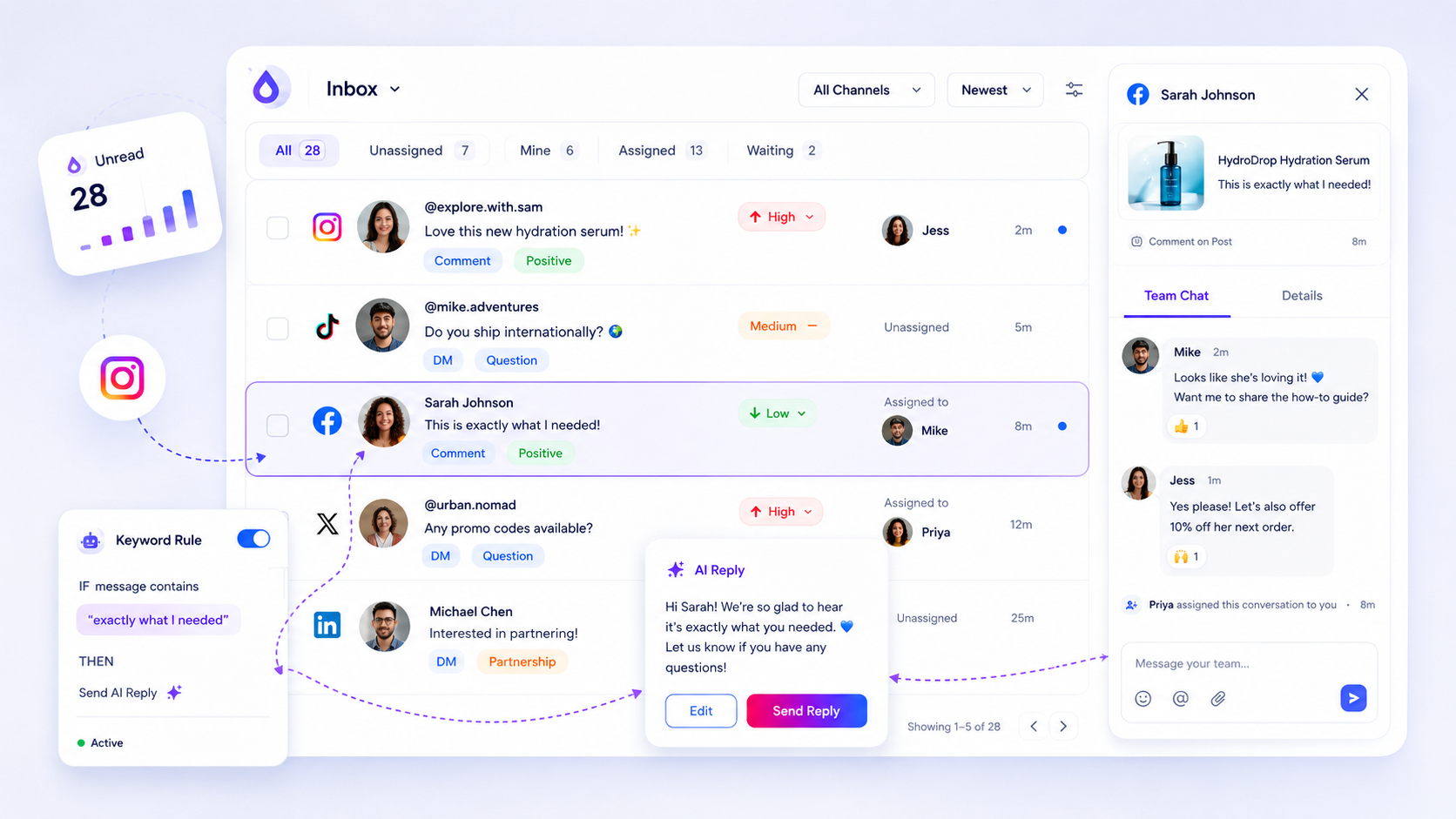
For enterprise teams, the best social media inbox isn't the one with the most bells and whistles. It is the one that forces normalized thread management, transforming scattered inbound noise into an auditable, team-owned operational queue. If you are still bouncing between native apps to answer DMs or chasing comments across five different browser tabs, you aren't managing social support; you are just surviving it.
We get it. The tab-switching fatigue is real. One minute you are buried in an Instagram DM thread, the next you are hunting for a crucial LinkedIn comment, all while trying to remember which brand account you are logged into. It is not just messy; it is operationally dangerous. The moment you lose track of who is replying to whom, you are one missed notification away from a PR nightmare or a frustrated customer who feels ignored by your brand.
At Mydrop, we see this across hundreds of brands: coordination debt is the silent killer of social strategy. You have the people, you have the content, but the operational gap between a fan sending a message and your team hitting "send" is where most enterprise workflows break.
What the best tools need to handle

To stop the chaos, your inbox needs to act like a CRM, not just a notification feed. The goal is to move from passive listening to active, auditable support operations. If your current tool just presents a list of messages without letting you treat them as actionable tickets, it is time to audit your stack.
| Feature | Why it matters for enterprise teams |
|---|---|
| Thread Normalization | Converts native formats (DM vs. Comment) into a unified object. |
| Assignee Logic | Prevents "reply collisions" where two agents answer the same person. |
| Status Tracking | Moves interactions from Unread to Resolved, proving work is done. |
| Internal Context | Adds private notes so agents know what happened in past conversations. |
Operator rule: If you cannot filter your inbox by "Needs Reply" and "Assignee," you are looking at a feed, not a workflow.
The most effective tools provide a clear operational heartbeat. This means real-time health checks on your webhook connections, so you know immediately if a profile stopped syncing. Without that, you are flying blind. When you work at scale, a silent sync failure is far more expensive than a slow reply.
Most teams do not have a volume problem. They have a coordination bottleneck. When you shift to a tool that treats every DM and comment as a trackable unit of work, you stop treating community management as a frantic scramble and start treating it as a measurable business function.
Where basic tools start to break

You know you are in trouble when your primary social media tool is just a glorified feed reader. If your team is still toggling between browser tabs, manually copying URLs into Slack to ask, "Did anyone see this?", or tracking conversations in a shared spreadsheet, you are not managing a brand-you are managing a coordination nightmare.
Basic tools fail the moment you need to do more than read a comment. They lack the connective tissue to turn an inbound message into an assigned task. Without thread normalization-the ability to pull DMs, comments, and mentions from Instagram, LinkedIn, or Threads into a single interface that looks and acts the same-your team will always be at the mercy of platform-specific quirks. When an inbox doesn't track status, priority, or ownership, conversations vanish into the ether, and the "reply gap" widens.
Common mistake: Treating every inbound message as an equal priority. Without a way to tag, assign, or filter by urgency, your team treats a crucial product bug report with the same urgency as a "nice post!" emoji, leading to inevitable burn-out and missed opportunities.
The buying criteria that matter
When you are ready to stop chasing shadows and start building a real support operation, you need a tool that treats your social inbox like a high-velocity support desk, not a vanity feed. We have seen this across dozens of agencies and multi-brand enterprises: the tools that scale are the ones that provide structured, auditable workflows.
Use this operational scorecard to audit your current stack before you sign that next contract. If your tool doesn't hit these marks, it isn't a social support platform-it's just a distraction.
The Social Support Operational Scorecard
| Metric | Why it matters | Decision Rule (Does it pass?) |
|---|---|---|
| Normalized Threads | Prevents platform-specific UI fatigue. | Does it convert all DMs and comments into one unified structure? |
| Assignment Logic | Stops "who is working on this?" confusion. | Can you assign individual threads to specific agents or queues? |
| Status Tracking | Eliminates the "reply gap." | Does it support explicit states: Open, Pending, Resolved? |
| Internal Context | Prevents redundant or inconsistent replies. | Can team members add private notes inside the thread? |
| AI Assistance | Speeds up high-volume responses. | Can it generate drafts based on brand voice and thread history? |
| Exportability | Required for compliance and audit. | Can you export client-safe CSVs for reporting on response speed? |
How to read this matrix: If you cannot track the lifecycle of a single comment from "Inbound" to "Resolved" without leaving the app, you do not have an operational queue. You have a collection of loose threads.
At Mydrop, we built the Inbox feature precisely to solve this. Because we normalize thread data across Instagram, LinkedIn, Facebook, and more, your team works off a single queue, not six fragmented apps. When you add internal notes or use AI to draft a response that actually fits the brand’s voice, you aren't just replying faster-you are building an auditable history of how your brand shows up. The goal is to move your team from reacting to the noise to managing the relationship.
How Mydrop supports this workflow
At Mydrop, we see the inbox not as a passive display of comments, but as an active operational queue. We built our approach around the reality that your team is likely managing dozens of profiles across Instagram, LinkedIn, and YouTube simultaneously. Without a way to normalize these threads, you are constantly fighting the UI instead of actually engaging with your community.
We treat every incoming DM or comment as a unit of work that needs a home. By normalizing provider formats, you stop playing "find the thread" and start working from a single, auditable stream. When a message hits the system, it automatically carries context-who it is, which brand it targets, and what platform it originated from-allowing your team to filter by priority, status, and assignee.
This is where the "reply gap" shrinks. Instead of leaving a comment hanging while you hunt for the original post URL, Mydrop keeps the conversation tethered to its source. And for those moments when the team is stretched thin, our AI-assisted drafting takes the load off. It doesn't just generate text; it pulls from your brand guidelines and specific thread history to ensure the reply is actually relevant, not just generic filler.
Decision check: If your tool doesn't let you set a thread status (like Open or Resolved) and assign it to a specific human, it is just a feed reader, not a support hub.
A simple shortlist checklist
Before you commit to a platform, run your current setup-or your potential new one-through this audit. If you can't check these off, your team will eventually hit a coordination wall.
| Requirement | Why it matters |
|---|---|
| Normalized Threads | All platforms (IG, LI, FB, etc.) appear in one consistent UI format. |
| Status Logic | Ability to set states like Assigned, Needs Reply, or Resolved. |
| Internal Notes | Private comments for your team to debate an answer without public risk. |
| Collaborative AI | Drafts that respect your brand's specific tone and context. |
| Audit Trail | A history of who replied, who edited, and when the ticket closed. |
| Client-Safe Export | Ability to pull inbox activity into CSV for non-technical reporting. |
Conclusion
The messy reality of enterprise social media is that volume eventually outpaces your ability to manually track it. Most teams don't have a communication problem; they have a coordination debt that gets worse with every new profile added.
Don't wait until a high-value lead is missed or a public comment thread turns into a PR risk to fix your infrastructure. The best social media inbox isn't the one with the flashiest interface-it's the one that turns the daily firehose of comments and DMs into a predictable, trackable, and professional support operation. If your team is still spending more time navigating between apps than actually talking to your community, it is time to stop auditing your strategy and start auditing your tools.