The most honest metric for your support team's efficiency is Average Response Time to Resolution. Stop counting raw messages. Volume is a vanity metric that masks the actual state of your operations. If you are not measuring the time threads sit idle or the interactions required to close a ticket, you are not managing a support queue; you are just reacting to noise.
We get it. Social media support feels like a game of digital whack-a-mole. You are jumping between platforms, dreading that an important request is buried in a thread you missed, all while leadership asks for data that requires hours of manual aggregation. It is chaotic, and the pressure to maintain speed while staying human is relentless. You are not just missing data; you are missing the ability to actually scale.
What the best tools need to handle
If your current setup relies on checking platform-native notifications, you have already lost the battle. Scaling support across enterprise channels requires moving from "monitoring" to "operational throughput."
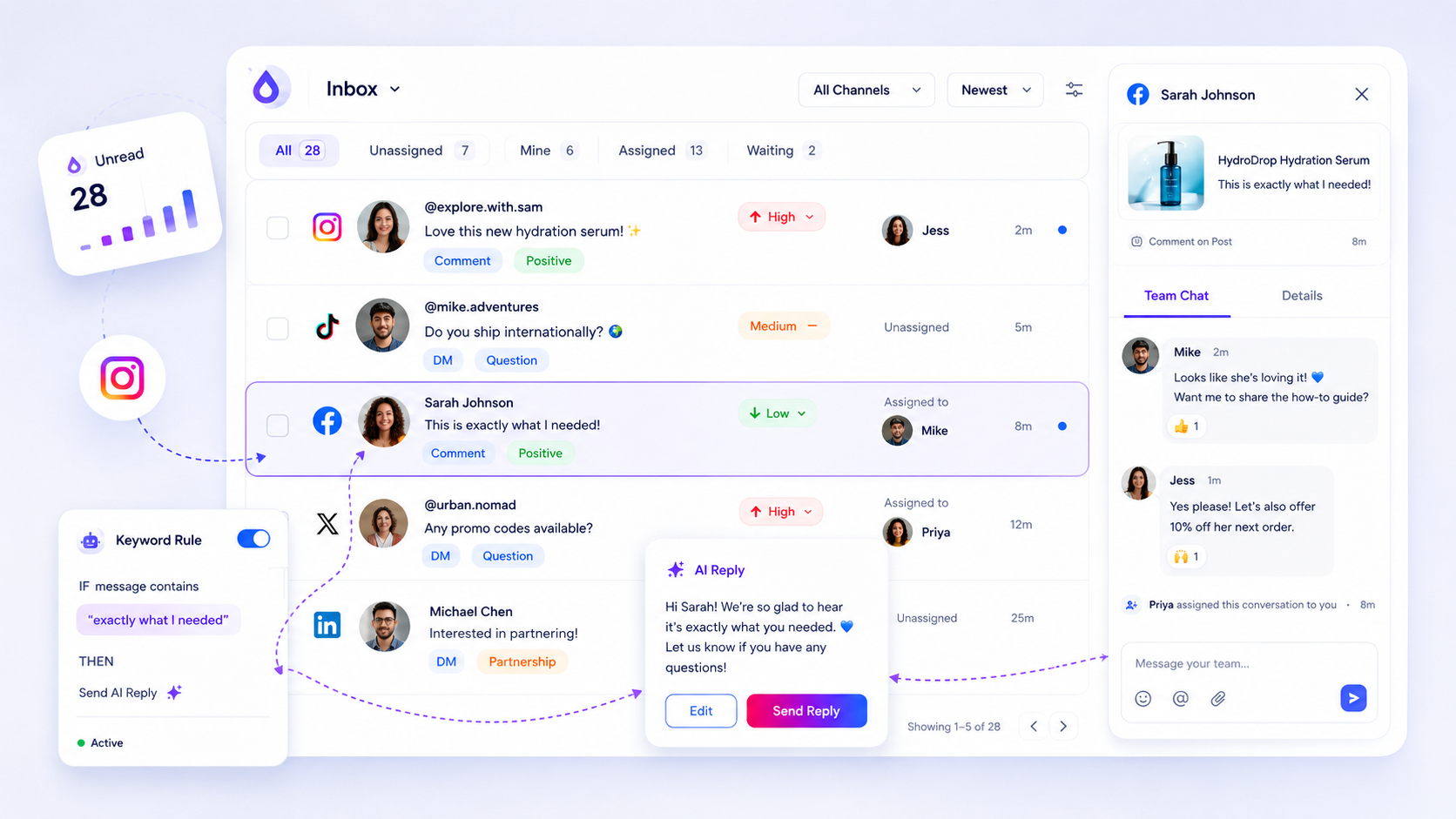
At the enterprise level, your tool stack must treat every DM or comment as a normalized ticket, not a fragmented notification. If the tool forces you to open a native app to see context, or if it lacks a shared status for thread tracking, it is not helping you; it is creating coordination debt.
To move from reactive to efficient, evaluate your current tools against this operational scorecard:
| Feature | The Chaos Baseline | The Operational Standard |
|---|---|---|
| Thread Visibility | Native app notifications | Normalized, unified queue |
| Assignment | Manual tagging or screenshots | Explicit owner attribution |
| Context | Fragmented per channel | Full thread history included |
| Metrics | Total volume counts | Latency to resolution |
When you force agents to manage threads across siloed platforms, they spend more time switching contexts than solving problems. You need a single, audit-ready queue where every interaction has a defined state-unread, in-progress, or resolved.
If a tool cannot give you a clean export of these states, you are blind to your own backlog. We have seen this across dozens of brands: the moment you unify your throughput data, the bottlenecks become painfully obvious. Most teams do not have a volume problem; they have a decision bottleneck, and they need a platform like Mydrop to normalize the chaos before they can even begin to measure true efficiency.
Without a unified way to assign priority and track resolution, you are just throwing human hours at an unmanaged problem. You need a system that does the heavy lifting so your team can focus on the response, not the retrieval.
Where basic tools start to break

Your support stack hits a wall the moment your brand grows beyond a single, quiet account. When you rely on native mobile apps or basic scheduling tools to handle inbound engagement, you aren't just working manually; you are actively creating a coordination debt that will eventually bankrupt your team's sanity.
The first crack in the foundation is context loss. When a community manager answers a DM on Instagram but has no visibility into a previous, frustrated comment thread on Facebook from the same user, your brand sounds disjointed and uninformed.
Here is where teams usually get stuck:
- The Notification Hunt: You spend more time switching between apps, profiles, and browser tabs than actually answering questions.
- The Spreadsheet Crime Scene: Because native tools offer no way to track thread status, you start using secondary spreadsheets or chat apps to log "who is working on what."
- The Audit Black Hole: If a legal or PR crisis erupts, you have zero ability to export a clean, searchable history of interactions to show exactly what was said and when.
This is the part most teams underestimate: you are not just managing social media; you are managing a distributed customer service department. If your tools don't treat every DM and comment as a ticket with its own lifecycle-assigned, prioritized, and eventually closed-then you are simply playing digital whack-a-mole until your team inevitably burns out.
The buying criteria that matter
Stop shopping for "social media features" and start shopping for operational infrastructure. If you are serious about scaling support across multiple brands or markets, your tooling must treat every interaction as a predictable data point.
Use this scorecard to evaluate whether your current or potential stack can actually handle the volume:
| Capability | What a Pro-Grade Tool Provides | Why It Matters |
|---|---|---|
| Thread Normalization | DMs and comments appear in one unified, searchable queue. | Eliminates platform-switching and context loss. |
| Assignment & Status | Ability to set ownership, priority, and "Closed" states. | Converts chaotic engagement into a managed workflow. |
| Auditability | Exportable, client-safe logs of all threads and activities. | Critical for compliance and justifying team headcount. |
| AI-Assisted Drafting | In-context drafting based on brand guidelines and history. | Drastically reduces response latency without losing human tone. |
| Health Monitoring | Real-time alerts if sync or webhook connections drop. | Prevents silent failures that hide your entire backlog. |
Operator rule: If you cannot report on your backlog at 9 a.m. without manually counting items in five different apps, your tool is broken.
When we look at how Mydrop handles this, the shift is simple: it stops the fragmentation. By pulling everything into a unified operational queue, you gain the ability to measure your real performance metrics-response speed and resolution rate-rather than just guessing based on how tired the team feels at the end of the day.
This isn't about automating away the human touch. It is about removing the friction that prevents your team from being human in the first place. When you don't have to chase down who answered which message, you finally have the bandwidth to actually care about the person on the other end of the screen.
How Mydrop supports this workflow
We built Mydrop specifically because we were tired of the frantic "app-switching" dance that defines social support today. When you are managing dozens of brand profiles across Instagram, LinkedIn, and Facebook, the biggest threat to your efficiency is context fragmentation. You cannot measure what you cannot centralize.
At Mydrop, we treat every interaction-whether it is a DM on Threads or a comment on an Instagram ad-as a unified, trackable thread. Because all that activity is normalized into a single operational queue, your team stops hunting for the conversation and starts resolving it.
Here is how that shift changes your daily reality:
- Single-source truth: Your team works from one dashboard, not five mobile apps. If a customer messages on Facebook and then comments on Instagram, you can see the full history in one thread detail view.
- Context-aware AI: Instead of typing "sorry for the delay" fifty times a day, our AI drafts responses using the specific brand context and thread history. It ensures your agents remain human while moving at enterprise speeds.
- Operational auditability: When leadership asks why your response times spiked last week, you don’t have to guess. You can export your inbox data to CSV, showing exactly when threads were assigned, prioritized, and closed.
We see teams move from "reactive firefighting" to "proactive engagement" once they stop managing accounts and start managing thread states.
A simple shortlist checklist
Before you commit to a new support tool or try to patch your current setup, run this checklist. If your current tools don't meet these three baseline requirements, your metrics will always be misleading.
- Unified Queue: Can you view and reply to DMs and comments from all platforms in a single, filterable list?
- Thread-Level Ownership: Can you assign specific conversations to team members and set priority levels without leaving the interface?
- Normalization: Does the tool treat a LinkedIn comment the same as an Instagram DM for the purpose of tracking status and response time?
- Health Monitoring: Is there an automated way to verify that your connections are actually syncing, or are you flying blind?
If you cannot tick these boxes, you aren't managing a support team-you are just managing a collection of individual app accounts.
Conclusion
The "best" metric isn't a complex formula. It is simply Average Response Time to Resolution, tracked across every channel your brand touches. If you aren't looking at that number daily, you are effectively letting your response quality remain a mystery.
Most teams do not have a "volume" problem; they have a coordination bottleneck. They spend more energy switching between apps than actually helping customers. By centralizing your workflow and focusing on the speed of your resolutions rather than the noise of your incoming notifications, you turn your social inbox from a chaotic liability into a measurable asset.
Stop counting the messages and start auditing the workflow. Your team, and your customers, will notice the difference immediately.