If you have ever felt that split-second cold sweat after hitting publish on a client account only to realize you were logged into the wrong brand, you already know why static permissions are failing your agency. The issue is rarely a lack of skill or attention; it is a fundamental collision between the way your software is built and the way your team actually works. When you are toggling between five different clients, managing ten active campaigns, and juggling last-minute changes, expecting your brain to act as a perfect filter for every click is simply setting yourself up for an expensive mistake.
We have seen this across dozens of agencies: the messiness is not a lack of discipline. It is an inevitable byproduct of high-volume agency life where switching context is a requirement, not an exception. That moment of panic when a post goes live on the wrong feed? That is a symptom of cognitive load, not bad training.
What the best tools need to handle

Most social media management platforms approach this problem from a security perspective. They want to ensure you have the correct "Read" or "Write" access to a profile, so they build rigid, role-based permission walls. That is fine for compliance, but it is terrible for safety. A junior manager might have permission to post to three different clients, but they should never have the ability to see all of them in the same selector at the same time.
To actually prevent errors, the best tools have to handle workspace-wide, personal focus states that adapt to the individual's current project. Here is the operational reality of what your team needs to stay safe:
- Persistent Contextual Filtering: The tool must allow a member to say, "I am working on Brand A for the next three hours," and then physically hide everything else-profiles, analytics, and schedules-associated with Brands B, C, and D.
- Per-Member Independence: If Sarah is auditing a tech brand while Mark is drafting content for a lifestyle client, Sarah should not have to manually toggle her view, only to break Mark’s workflow. Focus must be local to the user, not global to the workspace.
- Dynamic Membership Updates: When you add a new social channel to a brand in your CRM, the tool should automatically include it in your active focus view. If you are relying on a static "saved list" of profiles, you are eventually going to miss a new account, leading to missed coverage or accidental posting.
Operator rule: A safety feature is only as good as its visibility. If a user has to remember to "turn off" a filter or check which brand is active in a tiny dropdown menu, they will eventually forget. The interface needs to make it obvious-visually and structurally-that they are in a restricted mode.
The difference here is between Access Control (which keeps unauthorized people out) and Context Control (which keeps the right people focused on the right job). If your current platform treats context as an afterthought, you are carrying unnecessary coordination debt every single day.
Where basic tools start to break

Most agency software treats access control (who can log in) as the end-all for security. It is a necessary foundation, sure, but it is not a safety layer for your daily operations. The real issue occurs after the login, during the high-velocity, multi-tasking hours where teams switch between three different client voices, four time zones, and a dozen active campaigns.
This is where "coordination debt" silently accumulates.
If your software displays every brand you manage in one unified, unfiltered dashboard, you are one missed click away from a high-stakes error. Basic tools assume that if you have the permission to see a brand, you always want to see it. That is a dangerous assumption for an agency managing hundreds of profiles. When your team is juggling multiple clients, the interface itself becomes the biggest threat to your brand integrity.
Common mistake: Relying on standard role-based permissions to prevent posting errors. Permissions stop unauthorized access, but they do nothing to stop a perfectly authorized user from posting to the wrong account during a late-night campaign rush.
The buying criteria that matter
When evaluating your tech stack, stop asking if a tool can manage multiple brands and start asking how it forces your team to focus on one at a time. The difference is between a system that permits errors and a system that makes them nearly impossible.
We have seen thousands of agency workflows, and the teams that thrive are the ones that prioritize "Context Control" over simple access lists. Use this scorecard to evaluate whether your current platform handles focus or just access.
| Feature Check | Focus-First Platform | Basic Agency Tool |
|---|---|---|
| Workspace Filtering | Persist focus per-member | Global shared state only |
| Dynamic Updates | Auto-includes new profiles | Requires manual re-selection |
| Cognitive Load | Hides irrelevant accounts | Displays all accounts always |
| Safety Logic | Active workspace-wide filter | Relies on user discipline |
| Operational Goal | Prevents errors by design | Relies on training/reminders |
A critical, often-overlooked requirement is dynamic membership. Many tools use static snapshots of profiles when you configure a project or workspace. That is a setup for failure. If you add a new LinkedIn page or TikTok handle to a client's brand next month, your focus tool needs to grab it automatically. If you have to manually update your "view settings" every time a client grows, your team will eventually stop doing it.
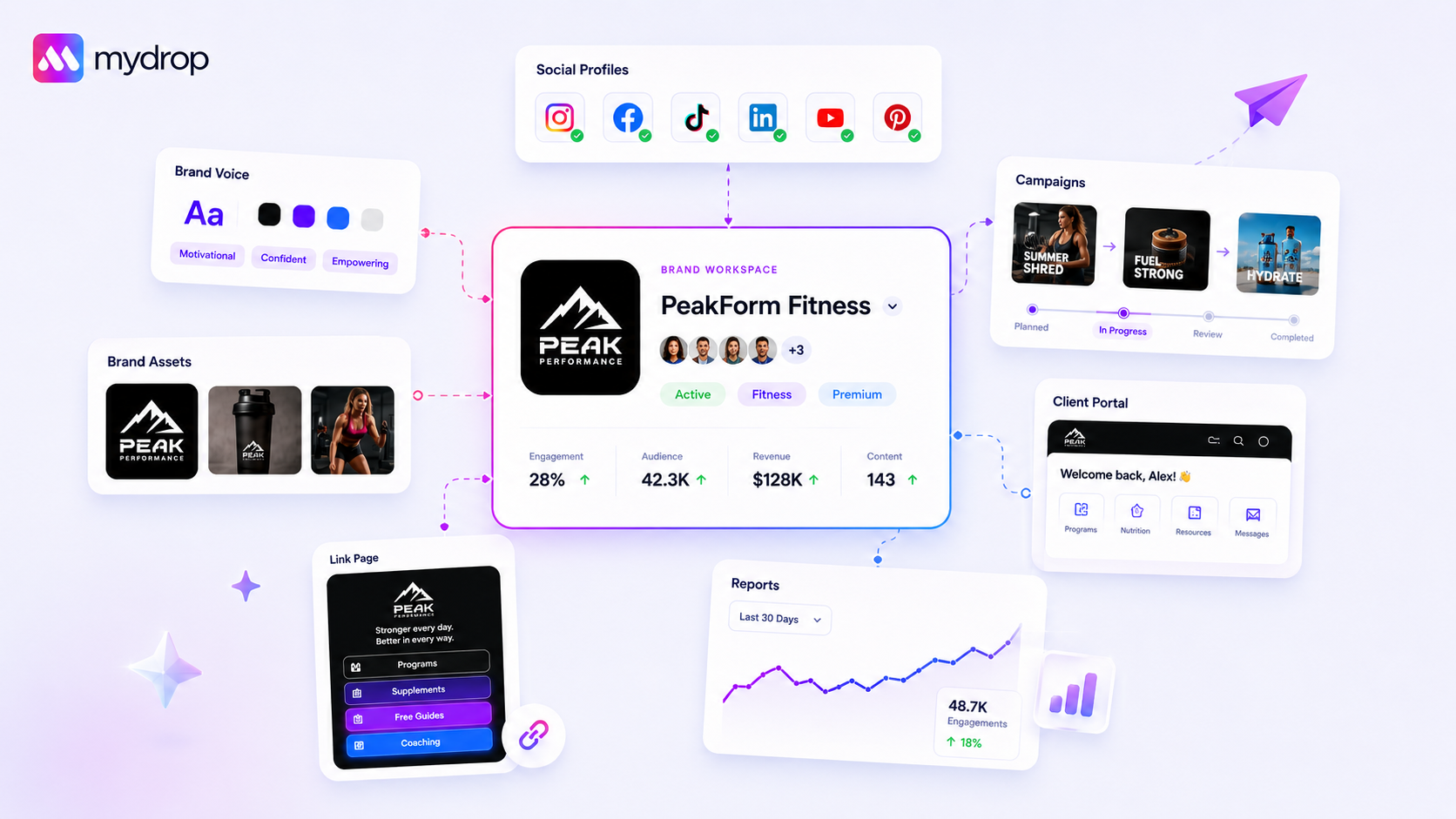
At Mydrop, we built the Brand Lock feature specifically to bridge this gap. It works by tethering your entire workspace experience-from your calendar view to your posting interface-to a specific brand context.
Crucially, this is a personal focus state. If your team lead is managing the cosmetics account and you are handling the tech client, you can each lock your workspace to your respective brands without ever interfering with the other. It is not an access-control boundary; it is a safety aid designed to reduce the cognitive load of a high-volume agency. If the selector isn't dynamic, and if it isn't persistent per-member, you are just masking the problem rather than solving it.
How Mydrop supports this workflow
At Mydrop, we watched enough teams scramble during a brand launch to know that the problem isn't "user error." It is cognitive load. When you manage fifty profiles across ten brands, the human brain eventually stops distinguishing between them.
We built Brand Lock to solve this at the root. It is not an access-control wall meant to hide data; it is a workspace-wide focus tool designed to shrink your world down to exactly what you are working on right now.
When you enable Brand Lock, the entire app behaves as if the other brands do not exist. Your sidebar selector, your reporting dashboard, and your post-composer are instantly filtered to show only the brand you have selected.
Decision check: Treat Brand Lock as a personal safety switch. If your teammates need to work on a different account simultaneously, they can set their own lock without impacting yours.
Crucially, this is dynamic. You do not need to manually refresh a list of profile IDs every time a manager adds a new channel or a new market campaign launches. You lock onto the brand, and the system handles the membership. If a new profile gets added to the "Coffee Brand" group next Tuesday, it automatically appears in your locked workspace view. You are always working with the current, live set of assets.
A simple shortlist checklist
Before you commit to a platform, run this quick audit against your current setup. If your team cannot answer "yes" to these five points, you are likely carrying more coordination debt than you realize.
| Audit Point | Focuses on Access? | Focuses on Context? |
|---|---|---|
| Can members isolate a single brand globally? | No | Yes |
| Do filters survive a page reload? | No | Yes |
| Is the focus state personal (per user)? | No | Yes |
| Does the filter update as profiles change? | No | Yes |
| Does the UI hide non-relevant assets? | No | Yes |
If you checked "Focuses on Access" for more than two, your team is likely operating with a high risk of cross-brand errors.
Conclusion
Most teams do not have a content problem; they have a decision bottleneck caused by excessive UI noise.
You can try to solve this with better training, stricter checklists, or more manual oversight, but you are fighting biology. Humans are not built to stay hyper-focused while toggling between dozens of distinct brand identities every hour.
Instead, optimize your environment. Stop relying on memory to prevent mistakes. Implement tools that force the interface to keep pace with your intent. When your software acts as a guardrail rather than just a storage container, you finally get the space to stop worrying about which brand you are posting to-and start focusing on the actual content your audience wants to see.