The best social media approval tool for large teams is one that eliminates the "toggle tax". This is the constant friction caused when planners, editors, and approvers must leave the scheduling surface just to perform basic quality checks. The superior workflow allows your team to view, edit, and approve content directly within the same unified calendar surface where your strategy actually lives.
Managing a brand presence at scale is messy and prone to high-stakes errors. When you are balancing five brands across ten platforms with a dozen stakeholders, the approval process often feels like playing a game of digital telephone. The anxiety of "what was actually approved versus what is currently live" is a weight no social lead should have to carry. We have been there, and it is exhausting.
What the best tools need to handle

If you are running a large-scale social operation, your approval process is only as good as the information your stakeholders see when they make a decision. A tool that hides the calendar view behind a separate "approval dashboard" is not saving you time; it is creating a coordination bottleneck.
To maintain quality control, the approval interface must be context-aware.
| Feature | Fragmented Tools | Calendar-Centric Workflow |
|---|---|---|
| Context Switch | High (Leave calendar to approve) | Zero (Action inside calendar) |
| Visibility | Siloed, abstract statuses | Full campaign context |
| Feedback Loop | Email or DM threads | Integrated, in-context comments |
| Decision Speed | 24-48 hour delay | Near real-time |
Operator rule: If your team has to ask "What is the context of this post?" while reviewing, your approval workflow is missing the necessary visibility.
Enterprise teams need to see the "why" alongside the "what". They need to see how a specific post fits into a wider campaign, which platform-specific assets are being used, and if the copy aligns with the brand voice across different regions. When approval happens in a vacuum, mistakes are inevitable.
The best tools allow approvers to:
- See the content exactly as it will appear on the platform.
- Check the post status without leaving the calendar view.
- Make adjustments or leave feedback without sending an external request.
If the approval action does not live on the calendar, it is just another folder for your team to manage. You are not just checking a box; you are verifying that the work you have planned aligns with the goals you have set. When these two processes are disconnected, you end up with a team that spends more time managing the tool than the actual social media presence.
Where basic tools start to break

Most platforms are designed for scheduling, not for the messy reality of enterprise approval. This is where the toggle tax destroys your team's momentum. When your schedulers are in one tool, your editors are in email, and your legal reviewers are in a separate "approval portal," you are not just managing content. You are managing a coordination nightmare.
Every time a stakeholder leaves the calendar surface to search for a "pending" post, they lose the context of the larger strategy. That is the blind spot. If they cannot see the monthly campaign cadence while making an approval decision, they might approve a post that clashes with another brand’s launch, misses a seasonal hook, or just feels repetitive. The tool might show the post, but if it hides the calendar, it hides the strategy.
When feedback is disconnected, the friction grows. A reviewer leaves a comment like "needs more context" in a separate pane, and the planner now has to hunt down the original post to interpret what that means. If the approval action itself is not anchored to the calendar date, the post becomes a floating task, detached from the timeline it is supposed to serve. This is how quality control slips through the cracks-not because anyone is lazy, but because the tool itself breaks the workflow.
The buying criteria that matter
If your approval process doesn't live on the calendar, it is just another folder you have to manage. At the enterprise scale, you need a calendar-first approach that forces transparency. Here is a simple scorecard to evaluate if a tool is built for a professional team or just a solo creator.
Workflow Efficiency Scorecard
| Feature | The "Disconnected" Workflow | The Calendar-Centric Workflow |
|---|---|---|
| Approval Context | Lost on toggle (exit/re-load) | Maintained in-situ |
| Decision Support | Siloed preview modals | Full campaign visibility |
| Feedback Loop | Separate email or chat | Integrated, context-aware comments |
| Edit Actions | Requires leaving the view | Integrated editing hooks |
When shopping for an approval tool, demand that it treats the calendar as the source of truth, not just a display board. The best tools allow your stakeholders to see the entire campaign, check the status, and perform the action-approve, edit, or request changes-without ever leaving the calendar view.
The real test is the "one-click" principle: Can a user see, verify, and act on a post from a single surface? If the answer is no, you are paying for a tool that forces your team to work harder, not smarter.
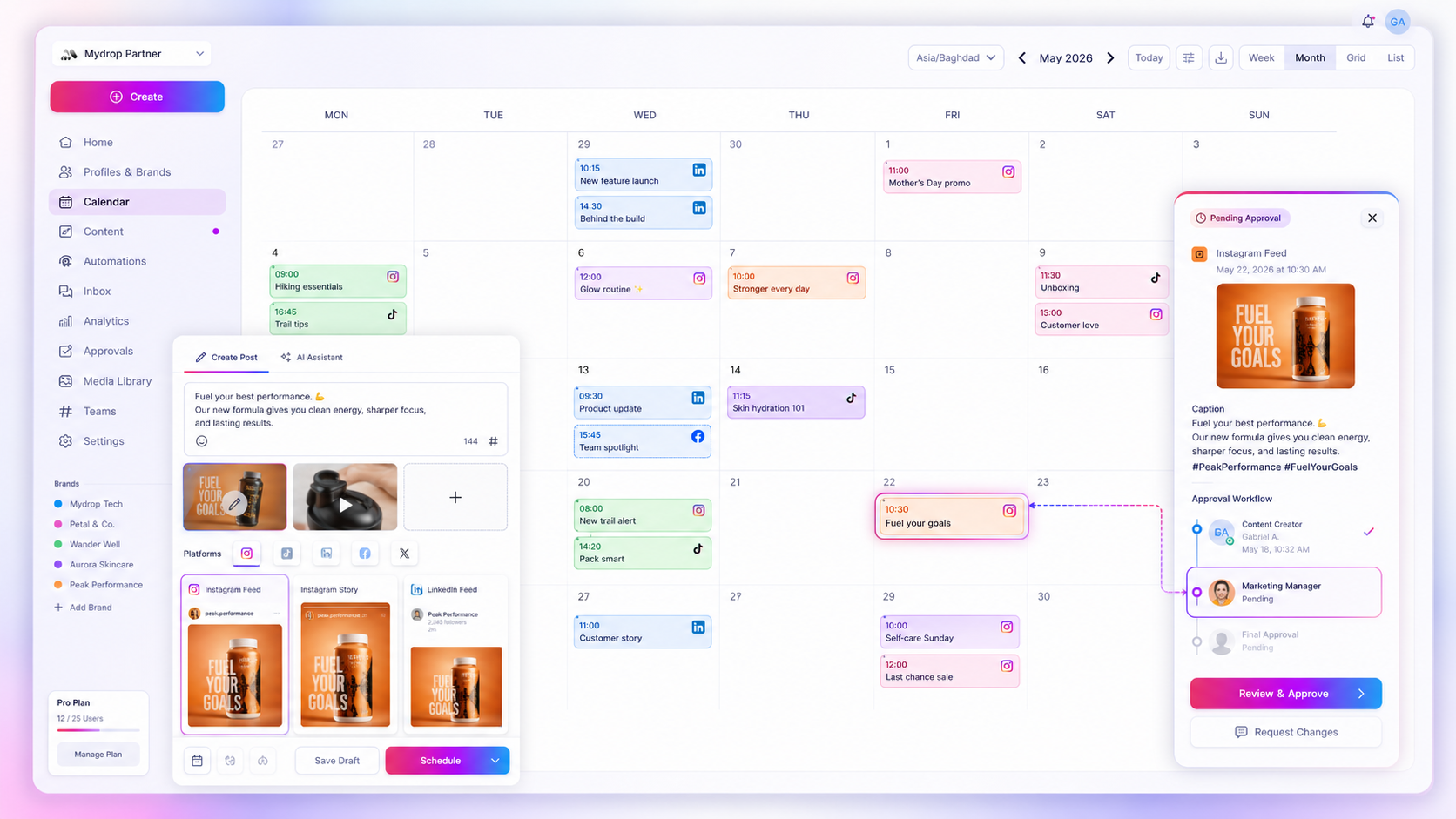
At Mydrop, we designed our calendar to keep the preview, status actions, and editing hooks in one single pane because we know how easily context is lost elsewhere. When the tools you use mirror the way you actually work-seeing the plan and approving it in the same breath-you stop fighting the software and start focusing on the content.
The operating rule is simple: If the approval action doesn't live on the calendar, your team will spend more time chasing statuses than they will perfecting the brand's voice. Don't settle for tools that treat approval as an afterthought.
How Mydrop supports this workflow
We built Mydrop for the reality of high-stakes social teams. We know that most of your day isn't spent brainstorming; it's spent coordinating. You have brand guidelines to enforce, legal reviews to clear, and a constant pressure to keep the content pipeline moving without mistakes. At Mydrop, we designed our calendar to keep the preview, status actions, and editing hooks in one single pane because we know how easily context is lost elsewhere.
When you open the Mydrop calendar, you aren't just looking at a schedule. You are looking at your operational command center. We wanted to eliminate the "toggle tax" entirely. When you click on a post, the unified preview doesn't just show you the creative; it lets you approve, edit, or leave a note without ever leaving the calendar view.
This is where the magic happens for large teams. If you are a social lead managing five different brand profiles, you can filter the entire calendar by specific campaigns or by "pending approval" status. You see exactly what is due, who it's for, and where it sits in the approval cycle. If a post is missing a crucial tag for a regional market, you can make that fix in real-time right from the preview modal.
We have seen this across thousands of posts and hundreds of brand profiles. When the approval action lives directly on the calendar, the bottleneck disappears. Your editors aren't chasing down emails; they are seeing the pending tasks right alongside the live strategy. You get to maintain your quality control without forcing your team to jump through three different interfaces just to hit "publish."
A simple shortlist checklist
When you are vetting a new tool for an enterprise team, do not get distracted by flashy scheduling features that everyone has. Look at the operational plumbing. Does the tool support the messiness of your actual workflow? Use this checklist to score your current process and see where you might be accumulating hidden coordination debt.
| Capability | Requirement for Enterprise Scale | Decision check |
|---|---|---|
| Unified Preview | Can you approve, edit, and leave notes without leaving the calendar? | If you have to click away, it fails. |
| Status Filtering | Can you isolate "Pending Approval" or "Ready" posts instantly? | Essential for high-volume teams. |
| Role-Based Access | Can you restrict editing or approval permissions by brand or market? | Prevents unauthorized changes to sensitive campaigns. |
| Contextual Notes | Are notes linked directly to the post object in the calendar? | Stops important feedback from being buried in threads. |
| Campaign Cadence | Can you view the monthly campaign view while approving a single post? | Keeps the big picture in sight during granular decisions. |
If you cannot check all five boxes, you aren't just missing a feature. You are running a high-risk operation that relies on manual checks and individual vigilance, both of which will fail eventually.
Conclusion
Most teams do not have a content problem. They have a decision bottleneck. You can hire more creators and you can increase your posting frequency, but if you do not fix the coordination debt in your approval process, you will only end up with more errors and faster burnout.
Stop treating your scheduling surface and your approval process as two different worlds. They need to live on the same calendar. The next time you feel that familiar dread of opening a dozen browser tabs just to verify a single week of content, remind yourself that it is not you-it is the tool. Switch to a workflow that respects your time and your need for control, and your team will thank you for it.