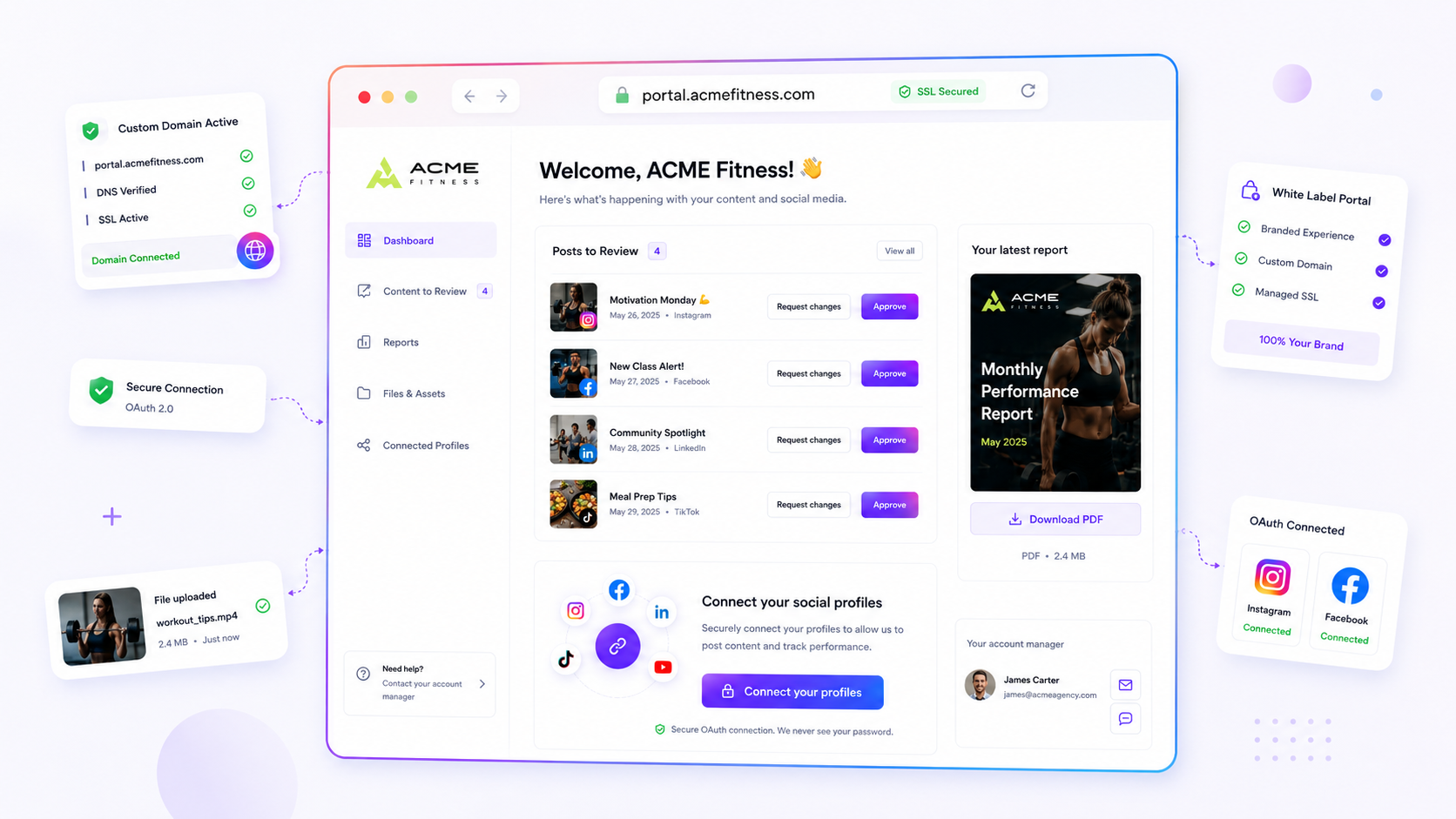
The secret to maintaining brand trust across agency portals isn't a feature; it's domain ownership. If you are still routing enterprise social traffic through generic, third-party URLs, you are signaling to stakeholders that the platform-not the brand-owns the customer journey. Most teams treat link-in-bio as a low-priority task, but it is actually the final conversion point. When you lose control of that URL, you lose the authority you worked so hard to build. Moving to a custom domain isn't just an aesthetic choice; it’s an infrastructure decision that keeps your client's brand experience cohesive, secure, and professional. It is the difference between an amateurish workaround and a scalable client-facing portal.
Managing this requires moving past the simple "link aggregator" mindset. The real payoff here is reducing the coordination debt that occurs when you have to manual-configure or re-verify dozens of client URLs every time a new campaign drops.
What the best tools need to handle

When you manage portfolios of fifty or more brands, manual domain management becomes a bottleneck. Most basic tools break down here, either because they lack automated SSL provisioning or because they force you into a single, inflexible URL structure.
Your tool must handle the heavy lifting of domain infrastructure seamlessly. Here is the impact of settling for generic tools versus investing in white-label domain infrastructure.
| Feature Impact | Generic URL Structure | White-Label Domain Infrastructure |
|---|---|---|
| Brand Authority | Owned by third-party platform | Fully client-owned and branded |
| SSL Security | Shared, often inconsistent | Individually managed per client |
| Conversion Path | Disjointed, confusing for user | Seamless, trusted experience |
| Scaling | Manual, high-friction updates | Automated via background dispatch |
At Mydrop, we approach this by handling the DNS verification and SSL lifecycle as an asynchronous background service. This ensures you are not stuck waiting for manual activation emails while a campaign goes live. The best tools don't just "connect" a domain; they dispatch hosts to the right destination-whether it is a simple link page or a complex, multi-brand portal-without exposing the underlying platform machinery.
If your current provider makes you manually refresh certificates or requires a support ticket to map a new host, you are losing money on operations.
DNS & SSL Readiness Audit Checklist
Before you commit to a platform for client portals, run this tactical pre-flight check to see if their domain infrastructure is enterprise-ready:
- Asynchronous SSL: Does the platform automatically provision and renew certificates without requiring manual intervention?
- DNS Feedback: Can you verify DNS status directly in the UI, or does it require guessing and waiting for propagation?
- Multi-Surface Routing: Can the same domain map to both a public link-in-bio page and a private brand portal?
- Clean Decoupling: Does the tool automatically clean up DNS resources and SSL certificates if you delete a domain or offboard a client?
When you treat domain assignment as a core infrastructure service rather than a peripheral setting, you stop fighting technical debt and start shipping faster.
Where basic tools start to break

It is tempting to think that managing custom domains for fifty clients is just fifty times harder than managing one. In reality, it is more like exponential growth in headache. Most link-in-bio tools treat custom domains as a bolt-on feature rather than core infrastructure. They work perfectly fine for your first client, and maybe your second, but the cracks appear the moment you start scaling.
The most common failure point is SSL certificate management. If your tool requires you to manually monitor or renew certificates for dozens of client domains, you are already behind. When an SSL certificate expires, the browser shows a terrifying "Connection Not Secure" warning right at the point of conversion. For an enterprise brand, that is not just an error; it is a reputational blow.
Then there is the issue of DNS transparency. Basic tools often fail to provide clear, actionable feedback when a client DNS configuration is wrong. You get a generic error message, and you are left guessing whether the issue is a missing CNAME record, an incorrect A record, or just slow propagation. For an agency, this creates a support bottleneck where your team spends hours playing tag with client IT departments, troubleshooting infrastructure they do not own.
Finally, inflexible routing is a silent killer. If you need to switch a client from a temporary campaign portal to a permanent bio page, basic tools often require you to delete the domain, wait for the old SSL to clear, and then start the entire provisioning process over. This is not just tedious; it is downtime that costs you traffic.
The buying criteria that matter
Stop shopping for a tool based on which one has the prettiest buttons. Start shopping based on whether the platform treats your client's domain as a first-class citizen. If the tool is not built for multi-brand governance, you will outgrow it in a fiscal quarter.
Look for a platform that treats DNS validation and SSL provisioning as an automated, asynchronous workflow. You should enter a domain, get clear feedback on what to configure, and let the system handle the rest.
Custom Domain Scalability Scorecard
| Capability | Basic Tool | Enterprise-Grade Platform |
|---|---|---|
| SSL Provisioning | Manual or often fails | Automated, asynchronous, & managed |
| DNS Feedback | Opaque or generic errors | Real-time validation & status |
| Target Routing | Static; requires full reset | Dynamic; map domain to any surface |
| SSL Renewals | Manual check | Self-healing (automated) |
| Host Dispatch | One domain per surface | Multi-target routing on same domain |
When evaluating your options, ensure the following requirements are non-negotiable:
- Asynchronous Managed SSL: The tool must provision and renew SSL certificates in the background without requiring manual intervention.
- Clear DNS Verification: The platform should provide a clear, checkable state for DNS so you know exactly when it is safe to assign the domain.
- Decoupled Target Assignment: You must be able to change the destination surface, such as moving a domain from a bio page to a portal, without having to delete and re-verify the domain itself.
- Robust Host Dispatch: The backend must handle routing traffic efficiently so you do not have to worry about redirects or latency.
At Mydrop, we approach this by treating domain infrastructure as a managed service. We handle DNS checks, automate SSL provisioning, and manage host dispatch so you can focus on the campaign rather than the certificate status. This level of technical maturity is how you maintain brand authority when managing social media at scale.
The goal is to eliminate the coordination debt that comes with managing branded surfaces. When the infrastructure is invisible, the brand experience becomes the only thing the customer sees.
How Mydrop supports this workflow
We built Mydrop specifically to handle the messy reality of custom domains for agencies managing hundreds of profiles. It is not just about routing a URL. It is about automating the things that break campaigns, like SSL certificates that fail right before a big launch.
When you connect a client-owned domain to Mydrop, our infrastructure runs the DNS verification, provisions the SSL automatically, and dispatches the host request to the correct surface, whether that is a link-in-bio page for a creator or a full brand portal for a corporate client.
The goal is to remove the "is the site secure?" ticket from your support queue entirely. If a certificate expires or a domain configuration shifts, the platform handles the polling and notification loop. It is infrastructure that stays out of your way until it is needed. Because our host dispatch system distinguishes between public link pages and private brand portals on the same domain layer, you can scale client surfaces without creating a new management headache for every single asset.
A simple shortlist checklist
Before you commit to a platform, run it through this pre-flight check. If the vendor cannot answer these clearly, keep looking.
| Capability | Requirement | Why it matters |
|---|---|---|
| White-Label Delivery | Zero platform branding on public URLs. | Protects brand equity at the final conversion step. |
| Managed SSL | Asynchronous, automated provisioning. | Eliminates manual certificate management for 50+ clients. |
| DNS Feedback | Clear, actionable status logs for verification. | Prevents "domain not pointing" support tickets. |
| Surface Routing | Ability to route to both links and portals. | Allows one domain to serve multiple client needs. |
| Infrastructure | Resilient, cloud-native host dispatch. | Ensures 99.9% uptime during high-traffic campaign spikes. |
Operator rule: If a tool requires you to manually generate or upload SSL certificates, it is not a tool, it is a technical debt factory. Walk away.
Conclusion
Stop treating your links as an afterthought. Every time you route traffic to a generic domain, you are handing over a piece of the brand experience and a percentage of your authority. The difference between a professional brand portal and a hobbyist landing page often comes down to the URL in the browser bar.
When your infrastructure matches the quality of your content, everything changes. Client trust increases, conversion paths become clear, and your team spends less time managing technical friction and more time focusing on campaign performance.
Take control of the final inch of the customer journey. You have already put the work into the creative and the strategy. Do not let the delivery infrastructure be the reason the deal breaks.