Your link-in-bio page should be a high-intent conversion engine, not just a digital business card. If it isn't capturing leads, distributing assets, and tying directly to your CRM, you are losing attribution for your best social traffic. For enterprise marketing teams, this page has historically been a black hole-you drive high-quality traffic from a TikTok or Instagram post into a dead-end list of buttons that offers zero visibility into what happens next.
We get it. You are managing dozens of brands, fragmented social channels, and a mountain of content assets. Tracking whether a visitor actually downloaded your whitepaper or joined your email list feels impossible when your tools treat all traffic the same way. The awkward truth is that using a consumer-grade tool for enterprise social operations creates data silos that break your conversion funnel at the very first step.
What the best tools need to handle
The shift here is moving from "navigation" to "destination." A basic link aggregator lists your current campaigns, but an enterprise-grade surface actively manages the conversion. When you support hundreds of profiles across multiple markets, you cannot afford pages that don't know who their visitors are or what they do.
Use this checklist to identify where your current link-in-bio setup is losing data.
The "Leaky Funnel" Diagnostic
| Capability | Status | Risk if Missing |
|---|---|---|
| Direct Email Capture | [ ] | You lose the lead before they ever hit your site. |
| Server-Side Tracking | [ ] | You are guessing at conversion attribution. |
| Custom Domain Hosting | [ ] | You damage brand trust and SEO authority. |
| Media Kit Hosting | [ ] | You waste time emailing static assets. |
| CRM Event Sync | [ ] | You cannot segment traffic by social source. |
Most tools stop at the click. They tell you someone tapped a button, but they cannot tell you if that person actually submitted a form, downloaded a file, or converted to a sale. At Mydrop, we see teams struggle most with this visibility gap. When you treat every interaction as a generic "exit," you lose the ability to prove ROI to stakeholders.
Operator rule: If your link page doesn't let you embed a native email capture block or trigger a custom pixel on a button press, it is not a conversion tool-it is just a glorified navigation menu.
The best setups handle content distribution internally. Instead of routing a user through three different sites just to download a media kit, you should be able to surface that asset directly on the page, track the download event, and keep the user in a branded, cohesive environment. This is the difference between a page that merely exists and a page that actually works for your team.
Where basic tools start to break

If you're managing social, you know the feeling. You’ve got high-quality traffic pouring in from your latest campaign, but it hits a wall the second it lands on that "link in bio" page. You see the traffic on the dashboard, but you have no idea what happens after they click.
The awkward truth is that most tools are designed as digital Rolodexes, not conversion engines. They count "clicks" on buttons, but they don't know if that click turned into a lead, a download, or a sale.
When you rely on these basic tools, you end up with a massive data silo. Your social manager sees a surge in traffic, but your CRM shows a flatline in conversions. You're losing attribution for your best traffic because the page is a black hole.
The fundamental breakdown is simple: generic tools treat all traffic the same, failing to track the value of the interaction. They force visitors off your site to fill out third-party forms, which is where the leak happens. When a visitor leaves your bio page to hunt for a form on another site, they're gone.
At Mydrop, we see teams struggle with this because their "bio page" is just a list of static buttons that don't talk to their marketing stack. If your bio tool doesn't know the difference between a curious click and a completed download, you aren't managing a conversion surface; you're just hosting a list of links.
The buying criteria that matter
Your link-in-bio page should function as a lightweight, branded landing page. When you're ready to upgrade, stop looking at "how many buttons it supports" and start looking at how it integrates into your actual marketing funnel.
The Conversion-First Rule is the benchmark: Every element on your page-from an email block to a media download-must be tied to a specific tracked event that feeds your analytics. If you can't see the conversion event in your main dashboard, you're flying blind.
Use this scorecard to audit your current platform. If you're missing more than two of these, your bio page is likely costing you leads.
| Feature | Why it matters | Risk of missing it |
|---|---|---|
| Custom Domain | Establishes trust, keeps traffic under your brand. | Brand dilution, broken SEO attribution. |
| Direct Email Capture | Converts on-page, removes friction. | High drop-off from external forms. |
| Event-based Tracking | Maps action to specific conversion event. | Blind to results, only "clicks" counted. |
| Asset Distribution | Keeps files trackable on-site. | Lost attribution for content downloads. |
| White-label Theme | Maintains visual brand consistency. | Higher bounce rates due to "cheap" look. |
When evaluating your next move, prioritize platforms that prioritize data ownership. If you don't own the domain, you don't own the data-it's that simple. You need a platform that treats a bio page as a destination, not just a waystation.
For teams managing hundreds of profiles, the platform must handle this scale by centralizing the tracking. Mydrop does this by recording events server-side the moment a visitor interacts with a content element, which ensures your conversion data is captured accurately regardless of client-side tracking restrictions.
Look for tools that offer:
- Seamless CRM integration: Does it sync lead captures automatically, or are you manually exporting CSVs?
- Unified analytics: Can you see the full path from the post to the conversion in one place?
- Flexible content blocks: Can you swap a button for a file download or a video gallery without rebuilding the whole page?
Most teams don't have a content problem. They have a decision bottleneck. If your platform makes it hard to change a destination or track a new lead magnet, you're not moving fast enough. Stop chasing vanity clicks and start building a destination that actually tracks the work your team is putting into the content.
How Mydrop supports this workflow
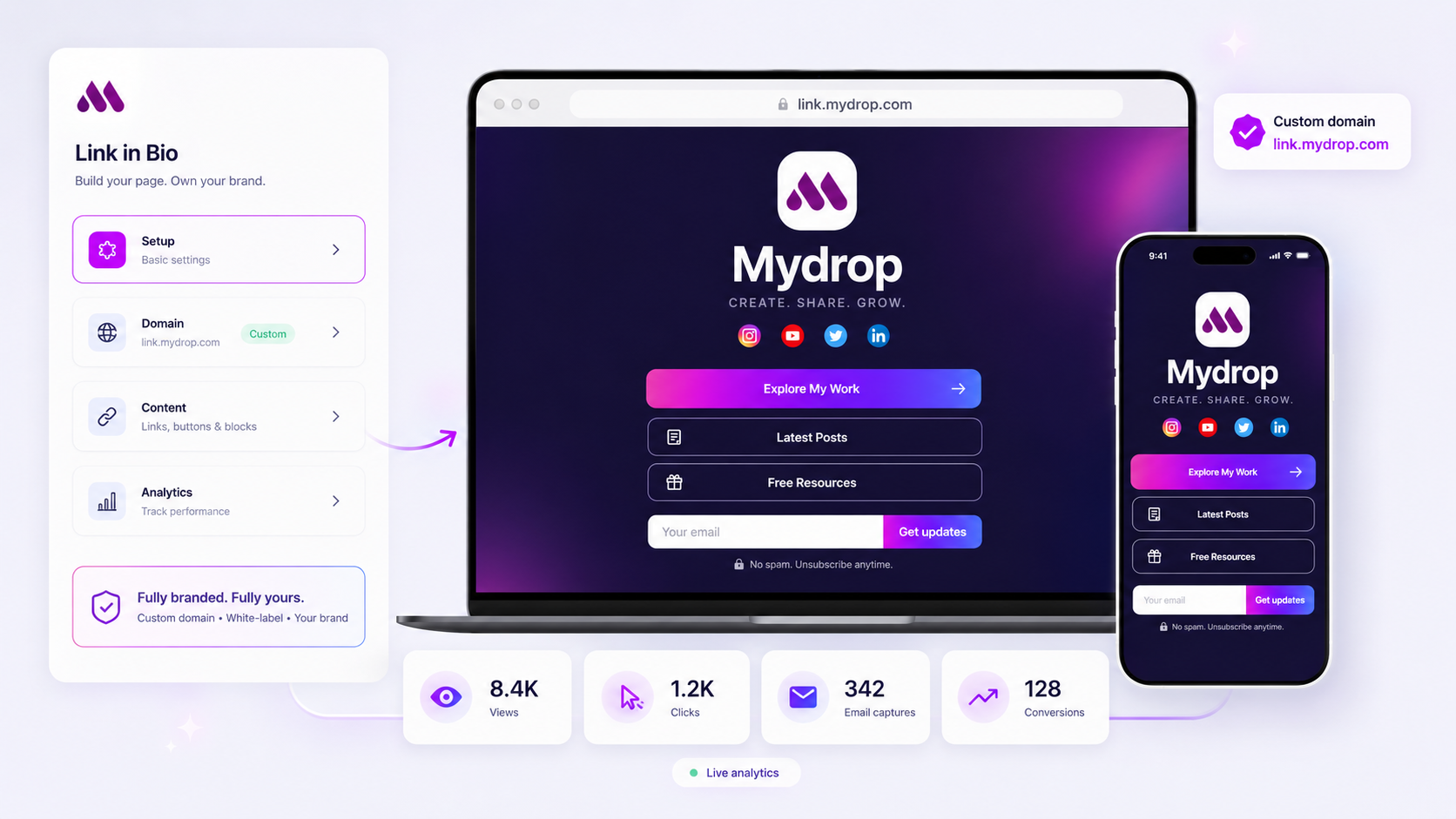
When you manage multiple brands, your link-in-bio page cannot just be a list of buttons that points away. It must act as a destination. At Mydrop, we approach this by treating each bio page as a white-label mini-site. Instead of merely recording that a user clicked a button, our system is built to capture the entire intent chain. Whether a visitor is downloading a media kit, signing up for an email newsletter, or browsing a recent social feed, the platform tracks these as distinct conversion events.
The real shift happens when you move these interactions under a client-owned domain. This is not just about aesthetics. It is about data ownership and trust. When you host your bio page on your own domain rather than a shared generic link, your analytics, SEO attribution, and visitor data remain under your control. You are no longer driving high-quality traffic to a third-party platform that then owns the pixel data. You are keeping that traffic inside your own branded ecosystem, allowing your marketing teams to retarget and measure the full funnel, from the first social impression to the final asset download.
A simple shortlist checklist
To determine if your current platform is truly ready for enterprise demands, use this scorecard. If you cannot check every box for your primary brands, you are likely leaving data on the table.
| Feature | Requirement | Why it matters |
|---|---|---|
| Data Ownership | Supports custom domains | Owns your own traffic and cookies |
| Lead Capture | Direct email/form integration | Prevents leakage to third-party forms |
| Event Tracking | Beyond click metrics | Measures downloads and conversions |
| Content Depth | Media galleries and kits | Keeps visitors on-page to convert |
| Brand Governance | Centralized, locked themes | Ensures compliance across many brands |
| Security | Sanitized, secure HTML blocks | Protects brand reputation and site integrity |
If your team is currently using a tool that only tracks clicks, use this checklist to start an internal conversation. Ask your stakeholders: what percentage of our social traffic are we losing because we cannot track what happens after that first link click?
The real path forward
The awkward truth is that most teams do not have a content problem. They have a decision bottleneck. You are already creating incredible content, but your conversion pipeline breaks at the very first step because your bio page is designed for a creator, not an enterprise brand.
Stop treating the link-in-bio as a static directory of links. Start treating it as a high-intent conversion surface. The technology to do this exists, and the shift is straightforward: move away from simple navigation and toward full-page destination experiences that record every interaction.
Ultimately, your goal is to close the loop between your social content and your marketing dashboard. Once you align your bio page with your actual conversion goals, you will stop wondering what happened to all that traffic and start seeing exactly how it drives your business forward. The tools you use should make that visibility easy, not an ongoing struggle.