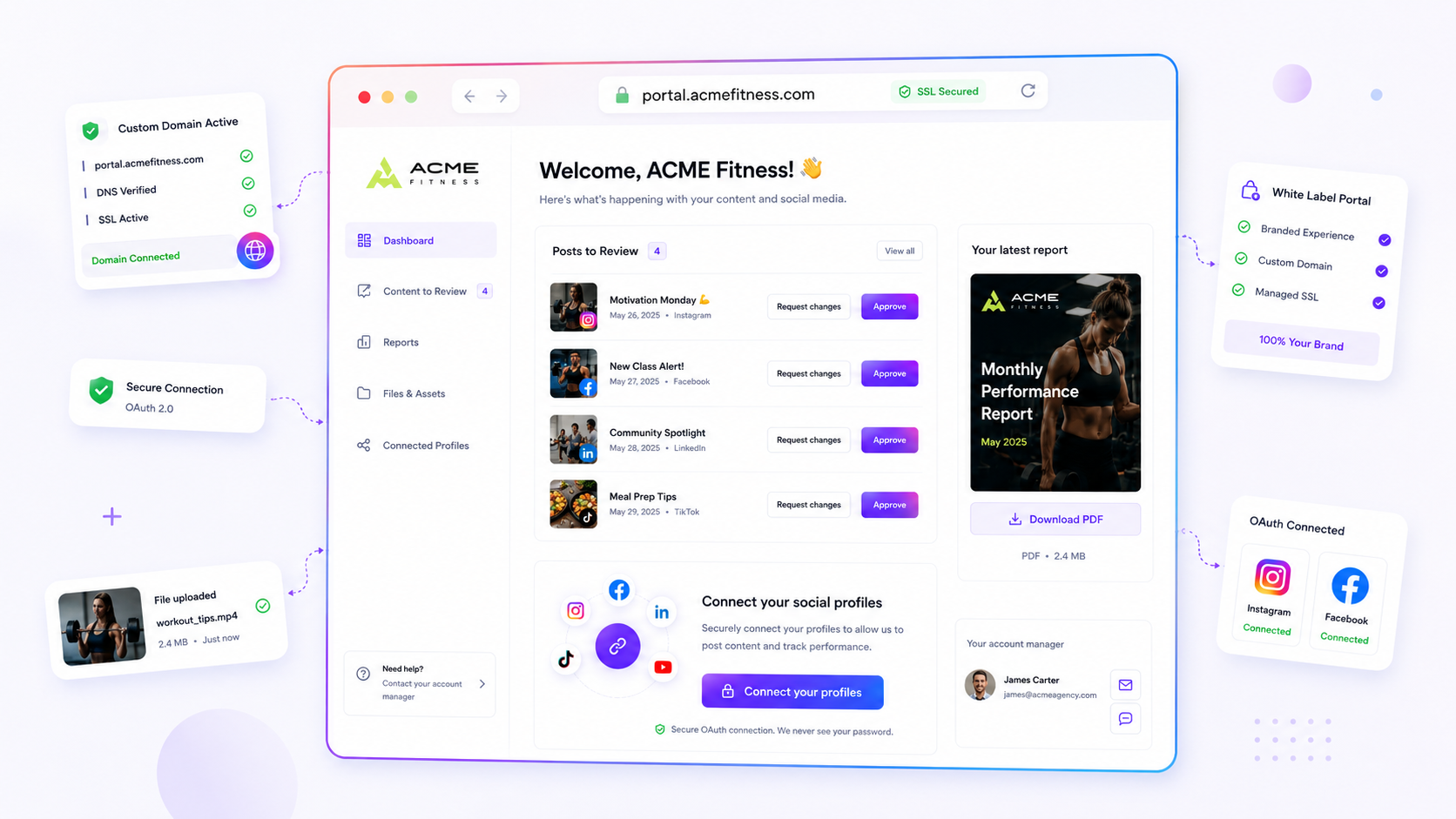
The best custom domain software for multi-brand social teams isn't about hosting; it’s about total surface ownership. If you are managing portfolios across dozens of channels, ensure every link-in-bio page and brand portal feels like a seamless extension of the client’s identity, not a vendor's subdomain. Scaling social is messy-juggling brand guidelines, deadlines, and the pressure to publish more. Watching your team struggle with fragmented URLs or broken SSL checks is an avoidable headache. You are building a powerhouse experience, not a directory of vendor subdomains. Your infrastructure must guarantee that your brand, not the platform's, stays front and center. It’s time to stop letting technical friction dictate your brand strategy.
What the best tools need to handle

Enterprise-grade domain management moves the needle from "it works" to "it scales." When you are responsible for hundreds of profiles across dozens of brands, you cannot afford to treat domain configuration as a manual, ticket-driven process. The bottlenecks here aren't just technical; they are operational.
To truly streamline your workflow, look for a platform that handles these core pillars of infrastructure internally:
- Asynchronous DNS Verification: Stop manual ping-pong with IT. A robust tool should automatically validate that a custom domain points to the configured target, providing status updates without requiring you to refresh a browser every thirty seconds.
- Automated Managed SSL Lifecycle: Manual certificate renewals are the fastest way to break a campaign. You need a system that provisions managed certificates, polls SSL states, and handles renewals silently in the background. If you are still setting calendar reminders to check SSL status, you are working too hard.
- Flexible Target Assignment: Your domain strategy needs to be fluid. A top-tier tool lets you assign an active, verified domain to any target-whether it’s a specific link-in-bio page for an influencer campaign or a comprehensive brand portal-without needing to redeploy or re-verify.
Decision check: Can your team connect a new client-owned domain, verify DNS, and provision SSL in under 10 minutes without opening a support ticket? If not, the platform is acting as a bottleneck to your growth.
When domain management is treated as a core service, it eliminates the "coordination debt" that slows down onboarding. Instead of waiting for tech approval for every new brand asset, you enable your team to self-serve secure, branded surfaces at speed. This is where operations transition from being a reactive, troubleshooting department to a proactive, scalable engine.
Where basic tools start to break

Most "link-in-bio" tools are built for a single creator who owns one brand identity. They work perfectly when you have one account, one domain, and one target.
But that is not the reality of enterprise marketing.
When your team scales to managing dozens of brand identities, markets, or client portfolios, the cracks in these "simple" tools become massive operational sinkholes. You start seeing the same patterns:
- The SSL Expiry Trap: You set up a domain months ago, forgot about it, and suddenly a campaign goes live to a "Connection Not Secure" error. Now you are scrambling to manually fix certificates while the campaign traffic drops to zero.
- The DNS Bottleneck: New brand launch? Time to open a ticket with IT, wait for a propagation window, and cross your fingers that the DNS records stick. If the tool does not verify this instantly, you are burning time you do not have.
- Fragmented Brand Experience: When your audience clicks a link and sees a third-party vendor domain instead of the brand name, you lose trust. It signals that your brand experience is outsourced, not owned.
The "spreadsheet of shame" becomes inevitable here. You know the one: it is the master list of domains, expiry dates, and manual workarounds that someone has to update every week just to keep the lights on.
Treating domain management as a "set it and forget it" task is a common trap. For an enterprise, it is a living infrastructure that requires constant validation and automated renewal.
The buying criteria that matter
If you are moving away from basic, manual-heavy tools, you need to look for features that treat domain management as automated infrastructure, not a simple redirect.
The goal is total surface ownership. This means your link-in-bio pages and brand portals look and act exactly like part of the brand domain.
Here is how to evaluate the tools currently on your shortlist.
Enterprise Domain Capability Matrix
| Feature | The "Simple" Tool | The Enterprise Standard |
|---|---|---|
| DNS Verification | Manual/Delayed | Instant validation via API |
| SSL Lifecycle | Manual renewal/monitoring | Automated provisioning + auto-renew |
| Surface Flexibility | Single-use only | Swap domains between Portal/Bio |
| Ops Load | High (Tickets required) | Low (Self-service workflow) |
What to prioritize
When you are evaluating options, ignore the "number of links" or "custom background" marketing fluff. Focus on these three metrics instead:
- Asynchronous SSL Provisioning: Does the tool automatically request, install, and monitor certificates? If you have to intervene when a certificate expires, the tool has failed.
- Routing Flexibility: Can you assign the same white-label domain to a link-in-bio page today and a brand portal tomorrow? This is the definition of flexible infrastructure. At Mydrop, we built our host dispatch layer to handle this natively because we know that brand requirements shift faster than developers can update code.
- Target Assignment Speed: How long does it take to connect a client-owned domain to a new surface? If it takes more than 10 minutes, you are building a coordination bottleneck.
Ultimately, the right software should be invisible to your audience and highly transparent to your team. If your tool keeps you updated on DNS status and SSL health proactively, you have found the right foundation. If you are still chasing approvals or manually checking links at 6 p.m., the tool is not working for you, you are working for the tool.
How Mydrop supports this workflow
We built the custom domain infrastructure at Mydrop to solve exactly the type of bottleneck you are facing. The goal is not just to let you connect a URL, but to make that connection invisible to the end user while giving your team total control.
When you bring a new brand into the platform, the system treats that domain as a first-class asset. You enter your domain, and the system runs the DNS check immediately. We know that waiting for a support ticket or an IT team to verify a record is how campaigns die, so we made that verification process instantaneous.
Once the DNS is verified, the platform moves to managed SSL provisioning. You do not need to hunt for certificates, copy-paste private keys, or manage renewals in a separate service. Everything is handled asynchronously. If a certificate needs a refresh or if the system detects an error, you get notified rather than finding out because a user clicked a broken link.
The real flexibility comes in target assignment. Because Mydrop decouples the domain from the surface, you can map the same white-label domain to a link-in-bio page today, then flip it to a fully-featured brand portal tomorrow without re-configuring your DNS. The host dispatch logic treats the domain as a pure pointer, giving you the freedom to move your client-facing surface based on your campaign strategy, not your technical limitations.
This means you spend your time on brand identity, not troubleshooting record propagation. You are not just managing links; you are managing a stable, secure, and branded experience that grows with your portfolio.
A simple shortlist checklist
Use this checklist when you are evaluating a tool's capability to handle multi-brand domain management. If a candidate tool fails more than two of these, it will become a liability as your team grows.
- SSL Automation: Can it provision and renew SSL certificates entirely without your intervention? If the process requires manual key uploads or external tools, pass on it.
- DNS Verification Speed: Does the tool provide immediate feedback on DNS status? You should know within seconds if your records are correctly pointed.
- Cross-Surface Mapping: Can you swap a domain between different page types, such as a link-in-bio target and a dedicated brand portal, without needing to delete and recreate the domain record?
- Zero-Ticket Onboarding: Can a non-technical brand manager initiate and complete the entire connection workflow without requiring a request to your internal IT or DevOps team?
- Error Reporting: Does the tool proactively alert you if a domain or certificate status changes, rather than waiting for you to notice a broken link in a production campaign?
If you are currently managing this through a patchwork of subdomains, redirected pages, and manual DNS entries, the cost of that technical debt is likely higher than you realize. It is not just the time lost to manual configuration. It is the risk of a campaign going live with broken links, the friction of onboarding new brands, and the constant, nagging feeling that your team is one configuration error away from a public-facing failure.
Conclusion
The decision to move to enterprise-grade, white-label domain management is usually the moment teams stop acting like a collection of disconnected accounts and start acting like a unified brand engine. Stop patching together fragmented, vendor-owned URLs and start building surfaces that actually reflect the strength and maturity of your brand portfolio.
The right tool should disappear into your workflow. It should handle the complexity of DNS, SSL, and routing so your team can focus on the only work that actually delivers value: creating and distributing brand experiences. If your current tool is creating more work than it saves, you are holding onto a bottleneck disguised as a solution. Make the switch, clear the path, and stop apologizing for broken links.