The best AI video tool for multi-brand teams isn't defined by the highest resolution. It is defined by how fast it eliminates the "approval lag" and "handoff debt" that turn 5-minute generations into 3-day bottlenecks. If you are downloading a video from one AI playground only to upload it to Slack for a brand lead's "thumbs up," you haven't gained efficiency, you have just moved the bottleneck. The right tool is a brand-aware engine that lives where the work is actually approved and scheduled.
We have all been there: a trend starts peaking, you generate the perfect 10-second clip in 30 seconds, and then… you wait. You DM the link, follow up twice, and by the time the brand lead sees it between meetings, the window has closed. It is messy, it is frustrating, and it turns creative energy into administrative dread. We get it. No one enjoys chasing approvals at 6 p.m. for a video that took less time to create than a cup of coffee. You will walk away with a rubric to evaluate tools based on operational flow, ensuring your next choice reduces campaign debt rather than adding to it.
What the best tools need to handle

In a multi-brand environment, video production doesn't happen in a vacuum. You aren't just making a "cool clip," you are managing an asynchronous task that needs to be verified, attached to a specific campaign, and tracked against a budget. The best tools treat video as a task status, not just a file download.
When you are operating at scale-say, managing three different brands with five different approval tiers-the tool must handle the "poll and attach" flow automatically. You shouldn't have to sit and stare at a loading bar. You should be able to trigger a generation, move on to your next task, and have the system notify you when the media is ready to be verified and applied to your media plan.
Here is where it gets messy for most teams. If your tool doesn't have a way to track workspace quotas in real-time, you end up with "quota shock." One creator burns through the entire month's credits on a Tuesday morning, and by Wednesday, the rest of the team is paralyzed.
Operator rule: If a piece of media requires more than two manual transfers (e.g., download > Slack > upload > schedule), the tool is failing the system.
The Diagnostic Cause Map
Before you buy another subscription, use this map to find where your current video production is leaking time:
| Bucket | The Culprit | Why it slows you down |
|---|---|---|
| Workflow | Missing "Verify & Apply" | Forces manual verification outside the tool. |
| Creative | The "Brand Gap" | AI ignores brand colors, requiring manual edits. |
| Technical | The Quota Silo | Credit tracking isn't visible to the whole team. |
| External | Platform Friction | Format errors only appear after you pay for the render. |
At Mydrop, we have seen this across thousands of workflows: social media scale usually fails from coordination debt, not a lack of ideas. The goal is to move from "generating content" to "orchestrating media."
Where basic tools start to break

Basic tools are built for the hobbyist sitting in a coffee shop, not a social lead managing five different brand voices across three time zones. Most AI video generators fall into the "Single Creator Trap." They work beautifully when one person is playing with prompts, but the moment you add a second brand, a third stakeholder, and a 48-hour approval window, the system collapses into a spreadsheet-shaped crime scene.
The first thing to snap is usually quota visibility. In a basic tool, credits are a black box. You have no idea if your agency partner just blew the month's video budget on "speculative concepts" until the "Balance: 0" notification hits right before a major campaign launch. Without workspace-level tracking, you aren't managing a team; you're just hoping nobody clicks "Generate" too many times.
Then comes the "Download/Upload" Carousel. If your workflow involves downloading a 100MB video from an AI playground, uploading it to Slack for a brand manager's review, then downloading it again to upload it into your scheduler, you've inherited a part-time job as a file courier. Every manual transfer is a chance for the wrong version to get published or for a brand lead to lose the link in a sea of DMs.
Finally, there is the issue of brand amnesia. Basic tools treat every prompt as a blank slate. They don't remember that Brand A uses a specific color palette or that Brand B has a strict "no-slow-motion" policy. Without brand-aware guardrails, your team spends more time fixing AI hallucinations in post-production than they would have spent just filming the content themselves.
The buying criteria that matter
When you're shopping for the "best" tool, stop looking at the demo reels. They all look great when the prompt is "cinematic sunset." For a multi-brand operator, the real winners are defined by asynchronous integrity and workflow stickiness.
You need to know exactly how the tool handles a 90-second render. Does it force you to keep the tab open like it's 2005? The best tools treat video generation as a background task status. You should be able to request a video, go grab a coffee, and have the finished asset automatically attached to your post draft once the callback is complete.
Here is a rubric to help you separate the toys from the tools:
The Multi-Brand AI Video Decision Matrix
Use this scorecard to evaluate your current stack. If you're scoring under 15 points, you're likely accumulating "campaign debt" that will eventually stall your production velocity.
| Criteria | Enterprise Weight | The "Red Flag" (Score: 1-2) | The "Green Flag" (Score: 4-5) |
|---|---|---|---|
| Workflow Loop | 30% | Manual download/upload between 3+ tools. | One-click "Apply to Post" within the composer. |
| Quota Control | 25% | Individual logins; no shared visibility. | Workspace-level counters for all users. |
| Brand Guardrails | 20% | Generic outputs; requires manual color grading. | Context-aware prompts that respect brand assets. |
| Job Stability | 15% | Tasks "hang" or disappear if the tab closes. | Robust polling/callbacks for async completion. |
| Approval Flow | 10% | External links; feedback lives in email/Slack. | Inline "Verify and Apply" steps for managers. |
Decision Rule: Any tool that scores a 1 in Workflow Loop is a "No-Go," regardless of how good the pixels look.
At Mydrop, we have seen this play out across thousands of workflows. The teams that scale aren't the ones with the "smartest" AI; they are the ones who integrated the AI into their existing approval logic. If the video generation doesn't live inside your Media Plan Review flow, it's just another silo to manage.
Look for a system that treats video as a status update, not just a file. When the tool handles the "poll and attach" logic for you, it eliminates the need for your team to babysit the render. You want a tool that lets you move from "Idea" to "Approved" without ever touching your Downloads folder.
The hidden truth of multi-brand social is that coordination is more expensive than creation. Choosing a tool that respects your team's time is the only way to stay ahead of the content curve without burning out your best operators.
How Mydrop supports this workflow
The best tools treat video as a task status, not just a file download. At Mydrop, we see this coordination debt play out every day. Teams don't just need a "Generate" button; they need a way to keep the line moving while the AI does the heavy lifting.
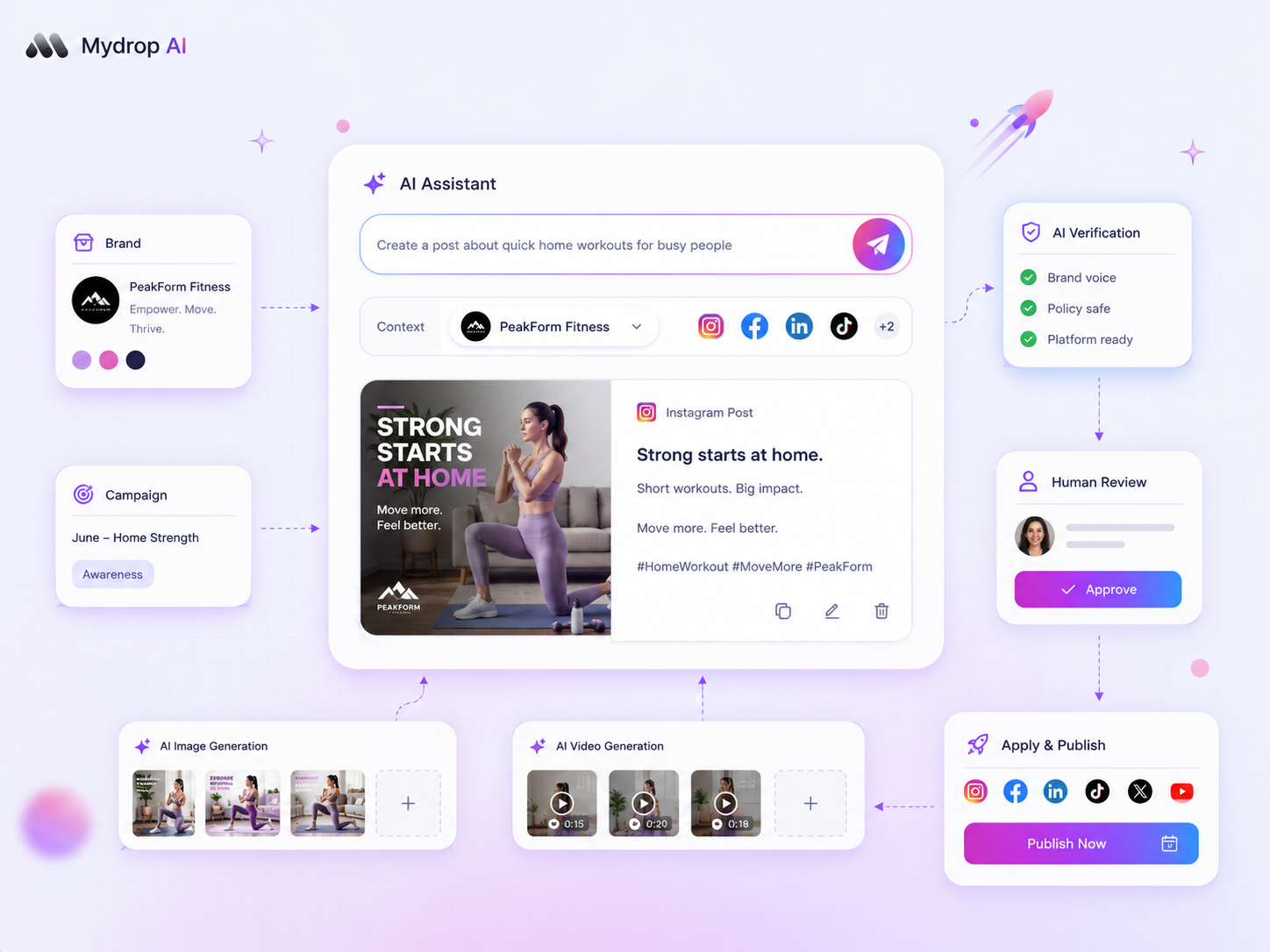
We built the AI Media Panel to solve the "loading bar stare." When you request a 10-second clip, the system creates an asynchronous media job. You don't sit and wait. You finish the caption, tag the stakeholders, and set the campaign tags. The system polls the task status in the background and attaches the completed video to your post the second it is ready. It is the difference between watching water boil and having a chef text you when the meal is plated.
The real magic happens during the Media Plan Review. For multi-brand teams, "Brand A" might have a different approval tier than "Brand B." Our verification flow allows a lead to review the planned media items in a single view. You can verify and apply a whole week of AI-generated content in a few clicks, ensuring that the "media plan" actually matches the brand guardrails before anything hits the queue.
We also keep the "credit chaos" at bay with workspace-wide quota tracking. Instead of every creator having their own login and credit card for five different AI tools, the usage is tracked at the workspace level. It is transparent, it is predictable, and it means no one is getting locked out of their account ten minutes before a launch because a "personal" credit limit was hit.
A simple shortlist checklist
If you are evaluating a new tool this week, stop looking at the resolution and start looking at the handoff points. Use this matrix to see if a tool is built for a solo creator or a high-volume enterprise team.
| Operational Check | The "Silo" Tool (Avoid) | The "Zero-Handoff" System (Buy) |
|---|---|---|
| Media Persistence | Files live on the creator's local hard drive. | Completed jobs write directly to a shared media library. |
| Approval Flow | "DM me the link when it's done." | Integrated "Verify and Apply" status in the calendar. |
| Status Tracking | You have to refresh the browser to see progress. | Automated background polling and notifications. |
| Brand Safety | Every prompt is a "guess and check" exercise. | Preset brand colors and context are applied to all tasks. |
| Resource Visibility | Usage is hidden in a single-user dashboard. | Real-time workspace counters for images and videos. |
Decision check: If a video requires more than two manual "movements" (e.g., download from tool A, upload to Slack, download from Slack, upload to scheduler), you are paying a "coordination tax" that will eventually bankrupt your team's schedule.
Before you sign a contract, put the tool through the 48-Hour Stress Test:
- Can a brand manager who didn't write the prompt still find the original file?
- Does the tool notify the "next person in line" when a render completes?
- If the AI hallucinates a weird background, can you "reject" the task and trigger a re-roll without leaving the dashboard?
Conclusion
At the end of the day, your social team isn't a film studio; you are a distribution engine. The "best" AI video tool is the one that disappears into your existing workflow. It shouldn't be another destination you have to visit; it should be a capability that lives right where you are already doing the work.
We have seen thousands of workflows, and the teams that win are never the ones with the flashiest gadgets. They are the ones with the clearest pipes. When you remove the manual downloads, the frantic Slack follow-ups, and the "who has the password?" drama, you give your team the space to actually be creative again.
Stop chasing the highest frame rate and start chasing the shortest loop. Your schedule-and your brand leads-will thank you.