If you are waiting for AI to fix your content bottleneck, you are looking at the wrong end of the machine. The real friction in enterprise social media is not coming up with ideas, it is getting them through the gauntlet of approvals, brand checks, and platform requirements. Stop buying "Generative AI" and start buying "Verification AI." An assistant that can draft a post but cannot verify it against your live workspace brands, media plans, and automation triggers is not a teammate; it is just another source of coordination debt. In our experience, if your tools do not let you draft, verify, and apply, you are just moving the manual labor around, not eliminating it.
We get it. You are tired of chasing stakeholders on Friday afternoon for a post that was supposed to go live on Wednesday. The creative feedback loop has become a graveyard where good campaigns go to die, buried under endless threads of "can we tweak this hook" and "did we check the brand guidelines?".
What the best tools need to handle

Most AI tools treat content generation as the finish line. The awkward truth? That is where the real work-compliance, brand alignment, and technical verification-actually begins. When you manage dozens of brand profiles and hundreds of stakeholders, you do not need more drafts; you need a system that ensures the draft is actually ready to go.
To spot the difference between a glorified spellchecker and a true operational partner, use this matrix to audit your current stack.
| Feature | Basic AI Writer | Mydrop AI Assistant |
|---|---|---|
| Context | Generic Prompting | Workspace-Aware (Brands/Media/Analytics) |
| Artifacts | Plain Text | Structured Objects (Post, Brand, Campaign) |
| Workflow | Copy/Paste | Verified "Apply" Paths |
| Safety | None | Pre-application Verification Routines |
The takeaway is simple: if an AI tool forces you to take its output and manually check every compliance box, you have not saved any time. You have just added a new step. At Mydrop, we see the most successful teams using assistants that function as an operating layer, not just a creative spark. They move from a vague request to a structured artifact that the platform understands. That is the shift from "generating" to "executing."
Where basic tools start to break

Here is the awkward truth: if your AI assistant lives in a browser tab isolated from your actual workspace, it isn't an assistant. It is a sophisticated distraction engine.
Most AI tools on the market are built for the ideation phase. They are fantastic at generating a list of catchy hooks or a week's worth of generic captions. But the moment you need to move that text into a production environment-where you have specific brand guidelines, defined media plans, active automation triggers, and a strict compliance workflow-these tools stop helping and start creating technical debt.
When you use a generic writer, your team falls into the "copy-paste-correct" cycle. You generate a draft, manually copy it into your scheduler, realize the tone is slightly off, manually edit it to fit your brand persona, check the character limits, re-upload the correct image asset, and then email it to a stakeholder for approval. You haven't saved time; you have simply moved the friction from the blank page to the editing room.
Common mistake: Treating AI output as a finished product rather than a raw, unverified input. If you are not verifying the output against your actual account context, you are shipping blind.
In our experience across hundreds of brand profiles, this disconnect is exactly where approval loops stall. The reviewer isn't just checking the idea; they are essentially forced to act as an editor, a brand custodian, and a technical QA engineer all at once. When a draft doesn't align with the reality of your workspace, the process doesn't just slow down-it grinds to a halt.
The buying criteria that matter
Stop evaluating AI tools based on how "smart" their prompts are and start evaluating them based on how well they integrate into your actual operating reality. You need to shift your focus from generation to coordination.
To move past the bottleneck, use this scorecard to evaluate whether a platform is building a true operational partner or just adding another layer of manual work to your team's plate.
The Enterprise AI Readiness Scorecard
| Criteria | Basic AI Tool | Enterprise-Ready Partner |
|---|---|---|
| Context Awareness | Generic, prompt-based | Workspace-grounded (pulls live brands/assets) |
| Output Type | Plain text blobs | Structured artifacts (ready to apply) |
| Validation | None (you spot the errors) | Pre-application verification routines |
| Workflow Path | Copy/Paste | Direct, verified Apply paths |
| Risk Profile | High (human error in manual transfer) | Low (system-checked constraints) |
When you look at this scorecard, the differentiator is always the "Apply" path. A true enterprise-grade assistant doesn't just give you a block of text and leave you to fend for yourself. It treats the draft as a structured product object that the system can actually understand, audit, and verify before anyone hits the publish button.
Decision check: Does this tool allow me to verify an AI draft against my specific brand, automation, or media plan before it becomes a task in my schedule? If the answer is no, keep looking.
Teams managing high-volume operations cannot afford to guess. You need an assistant that treats verification not as an optional final step, but as a mandatory gate in the workflow. If it isn't verifying your drafts against the live reality of your account, it is just adding noise to an already chaotic week.
How Mydrop supports this workflow
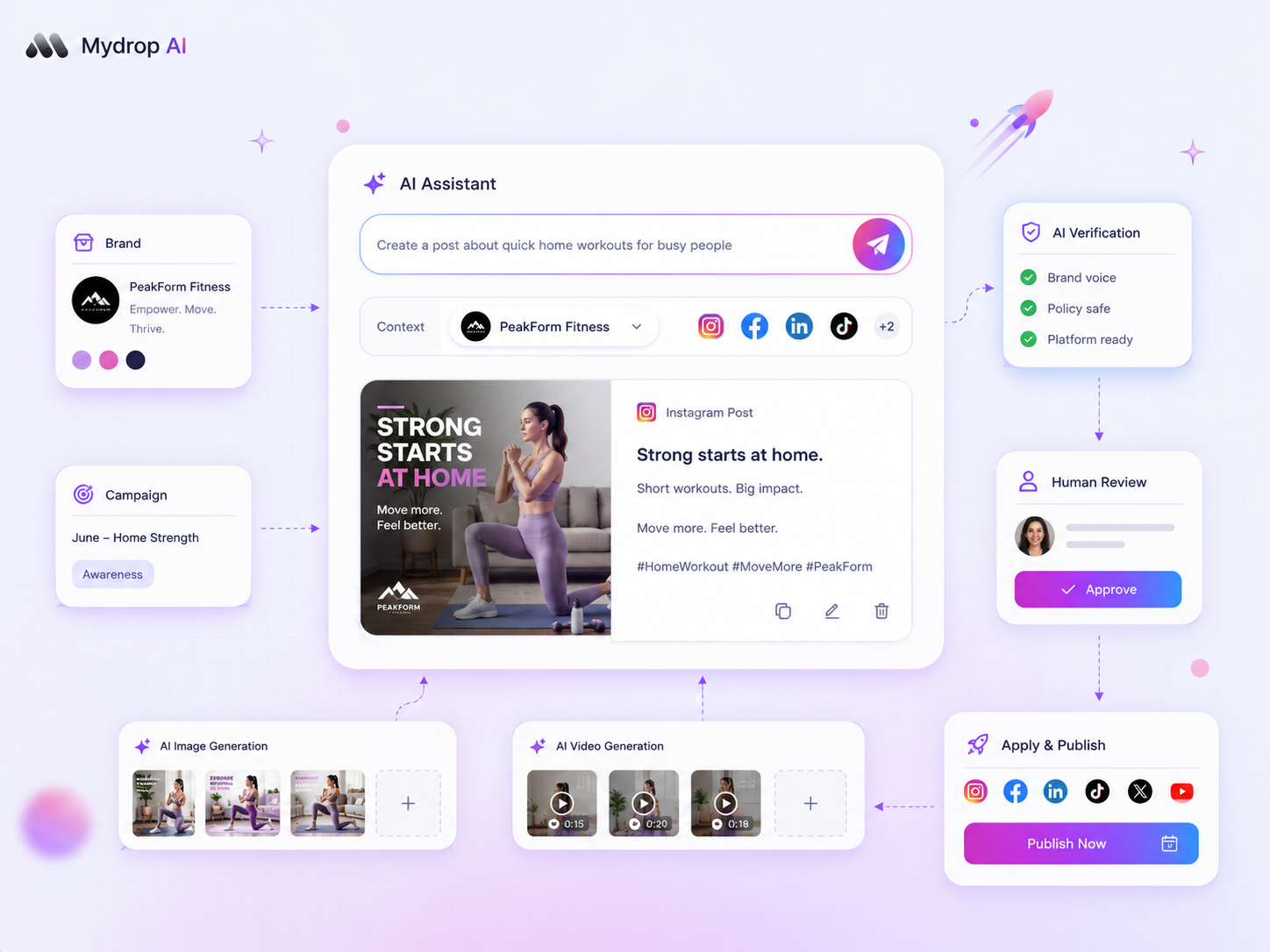
At Mydrop, we built our AI Assistant Agent to turn "creative drafting" into "operational execution." Instead of just handing you a block of text, it operates as a workspace-aware partner. When you ask it to draft a campaign, it isn't guessing your brand tone; it pulls from your actual brand guidelines, past top-performing posts, and your current library of media assets.
Here is where the transition from "draft" to "apply" actually happens:
- Context-Grounded Drafting: The agent doesn't work in a vacuum. It uses your team's knowledge documents-your specific messaging, conversion hooks, and tone guides-to ensure the draft starts at 90% accuracy, not 0%.
- Structured Artifacts: Rather than dumping plain text in a chat, the agent outputs structured objects. Whether it’s a post, a campaign skeleton, or an automation setup, these are objects the Mydrop platform recognizes, reviews, and stores as part of your content project.
- Built-in Verification: This is the game-changer. Before you even think about applying a post, the assistant runs a verification routine. It checks for compliance issues, missing media, or brand rule violations. You are not just reviewing creative; you are reviewing a verified asset that is ready to enter your production pipeline.
In our experience, teams managing hundreds of brand profiles often see the biggest relief here. They aren't struggling to find ideas; they are struggling to maintain governance. By forcing the AI to go through a verification routine before becoming a "drafted post," we remove the guesswork and the potential for a rogue, off-brand post slipping through.
A simple shortlist checklist
If you are vetting AI assistants, stop looking at how fast they write and start looking at how well they fit into your actual machinery. The best tool for your team should reduce coordination debt, not add to it.
Use this checklist to score your next vendor demo. If they cannot answer "yes" to these four questions, you are likely buying a distraction engine, not an operational partner.
| Feature | What to look for | The "Run Away" Red Flag |
|---|---|---|
| Brand Awareness | Deep integration with my style guides, media, and past post data. | Relies solely on generic internet-wide prompt data. |
| Output Type | Structured objects (Post, Campaign, Link, Automation). | Outputs only plain text blocks I have to manually map. |
| Verification | Native check routines to flag issues before I apply the draft. | "Just trust the AI, it's perfect." |
| Operational Path | A clear "Apply" button that moves output into the production workflow. | Requires copy-pasting into a separate system. |
Workflow check: If the tool requires your managers to copy-paste, double-check, and reformat everything, it is not an AI assistant. It is just an expensive autocomplete engine.
Conclusion
The most successful teams we see today have stopped treating AI as a magic shortcut and started treating it as a new team member that needs clear guidelines. They have embraced the reality that creative generation is the easiest part of the job; ensuring that generation is brand-safe, compliant, and ready to publish is where the real work happens.
Stop searching for the AI that writes the "catchiest" caption. Start searching for the AI that understands your brand rules well enough to stop you from publishing something you'll regret.
Your bottleneck isn't the blank page. It’s the friction of getting the right content from a spark of an idea to a live, verified post. Fix the workflow, and the output will follow.