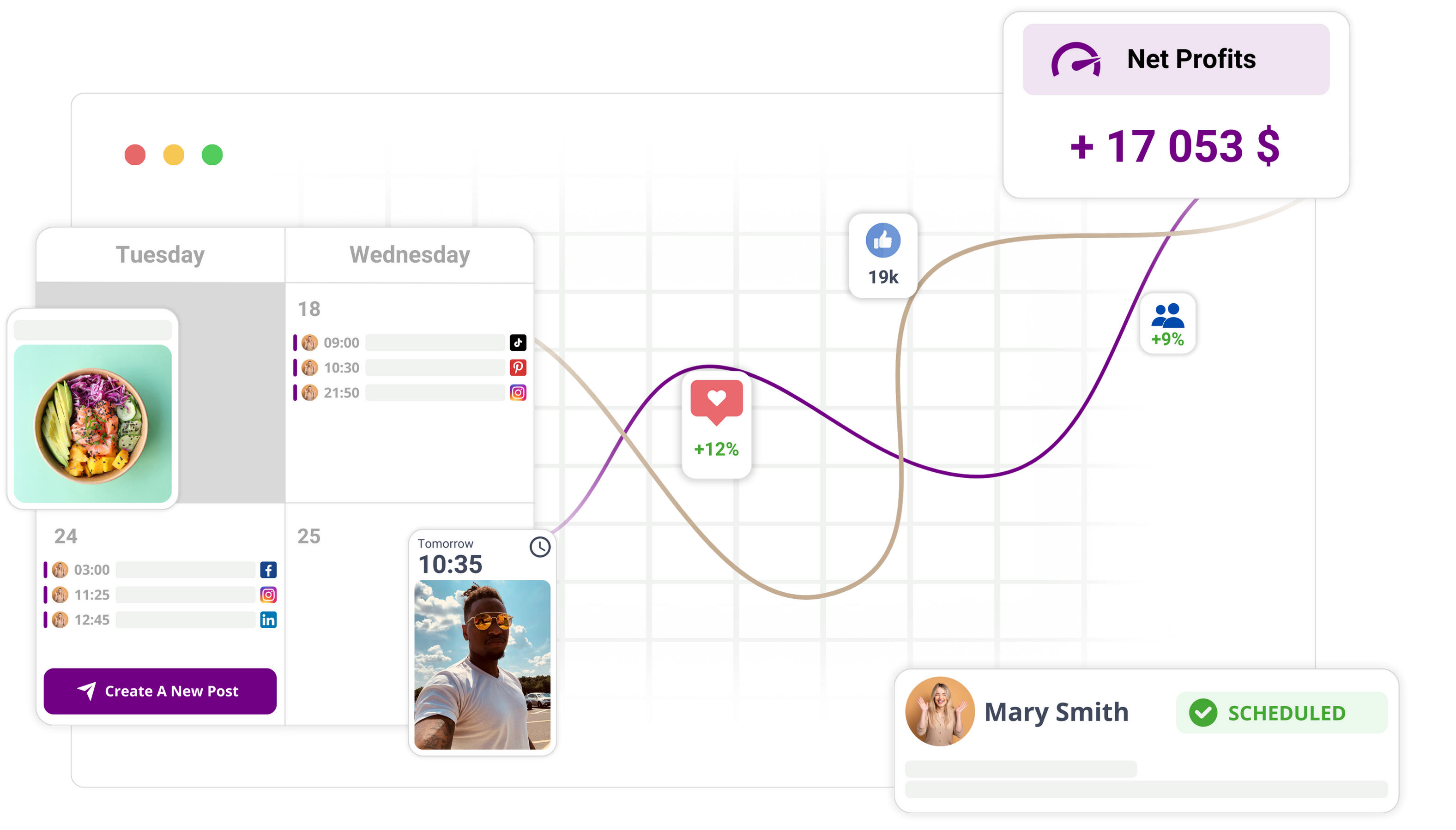

Your biggest social campaign launched at 9:00 AM-but for half your audience, it hit at 3:00 AM while they slept, and for the other half, it vanished into the Friday night noise. You burned the midnight oil perfecting the creative and setting the copy, only to have the algorithm bury your best work because it landed in an engagement graveyard.
There is a specific kind of exhaustion that comes from manual calendar math across ten different regions. It is the feeling of watching a perfectly crafted post land at the absolute wrong moment, knowing your team did the work but missed the window. It turns your social operation into a high-stakes guessing game rather than a strategic engine.
TLDR: The 30-Second Fix: Standardize your core publishing workspace timezone to match your primary market, then use platform-specific adjustments for outliers. Stop doing the mental gymnastics and let your tools handle the drift.
The reality is that timezone errors are not just "human error" or simple mistakes. They are an architectural failure of your current stack. If your team is doing math instead of creating, your social strategy is already failing.
The real problem hiding under the surface

We tend to treat timezone management as a secondary concern, something that gets sorted in the final click of the "Publish" button. This is where scaling volume amplifies the drift. When you manage ten accounts across five timezones using scattered tools, you aren't just managing content; you are managing a coordination debt that grows every time you add a new market or channel.
The real issue: Most teams treat time as a constant, but your operations are inherently global. Using tools that require you to manually convert UTC to local time for every single post is a recipe for fractured engagement and brand inconsistency.
Consistency isn't about posting the same content everywhere; it's about being present everywhere at the right moment. When you lose control of the clock, you lose control of the conversation. Your content hits when the audience is offline, your brand signals look disconnected, and your analytics-if you are even looking at them-are skewed by the sheer noise of misaligned delivery windows.
To break this cycle, you need to stop thinking about time as a per-post variable and start thinking about it as a workspace foundation.
Here is how to audit your current state before it costs you another campaign:
- Audit your primary engine: Does your team default to your headquarters timezone for everything, or does each market dictate its own scheduling reality?
- Identify the "Dead Zones": Map out which of your high-priority regions are currently receiving content outside of their peak engagement windows.
- Evaluate your tools: Can your current setup handle a multi-brand, multi-region calendar without forcing your team to open a timezone converter in a separate browser tab?
Global-Ready Operations
When you shift from manual calculation to a unified, centralized clock, you aren't just saving time-you are reclaiming the impact of your brand. You stop worrying about whether the London team is accidentally posting on Eastern Standard Time and start focusing on whether the content itself is actually resonating with the local audience.
Moving to a unified calendar control means your team can finally stop playing "calendar tetris." Instead, they can focus on the nuance of the creative, ensuring that the message is as sharp as the timing. It is the only way to scale social operations safely, ensuring that your team's hard work doesn't evaporate because of a simple, preventable scheduling error.
Ultimately, your social strategy lives or dies by the relevance of your delivery. If you are not present when your audience is ready to engage, the quality of your content is moot. You have to bridge that gap by aligning your architecture with your ambition.
Why the old way breaks once volume rises

Scaling is the point where manual coordination turns into coordination debt. When your team manages two accounts for a single brand, timezone management is a mental annoyance you can solve with a sticky note or a quick mental conversion. When you scale that to twenty brands across six timezones, the overhead of constant calculation becomes a full-time job-and a dangerous one.
The traditional "Excel and Platform" approach relies on individuals remembering which timezone a specific dashboard uses, or worse, manually shifting publication times to account for Daylight Savings transitions.
Most teams underestimate: The cumulative cost of context-switching between a spreadsheet of local times and the native scheduling input of five different social platforms. It is not just the five minutes spent calculating; it is the hidden cognitive load that leads to a "good enough" publishing time rather than the optimal one.
The friction matrix of legacy workflows
| Feature | Legacy Way (Spreadsheet/Native) | Mydrop Unified Way |
|---|---|---|
| Source of Truth | Scattered across tabs | Single workspace clock |
| Daylight Savings | Manual recalculation | Automatic system adjustment |
| Cross-Platform | Fragmented per-network UI | One-click multi-platform sync |
| Auditability | Invisible (lost in email/chat) | Transparent calendar history |
The result of the legacy model is almost always a slow-motion collision. Your creative team produces high-quality assets, but the operations team-buried under dozens of manual scheduling steps-starts taking shortcuts. They stop adjusting for local engagement peaks. They stop checking if a "First Comment" feature aligns with the local audience’s morning commute. They start "batching" by their own office hours rather than the audience's reality.
This is where the "Guesswork Gap" takes root. You stop publishing for your audience and start publishing for your team's convenience.
The simpler operating model

If your team is doing math instead of creating, your social strategy is already failing. The only way to stop this is to stop treating time as a variable you solve for every single post.
Instead, adopt the principle: "Centralize the Clock, Decentralize the Content."
By using a workspace-wide timezone control, you treat your central hub as the master clock. You do not calculate "8 AM London time" at 2 AM in your local office. You set the workspace to the target market's timezone, and you schedule as if you are sitting at that desk.
- Map your core markets: Define the three primary timezones where 80 percent of your audience lives.
- Align the workspace: Switch your Mydrop workspace to the primary market timezone to anchor your team's perspective.
- Template the rhythm: Save reusable post templates that include local-market publishing constraints, so you do not have to redefine "best time to post" for every new asset.
- Final audit: Review your planned content against the unified calendar view before hitting save, ensuring regional gaps are filled without manual math.
Operator rule: Never manually convert times during the composition phase. If you are doing manual conversion, the system has already failed you.
This shift changes the team's role from "data calculators" to "strategy executors." When you use a unified calendar, you can visually spot gaps in your coverage-like an entire region sitting silent on a Tuesday-that are invisible when you look at isolated platform reports.
Consistency is not about posting the same content everywhere; it is about being present everywhere at the right moment. By pulling your team out of the weeds of manual conversion, you give them the bandwidth to actually look at the metrics in your Analytics dashboard and decide which regions need more attention next month.
When you remove the friction of the clock, the only thing left to focus on is the quality of the conversation.
Where AI and automation actually help

Technology should not be another layer of coordination debt; it should be the thing that removes it. You do not need an algorithm to rewrite your captions or a bot to suggest "engaging" hashtags. You need automation that acts like a relentless operational assistant, ensuring your content calendar stays anchored to reality while your team focuses on the narrative.
When you centralize your workspace timezone, you stop the manual labor of converting UTC to local market time. AI in this context is simple utility: it validates the gap between your intended publish time and the actual audience peak. It flags when a global campaign configuration-built in your home office-is set to hit a desert of engagement in a critical growth market.
Operator rule: Automation should never make a decision for you; it should only provide the visibility required to make an informed one.
Think of it as a sanity check that lives in your calendar. If you attempt to schedule a post for 10:00 AM in New York, and your target market is Sydney, the system doesn't just block it-it shows you the misalignment instantly. By shifting the "math" to the background, you free your team to treat every post as a deliberate, global connection rather than a rushed translation of a local idea.
The metrics that prove the system is working

Success in a global, multi-brand environment isn't measured by how much noise you make, but by how precise your presence is. When you strip away the chaos of timezone-math, you are left with the true indicators of social health.
KPI box: Track the Audience Synchronization Rate. Aim for 85% of high-impact posts to land within 60 minutes of your target local demographic's peak engagement window.
If this number is low, your content isn't the problem-your architecture is. You can write the best copy on earth, but if it drops when your audience is asleep, you are effectively shouting into a vacuum.
Common mistake: Measuring success by global total impressions instead of per-market performance. Aggregate metrics often hide the fact that your campaign is booming in one region while completely missing the mark in three others.
Here is how to audit your team’s readiness for high-volume, cross-market publishing. Run this check every quarter, or whenever you add a new brand or channel to your workspace.
- Workspace Baseline: Ensure the primary workspace timezone reflects your operational headquarters, not a default setting.
- Regional Peak Map: Document the top 3 peak engagement hours for each primary market you serve.
- Calendar Overlays: Verify that your social calendar allows for regional views, not just a single "global" timeline.
- Template Audit: Review your recurring campaign templates to ensure they contain regional-specific timing buffers.
- Reporting Alignment: Confirm that your analytics dashboard is aggregating data by the local market's clock, not just your team's local time.
By shifting from "manually scheduling everything everywhere" to "centrally managing the clock," you move the bottleneck from the calendar to the creative. When the system handles the logistics, your team can return to the work that actually justifies your brand’s presence in the feed. The goal is simple: be a local, everywhere. Anything less is just a waste of good content.
The operating habit that makes the change stick

The most effective way to lock in this new workflow is to stop treating time as an abstract variable your team calculates on the fly and start treating it as a defined resource at the workspace level. When you treat the workspace timezone as the absolute, non-negotiable anchor for every campaign, you offload the cognitive weight of manual conversion from your staff.
If you are running a multi-brand agency or managing global channels, your team should never be performing timezone math in their head or via a spreadsheet while they are in the middle of a post composer. That is exactly where the friction lives. Instead, set your workspace clock to the primary market of that specific brand or region. Once that anchor is set, the system handles the delta.
Operator rule: Every member of your team should have a clear, documented "Home Time" for every active workspace they manage. If the workspace is for a UK-based campaign, the team works and schedules against London time, regardless of where they are physically sitting.
This is the shift from managing individual post times to managing market-specific calendars. When you move your team to this model, you remove the "is this 5:00 PM EST or GMT?" ambiguity that kills momentum and leads to bad publishing data.
To get your team aligned this week, implement this simple 3-step audit:
- Map Your Workspaces: Assign a mandatory, primary timezone to every active brand workspace in your tool. Remove "local user timezone" overrides if they exist.
- Standardize the Template: Update your recurring post templates to include platform-specific offsets. If you know a campaign always hits Instagram at 6:00 PM in the local market, bake that into the template logic once so nobody has to remember it for the next ten launches.
- Verify the Sync: Run a bi-weekly check to confirm that your posts are landing within that 60-minute peak engagement window. If the data shows you are missing the mark, adjust the workspace template, not the individual post schedule.
Quick win: Take your current "master schedule" spreadsheet-the one everyone hates-and turn it into a dedicated workspace view. If you can see the calendar in the target market’s timezone, you’ve already won half the battle.
Conclusion

The hidden cost of bad timezone management isn't just a handful of posts landing while the world sleeps. It is the steady erosion of your team's confidence in their own output. When your people spend more time checking time converters than they do iterating on strategy or creative, you have a structural problem.
Consistency isn't just about showing up; it is about showing up when it matters to your audience. True scalability for enterprise brands comes when you stop fighting the clock and start configuring it to work for your strategy.
You cannot fix global scale with local manual work. Whether you are scaling to one new region or managing fifty channels, the goal is to make the "right time" the default time. Build the infrastructure, set the clock, and let your team get back to the work that actually builds the brand.
By unifying your publishing operations inside a single, timezone-aware workspace like Mydrop, you transition from constant, error-prone manual adjustments to a reliable, automated cadence that respects the rhythm of your global markets. The best social operations are the ones that run in the background, leaving your team free to focus on the next big campaign.