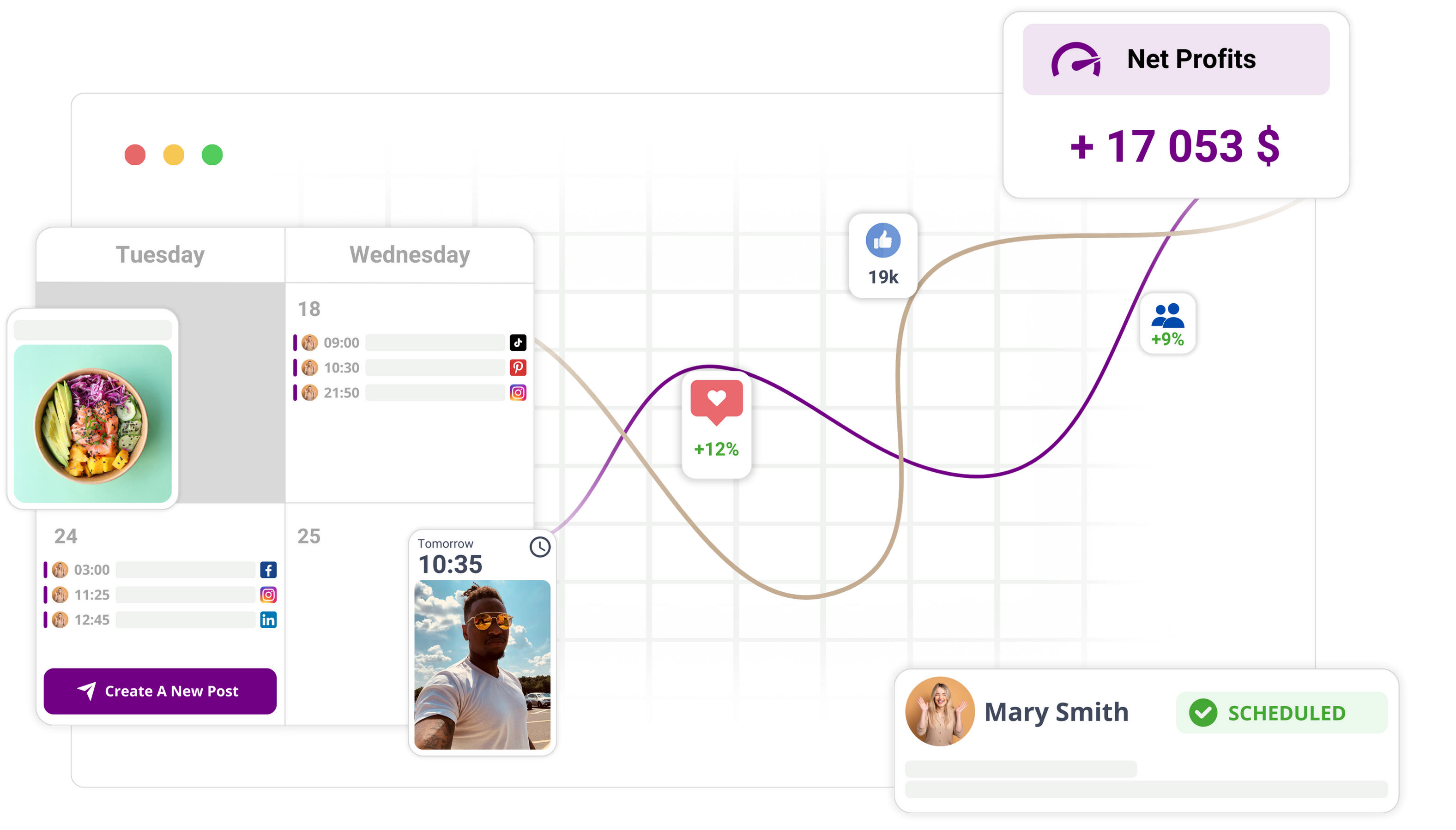

You aren’t tired because social media is inherently toxic; you’re tired because you’re living in a constant state of "emergency publishing," where every post feels like a new, high-stakes decision made under pressure.
Imagine the relief of a Tuesday where the week’s content is already locked, validated, and scheduled. You aren't chasing the algorithm; you are executing a strategy you built with a clear head last Friday. The burnout you feel is an operational failure, not an emotional one.
TLDR: Burnout is an operational failure, not an emotional one. Your team isn't exhausted from creating content; they are exhausted from the relentless, unplanned decision-making required to get that content live.
The industry blames algorithms and platform changes for burnout. The real culprit is the "last-minute hero" culture in marketing teams, where the lack of a system forces creators to be the engine and the fuel.
The real problem hiding under the surface

Most teams do not have a content problem. They have a decision bottleneck. When your team relies on Slack pings, disconnected spreadsheets, and manual last-minute platform checks, you are incurring heavy coordination debt. Every time a post needs a last-minute tweak, you aren't just editing a caption; you are context-switching out of deep work, pulling in stakeholders who didn't plan for the review, and rushing to meet a deadline that was only urgent because the workflow was ignored until the final hour.
The real issue: The cognitive load of constant context-switching. When you treat your calendar as a suggestion rather than a command center, you are effectively choosing to spend your day in a state of high-alert reactivity.
A content calendar that doesn't enforce boundaries isn't a strategy; it's a reminder of what you're behind on. If your calendar is just a place to track dates, it is useless. A System-First Marketing approach requires the calendar to act as the single source of truth that forces decisions before the pressure of the publish window arrives.
To escape the cycle of emergency publishing, you need to tighten the constraints of your operation. Start by auditing your current team workflow against these three criteria:
- Centralization: Is every asset and caption sitting in one place, or are you hunting through DMs and shared drives?
- Validation: Are you catching missing media, wrong aspect ratios, or platform-specific errors before the post is scheduled, or are you fixing them during the scramble to publish?
- Governance: Who has to sign off, and are those approvals happening in the same interface where the post lives?
Operator rule: If it is not validated in the calendar, it does not go live.
When you treat your workflow as a series of repeatable, pre-flighted stages rather than a creative "emergency," you regain your bandwidth. You stop managing content and start managing the system that carries it.
| Stage | Chaotic Ad-Hoc (The Burnout) | Systemized Calendar (The Flow) |
|---|---|---|
| Ideation | Random DMs/Slack pings | Campaign notes inside Calendar |
| Asset Mgmt | Desktop clutter/manual uploads | Google Drive import via Mydrop |
| Validation | Last-second platform check | Auto-validation of captions/dates |
| Publishing | Manual "hit send" anxiety | Pre-flighted, scheduled automation |
The shift from chaos to flow starts with admitting that the "always-on" lie is killing your team's creativity. You cannot be creative while simultaneously performing data entry, chasing file permissions, and worrying if the LinkedIn preview will break. By moving your operational context into a tool like Mydrop, you capture the campaign idea, pull the asset from Drive, and validate the platform requirements all in one motion. You aren't doing less work; you are doing the right work, at the right time, with the right level of oversight.
Why the old way breaks once volume rises

When you are managing two accounts, chaos is just a colorful feature of your Tuesday. But once you scale to managing dozens of profiles, multiple regions, and a rotating cast of stakeholders, that same "nimble" approach becomes an existential threat to your team's mental health. The old way fails because it treats social media as a series of isolated events rather than a continuous pipeline.
Most teams underestimate: The hidden cost of "coordination debt." Every email thread, Slack ping, or shared document searching for the "latest version" of a caption doesn't just eat time; it drains the cognitive focus required for actual creative work.
When you lack a central system that enforces structure, you create a "hero culture." You rely on individuals to remember platform-specific requirements, hunt down media assets, and manually double-check that a date hasn't shifted in a spreadsheet. This works right up until the moment someone is sick, on vacation, or simply overwhelmed. When the volume rises, the manual friction doesn't just increase-it compounds.
| Operational Stage | Ad-Hoc (The Burnout Cycle) | Systemized (The Flow) |
|---|---|---|
| Asset Gathering | Searching emails/Drive folders | Direct import into library |
| Approval | Scattered threads/PDFs | In-calendar comment threads |
| Validation | Last-second platform panic | Automated pre-flight checks |
| Posting | Manual, error-prone execution | Scheduled, governed release |
This isn't about working harder; it is about stopping the cycle where your team's best talent is reduced to glorified data entry clerks who spend more time verifying if a post is compliant than they do thinking about the audience.
The simpler operating model

The secret to preventing burnout is not to post less, but to move your operational focus upstream. Instead of managing individual posts as they go live, your goal is to manage the system that produces them.
Think of your calendar as a Constraint-Driven Command Center. It should act as the single source of truth where you capture ideas, attach approved creative, and validate every detail long before the post hits the live feed. By using tools like Mydrop, you can pull assets directly from Google Drive into your workflow, removing the manual download-and-reupload dance that accounts for half of the "busy work" in most marketing departments.
Operator rule: If it is not validated in the calendar, it does not go live.
By building your workflow around a 3-Stage Validation Loop, you turn the calendar from a passive display into an active engine:
- Capture/Note: Log campaign themes and operational context as Calendar notes so the "why" behind the work is visible to everyone on the team.
- Compose/Attach: Draft platform-specific versions in one go, using the composer to handle the nuances of LinkedIn vs. TikTok without losing the core campaign message.
- Pre-flight/Schedule: Run your final check-captions, media, profile targets, and dates-and then lock it.
Once you have your week scheduled, you are not reacting to the algorithm; you are executing a strategy. Your Tuesday morning becomes a time for review, not a frantic race against the clock. When you stop treating the calendar as a suggestion and start using it to enforce boundaries, you regain the mental space to actually innovate. You stop managing content and start managing the system that carries it.
Where AI and automation actually help

AI is often pitched as a magic wand that generates endless content, but for enterprise teams, that is a trap. If your problem is generating more noise, you do not need AI; you need a strategy. The real value of intelligent automation is not in creating the post, but in de-risking the distribution.
You can stop burning out when you stop manually babysitting the technical requirements of ten different social networks. This is where a system like Mydrop changes the game. By automating the "pre-flight" check, you ensure that captions, image ratios, and platform-specific requirements are correct before they ever hit the calendar. You stop being a glorified copy-paster and become an editor who checks the machine's work.
Operator rule: Automation should enforce quality, not just speed. Use tools to catch missing media, broken links, or non-compliant branding before your team loses another night of sleep fixing a typo on a live post.
Here is how you shift from manual grind to system oversight:
- Centralize the assets: Stop hunting through Slack threads for that final graphic. Use direct Google Drive imports to pull assets into a single gallery.
- Validate by default: Use automated pre-flighting to ensure every post meets platform specs-no more "failed to upload" messages five minutes before a campaign launch.
- Use reminders as guardrails: Stop relying on memory for community replies or analytics reviews. Set recurring reminders in your calendar that link directly to the work.
Common mistake: Treating automation as a replacement for human oversight. Automation handles the syntax-the technical constraints of the platforms. You still have to handle the semantics-the tone, the brand voice, and the strategic timing.
The metrics that prove the system is working

When you move to a system-first model, your KPIs shift. Stop counting "posts published per day" as a badge of honor; that is a vanity metric that correlates perfectly with burnout. Instead, start measuring your operational health.
If your team is truly systemized, you should see the "last-minute hero" behavior plummet. If you are still scrambling on Friday afternoons, the system is not functioning; it is just a suggestion.
KPI box: The System Health Scorecard
- Planning Horizon: Percentage of content scheduled 14+ days in advance. Target: >80%.
- Emergency Fixes: Number of post edits made after a post has gone live due to errors. Target: 0.
- Approval Lag: Average time between content submission and final calendar lock.
- Governance Score: Percentage of posts that followed the approved campaign brief.
This scorecard tells you exactly where the friction is. If your planning horizon is low, look at your intake process-are stakeholders dumping late requests on you? If your emergency fix rate is high, look at your pre-flight validation rules-are you letting posts bypass the check?
The 5-Point Friday Pre-Flight Before you close your laptop for the weekend, run this check. If you cannot check every box, your week is not actually finished.
- All assets are pulled from the master repository, not local drives.
- Every post has an approved caption and platform-specific formatting.
- Posting dates align with the master campaign calendar.
- All team reminders for community management are set for the upcoming week.
- No "To-Do" notes remain floating outside the calendar view.
System-First Marketing
Stop managing content; start managing the system that carries it. Once you offload the cognitive weight of tracking files, dates, and platform specs to a reliable infrastructure, you might actually find the space to think about what you are saying, rather than just worrying about how you are going to get it published. A content calendar that does not enforce boundaries is not a strategy; it is just a reminder of everything you are currently behind on. Fix the system, and the burnout fades with the chaos.
The operating habit that makes the change stick
The biggest reason content calendars fail isn't that they aren't detailed enough; it's that they are disconnected from the actual work. To stop the cycle of emergency publishing, you have to shift your calendar from a passive spreadsheet into an active command center.
This is where the System-First Marketing mindset takes hold. You stop treating the calendar as a record of what happened and start treating it as the only place where the future is permitted to exist. If a piece of content isn't pre-flighted in the system, it simply does not go live. This creates a hard boundary that forces your team to shift from "heroic effort" to "systemic execution."
Here is how to lock this in before the next Monday morning rush.
Framework: The 3-Stage Validation Loop
- Capture/Note: All raw ideas and campaign requirements are logged as notes directly in the calendar. No loose documents or DMs allowed.
- Compose/Attach: Assets are pulled from your central drive (like Google Drive) directly into the composer. No local files on desktop.
- Pre-flight/Schedule: Run a platform-specific validation check-checking character limits, aspect ratios, and profile settings-before clicking schedule.
By moving your planning and reminders into the same interface you use to schedule, you stop the context-switching that kills focus. When you can see your upcoming campaign requirements and the actual media assets side-by-side, you aren't just reacting to a deadline; you are managing a pipeline.
To get your team onto this rhythm this week, follow these three steps:
- Clear the backlog: Take every ad-hoc post currently sitting in a shared doc or email chain and migrate them into a single, unified view. If it does not belong in the calendar, delete the item.
- Set the "Hard Friday" rule: Mandate that all content for the following week must be validated and scheduled by 4 PM on Friday. Use a recurring calendar reminder to hold yourself and your team accountable.
- Automate the pre-flight: Stop manually checking every platform constraint for every post. Use Mydrop to surface missing captions or media requirements automatically before you ever hit "publish."
Conclusion

Social media burnout is rarely a result of the volume of content required by modern algorithms. It is almost always an operational failure rooted in a lack of visibility and the absence of a centralized validation system.
When you treat your content calendar as a suggestion, you invite chaos. When you treat it as a constrained, high-fidelity map of your operations, you buy back your team's headspace. The goal is to move beyond the mindset of "managing content" and start "managing the system that carries it."
Your team’s creativity is a finite resource; stop spending it on the mechanics of getting a post live. When you centralize your assets, automate the technical pre-flight, and treat the calendar as a binding contract, you stop reacting to the internet and start leading your brand's presence. At the enterprise level, the winners aren't necessarily those who post the most-they are the ones who have successfully eliminated the coordination debt that keeps everyone else in a constant state of fire-fighting.