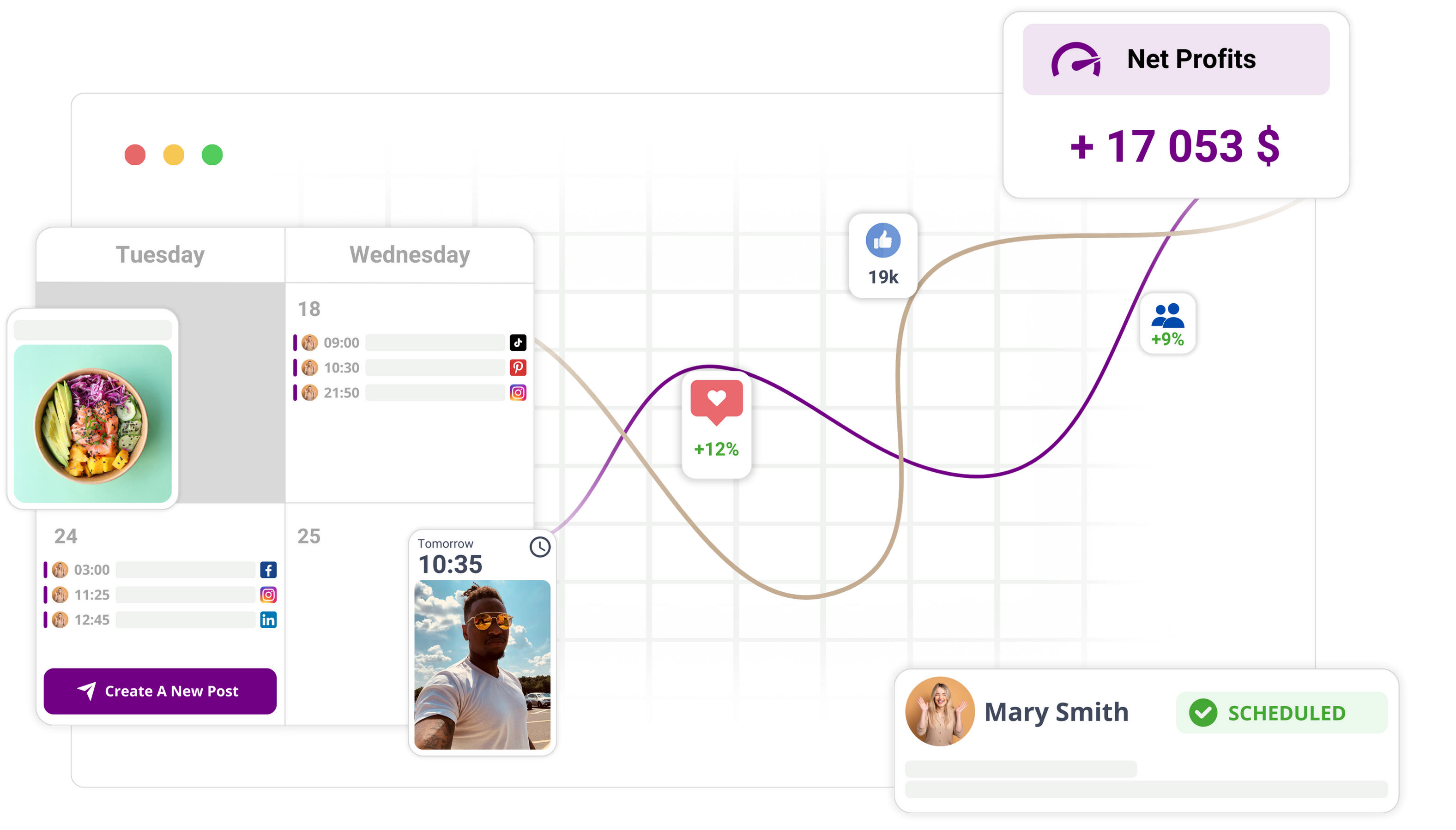

The quality of your social media calendar is not measured by how far out you plan, but by how few failed posts your team has to fix on launch day. Your team doesn't have a content problem; they have a "formatting blind spot." You have likely spent hours color-coding a calendar, aligning hashtags, and securing approvals, only to have a 9:00 AM campaign launch ruined by an automated "Post failed" notification. It is the quiet dread of manual fire-fighting that turns a sophisticated marketing strategy into a high-stress operational liability.
TLDR: A beautiful calendar full of broken posts is just a map of future headaches. You can plan further and publish less-unless you’ve automated your pre-flight validation to catch constraints before they hit the live schedule.
When you manage multiple brands and dozens of channels, your calendar stops being a creative tool and starts acting like a high-stakes flight board. If your team relies on the "eyeball test" to ensure that every asset, tag, and link is correct for every platform, you are essentially gambling with your brand reputation. Automation, rather than just more diligent manual checking, is the only way to scale without sacrificing quality.
The real problem hiding under the surface

Most teams treat a scheduled date as a signal of completion. They see a full calendar and assume the work is done. But there is a massive delta between a "planned" post and a "publishable" one. The real issue is that most calendars plan time, not mechanics. They track the "when" while completely ignoring the "how" until the exact moment of delivery.
The real issue: We confuse calendar density with campaign readiness. Filling a grid with content blocks provides a false sense of security that blinds teams to the technical requirements of the social platforms themselves.
If your toolset allows you to schedule a post that violates platform-specific constraints-such as an unsupported video duration, a broken link, or a non-compliant aspect ratio-you aren't actually managing a calendar. You are managing a ticking bomb that will inevitably detonate during your most important campaign windows.
Consider the "Deadline Mirage." A team might spend days polishing a post, but if the final handoff doesn't pass a technical pre-flight check, the entire effort is wasted. This leads to the "fail-fix-reschedule" cycle that drains your team's energy and creates inconsistent brand presence across markets.
High-risk handoff
To stop the cycle of manual fire-fighting, you need to transition from a "Plan and Pray" approach to a "Pre-flight and Publish" model. This shift requires three non-negotiable operational standards:
- Constraint-First Planning: Every asset must be validated against platform specs at the moment of upload, not at the moment of publish.
- Centralized Governance: Standardize profile selections and tag requirements in one place to avoid the "oops, wrong brand" errors that occur in fragmented environments.
- Timezone Alignment: Ensure your publishing window is anchored to the target market's clock, not just your team's local time, to prevent engagement drops caused by off-peak delivery.
Operator rule: If your calendar tool doesn't stop you from scheduling a faulty post, you aren't managing a calendar-you're managing a liability.
The best-performing teams have stopped treating publishing errors as "part of the job." They treat them as process failures that can be engineered out of existence. By shifting the burden of validation from human eyes to automated systems like Mydrop, they reclaim the time previously spent on manual double-checks and panicked last-minute adjustments. You are not just trying to hit a deadline; you are trying to land content flawlessly. If the platform rejects your delivery, your strategy remains stuck in the draft folder.
Why the old way breaks once volume rises

The manual checklist is a classic trap. It works fine when you have one brand, three channels, and a single person responsible for posting. But as soon as your volume scales-meaning multiple regions, dozens of stakeholders, and hundreds of assets-the "eyeball test" fails. You cannot manually inspect every aspect ratio, file size, and character limit for every single platform, day after day, without eventual failure.
Most teams underestimate: The cost of "human latency" in the publishing loop. When a manager has to pause their actual work to manually verify that a JPEG fits the LinkedIn spec, your entire production pipeline slows down.
Here is where the cracks start to show. The sheer volume of manual verification leads to "alert fatigue," where your team starts glazing over critical warnings. The human brain is simply not built to catch the same microscopic formatting errors on the ten-thousandth post. You are left relying on the hope that someone spotted the error before the deadline. That isn't a strategy; it is a prayer.
| Failure Point | Manual Calendar Workflow | Mydrop Automated Workflow |
|---|---|---|
| Media Constraints | Check manually after upload | Auto-validation (size/type/ratio) |
| Profile Selection | Verify by memory/notes | Auto-match vs platform rules |
| Character Limits | Count manually in draft | Real-time constraint check |
| Scheduling Conflicts | Cross-reference spreadsheets | Global timezone sync |
This is why we see so many teams move away from manual spreadsheets toward a model that treats the calendar as a living, self-validating system.
The simpler operating model

The most effective teams have stopped trying to "be more careful" and instead changed their mechanics to make failure nearly impossible. You have to move from a culture of "Plan and Pray" to "Pre-flight and Publish." This means embedding the constraints of every social platform directly into the moment of creation.
When you shift to an automated validation model, the calendar ceases to be a passive document and becomes an active guardrail. If the media you uploaded doesn't meet the requirements for, say, Instagram or X, the system stops you right there. You don't get the "Post failed" alert at 9:00 AM because you never had the option to schedule the post in a broken state.
Operator rule: Never treat a scheduled date as a signal of readiness. A post is ready only when it passes its final validation check.
Here is what this shift looks like in practice for a high-functioning team:
- Drafting: The creator uploads assets and adds copy within a unified interface.
- Constraint Check: Mydrop runs an immediate validation against the requirements of the selected profiles.
- Remediation: If the aspect ratio is off or the file is too large, the system flags the specific issue before the
Schedulebutton ever becomes active. - Finalization: With the "green light" confirmed, the post is locked into the calendar with total confidence.
- Publishing: The post lands on time, exactly as intended, without a single manual intervention or "error" notification.
High-risk handoff: The transition from a creative draft to a live post is where most teams lose control. By automating the pre-flight checks, you stop chasing errors and start focusing on the actual quality of the content. A beautiful calendar full of broken posts is just a map of future headaches. If your tool doesn't stop you from scheduling a faulty post, you aren't managing a calendar-you're managing a ticking bomb.
Where AI and automation actually help

The most effective way to eliminate the "publishing error" notification is to treat every piece of content like a software deployment. In development, you would never push code to production without running a suite of automated tests. Yet, in marketing, we somehow expect human eyes to catch every broken link, invalid aspect ratio, and missing caption tag across twenty different platforms. That is not just optimistic; it is a structural failure.
AI and automation shift the burden from human memory to platform intelligence. Instead of relying on a checklist pinned to a monitor, you lean on a system that knows the rules for every network by heart. When your team uploads a video for Instagram, the platform doesn't wait until it hits the feed to tell you the resolution is wrong. It flags the issue immediately, during the drafting phase, because the logic is baked into the calendar workflow. This isn't just about speed; it is about reclaiming the headspace currently occupied by anxiety-inducing "pre-flight" jitters.
Operator rule: If your calendar allows you to schedule a post that it knows will be rejected by the API, your tool is working against you. Automation is not a luxury; it is a gatekeeper.
The goal is to stop treating scheduling as the final step and start treating it as the validation step. When you move to an environment where the system automatically verifies constraints like media size, profile permissions, and caption requirements, you remove the "guessing" game entirely. It transforms your team's workflow from a high-stakes, manual scramble into a predictable, boringly consistent process.
Common mistake: Treating a deadline date on a calendar as a status of "ready for public view." A calendar is a map, not a guarantee. Just because a post is sitting on a date does not mean it has passed the mechanical requirements to actually survive the internet.
To start moving toward this model, implement a "pre-flight" ritual that your team runs on every single asset before they hit the final schedule.
- Profile Check: Confirm the correct brand/account grouping is linked to the intended audience segment.
- Constraint Audit: Verify that the media format, aspect ratio, and duration align with the target platform requirements.
- Metadata Scan: Ensure that all mandatory tags, local disclosures, or tracking parameters are present.
- Temporal Alignment: Check the workspace timezone to ensure the post lands in the correct local market window.
- Link Integrity: Verify that the link-in-bio destination is active and redirects correctly for the specific campaign.
The metrics that prove the system is working
Most teams are still obsessed with "Calendar Coverage"-a metric that counts how many slots are filled-but it is a vanity metric that masks operational chaos. If you have a calendar that is 100% full but 15% of those posts fail or require emergency edits on the weekend, your "coverage" is actually a liability. You need to shift your focus to First-Time Success Rate. This is the only KPI that accurately measures the health of your production engine.
KPI box:
- First-Time Success Rate (FTSR): The percentage of posts that publish without manual intervention or post-mortem error corrections.
- Target: 98% or higher.
- Warning zone: Below 90% suggests your team is spending more time fire-fighting than creating.
By tracking how many posts actually go live on their first attempt, you expose the "coordination debt" hidden in your workflow. If your FTSR is low, it means your planning process is decoupled from the reality of the platforms. It forces you to look at the process gaps, not the creativity of the team. When you use a platform like Mydrop that catches these errors at the moment of creation, your FTSR naturally trends upward because the "wrong" content simply cannot enter the publishing queue.
A reliable, error-proof system doesn't just save your weekend-it allows your team to stop thinking about the mechanics of publishing and start thinking about the impact of the content itself. The best marketing teams have reached a point where "publishing" is the most boring part of their day. They have offloaded the complexity to the tool, so they can focus on the one thing that actually drives growth: the message.
Great strategy is useless if the platform rejects your delivery. Don't waste your best ideas on a broken pipe.
The operating habit that makes the change stick

The true test of a content calendar isn't the aesthetic of your grid; it is the silence of your notifications on a busy morning. To make this shift from reactive fire-fighting to proactive scheduling, you must build a "Pre-Flight Ritual" into your team's weekly workflow. This isn't just about training people to check their work; it is about automating the constraints that humans consistently miss.
When your team knows that Mydrop will flag a mismatched aspect ratio or a missing geo-tag before they even hit the schedule button, the "will it post?" anxiety disappears. You stop debating if the formatting is correct and start spending that energy on the creative strategy itself.
Here is the three-step workflow your team can adopt this week to kill the "failed post" cycle:
- Conduct a Post-Mortem on the Last Three Failures: Identify the exact technical cause. Was it a file size limit? A missing timezone adjustment? A platform-specific character count? Label these as "known blockers."
- Standardize the Handoff: Shift your team’s internal communication from "Is this post ready?" to "Have you run it through the Mydrop validator?"
- Audit Your Calendar Settings: Verify that your workspaces have the correct timezone and profile-specific rules enabled. If the tool is configured to catch errors, you don't have to keep the entire library of social media documentation in your head.
Framework: The Pre-Flight Success Metric
Stop measuring your team by how many posts they plan. Start measuring by the First-Time Success Rate (FTSR).
- Standard Goal: 100% of planned posts on the calendar.
- Pro Goal: 100% of scheduled posts go live without a manual re-upload or error notice.
- The Reality: A calendar full of broken posts is just a map of future headaches.
Most teams underestimate how much "coordination debt" they are carrying. Every time a post fails, you lose the original momentum, your analytics data gets skewed, and you have to pull a team member off their actual work to perform a manual fix. By treating each post like a software deployment-where the validation step is mandatory and automated-you eliminate the friction that keeps your team stuck in the cycle of constant manual repair.
Conclusion

The goal of a mature content operation is not to be perfect at the planning stage; it is to remove the possibility of error before the post even reaches the server. When you move the validation point earlier in the workflow, you aren't just saving time on bug fixes. You are protecting your brand's consistency and giving your team the space to actually improve their output rather than just maintaining it.
You cannot scale social media operations by simply working harder or hiring more people to watch the clock. You scale by building systems that make errors impossible to schedule. Great strategy is useless if the platform rejects your delivery. Secure the mechanics first, and the creative impact follows.