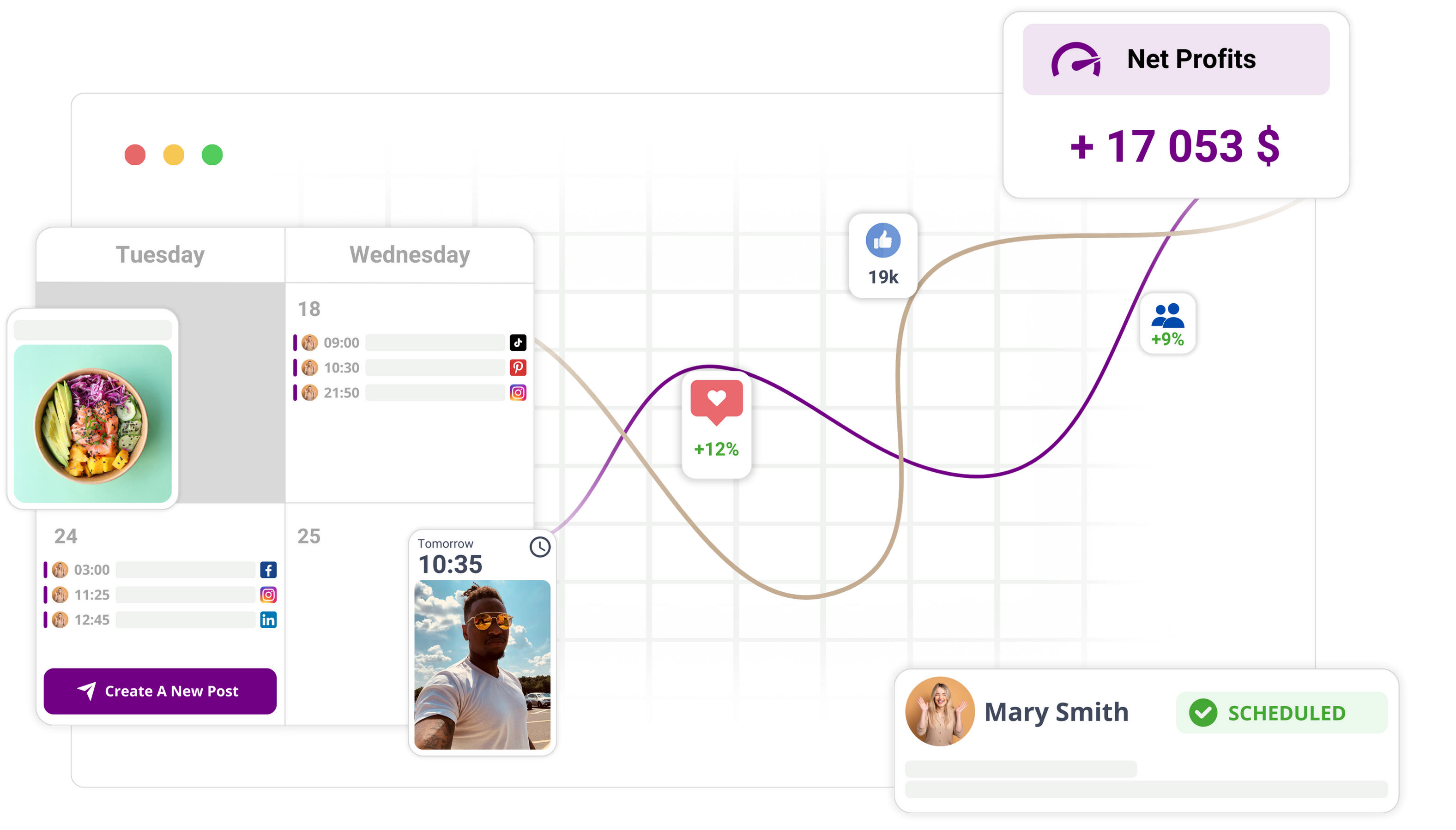
Your content calendar should not be a source of stress. It should be a predictable machine that turns one high-impact insight into thirty days of meaningful audience connection.
Most marketing teams are drowning in the blank-prompt fatigue of daily creation. They treat every post like a bespoke manufacturing project, paying the heavy creative debt of starting from absolute zero every single morning. The shift from struggling to invent something new while the clock ticks to orchestrating a pre-planned, AI-amplified cadence brings the kind of operational peace that high-scale teams crave. You do not need more hours; you need a system that forces your existing ideas to do the heavy lifting for you.
TLDR: Content scaling fails not from a lack of ideas, but from a broken bridge between creative conception and platform-native distribution. Use the "Core-and-Satellite" model: one core concept (the Sun) powers thirty days of diverse, platform-specific posts (the Satellites) using AI to handle the heavy lifting of transformation and scheduling.
The real problem hiding under the surface

If you are starting every post with a blank cursor, you have already lost the efficiency race. The friction is not usually in the writing; it is in the context switching and the manual overhead required to move a single idea through the labyrinth of corporate social media.
When you manage multiple brands or large channels, you are not just a content creator. You are an air traffic controller. Every time a designer drops a file in a folder, a manager emails a request, or a compliance officer asks for a tweak, you are losing momentum. Most teams treat their social output as a series of disconnected events rather than a supply chain.
Here is where teams usually get stuck:
- The Translation Gap: Trying to manually rewrite the same core message for LinkedIn, Instagram, and X without sounding robotic or losing the original nuance.
- Asset Friction: Losing hours downloading files from cloud storage only to re-upload them into a social scheduling tool.
- Coordination Debt: Spending more time checking if a post is approved than actually crafting the message itself.
The real issue: Bespoke creation at scale is a math problem you will lose. If you spend one hour per post, a team of three managing five brands is effectively bankrupted by "coordination debt" before they even hit the publish button.
This is the awkward truth that enterprise teams avoid: your current toolset is likely making this worse. When your asset storage, your calendar, and your AI assistant are three separate tabs that do not talk to each other, you are not working-you are juggling.
Operator rule: Always create the template once, refine it forever. If you find yourself manually adjusting the format of a post for the third time, stop and build a reusable template.
High-scale operation relies on a simple, ruthless logic: move the idea, not the file. When you use an AI home assistant that understands your workspace context, you stop asking it to "write a post." Instead, you ask it to "apply our Q3 pillar strategy to the asset in our shared gallery." The difference is the difference between a amateur task and a professional workflow.
If you are currently trapped in the "blank prompt" cycle, look at your last week of output. How many of those posts shared a common DNA? Chances are, you already have the seeds of a month of content sitting in your sent folder, waiting to be reorganized. You just need to stop manufacturing every post and start harvesting them from your own best ideas.
Why the old way breaks once volume rises

Scaling social content usually hits a hard ceiling not because you run out of ideas, but because your coordination overhead grows exponentially. When you manage ten channels across five brands, the manual friction of "download, rename, upload, and format" isn't just an annoyance-it is a hidden tax on your team’s creative bandwidth.
Most teams underestimate: The cumulative cost of context switching between cloud storage, design tools, and native publishing platforms. Each file move is a micro-failure point where compliance risks leak and brand consistency drifts.
This is the "bespoke manufacturing" trap. Teams treat every post like a custom art project, manually shepherding assets through a tangle of email chains and shared folders. When the volume rises, this manual labor crowds out the time needed for actual strategy, resulting in a team that spends sixty percent of its day as glorified file-movers.
| Pain Point | Manual Content Silos | AI-Orchestrated Workflow |
|---|---|---|
| Asset Handoff | Email/Slack/Drive links | In-app gallery import |
| Drafting | Blank cursor syndrome | Context-aware AI assistance |
| Consistency | Ad-hoc templates | Saved platform-native patterns |
| Compliance | Manual audit/Review | Integrated approval workflows |
When you treat every post as a unique event, you also lose the ability to refine your process. You are constantly building the airplane while flying it. The old way breaks because it relies on human memory and individual effort to maintain standards, rather than an operational system that enforces them by default.
The simpler operating model

The secret to sustainable high-volume content is shifting your team’s focus from "creation" to "orchestration." Instead of building every post from scratch, you treat your core insight as a master seed that propagates across channels via pre-defined templates and AI-powered drafting.
Operator rule: Always create the template once, refine it forever. If you are doing a task for the third time, it should be an automated template in your calendar.
By moving your planning into a unified workspace, you eliminate the gap between the idea and the asset. Your AI home assistant acts as the connective tissue, allowing you to drag approved creative directly from your drive imports into your workflow, apply a saved template, and ask for a platform-native adaptation in seconds.
This model relies on a clear, repeatable cycle that keeps your team focused on quality:
- Seed Creation: Distill your core concept into a single, high-impact note.
- Asset Import: Bring approved visuals directly into the gallery from your cloud storage.
- AI Drafting: Use your home assistant to adapt the seed content for each channel’s unique tone.
- Template Application: Apply saved post structures to ensure brand-safe formatting.
- Final Polish: Conduct a streamlined review before scheduling across the full month.
This shift moves the burden of heavy lifting onto the platform, leaving your team with the final, high-value editorial call. You stop being a collection of siloed operators pushing files around and start functioning as a strategic unit that pushes a unified brand message.
Common mistake: Trying to copy-paste the exact same caption across LinkedIn, Instagram, and X. It is a one-way ticket to low engagement and brand fatigue.
The goal isn't to blast noise; it is to use the AI home assistant to understand the nuance of each platform while staying true to the central seed idea. By standardizing the "how" of your publishing-using templates for recurring formats and direct integrations for asset management-you buy back the time to focus on the "what." In an enterprise environment, that operational clarity is the only way to scale without sacrificing the integrity of the message.
Where AI and automation actually help
The magic of this model is not in letting an algorithm write your posts, but in eliminating the administrative drag that kills momentum. When you use an AI home assistant to draft your satellite content, you aren't just saving time on typing; you are centralizing the "brain" of your campaign. Instead of jumping between a Google Doc, a separate design tool, and your publishing calendar, you keep the conversation in one place.
Operator rule: If your team spends more time coordinating the status of a post than writing the content, you have a coordination problem, not a creative one.
This is where the friction usually disappears. When your AI assistant has context on your brand voice, recent wins, and upcoming objectives, it produces drafts that actually sound like you. You save the best outputs as templates, turning a one-time win into a permanent asset.
- Import your master asset from Google Drive directly into your media library to avoid duplicate downloads.
- Use the AI home assistant to generate five variations of a caption for your core concept.
- Save the highest-performing post structures as reusable templates to skip the setup phase next time.
- Connect your design workflows so exported assets arrive in your gallery with the right dimensions.
- Set up a recurring reminder in your calendar notes to review engagement data on the 15th of the month.
Common mistake: Teams often try to push the same exact message to every platform. This is the fastest way to signal to your audience that your brand is on autopilot. Use the assistant to shift the tone-professional on LinkedIn, conversational on Instagram, urgent on X-while keeping the core message anchored.
The goal is to stop treating every post as a bespoke manufacturing project. By treating the AI assistant as a junior teammate who handles the "first draft" and "formatting" heavy lifting, your senior strategists get to focus on the high-level narrative.
The metrics that prove the system is working

Data is the only cure for the "this feels like busywork" sentiment that plagues most marketing operations. You cannot manage what you do not measure, and you certainly cannot justify a change in workflow to stakeholders without seeing the impact on your bottom line.
KPI box:
- Time-to-Publish: Track the hours from initial concept to live post. A healthy move from manual to orchestrated workflows should cut this by 40 percent.
- Creative Reuse Rate: Measure the percentage of published content derived from a "master seed" versus bespoke creation.
- Channel Coverage: The number of unique platform-native formats produced from a single core campaign concept.
- Approvals Velocity: The average time a post spends in the "pending approval" state.
When you transition to this model, your metrics should shift. You will stop measuring volume (posts per day) and start measuring efficiency-per-concept. If you are producing more output with the same headcount, the system is working. If you are hitting your compliance and brand safety benchmarks faster, the system is working.
Framework: The "Content Value" Lifecycle Concept Seed -> AI Drafting -> Template Application -> Stakeholder Review -> Native Distribution
The most successful teams I see aren't the ones posting the most; they are the ones with the shortest distance between a great idea and a live post. They understand that every hour spent manually uploading files or re-formatting captions is an hour stolen from the strategy that actually drives growth. When you stop fighting the tools and start orchestrating your workflow, the "content treadmill" finally stops being a chore and starts being an engine.
The operating habit that makes the change stick

The biggest danger isn't the technology you choose, but the tendency to slip back into "hero mode" whenever a deadline looms. Most teams fail to scale because they treat content planning as a series of isolated events rather than a rhythmic, reproducible habit. If you only build a system when you have time, you will never actually have time.
You must move from "creating content" to "maintaining a creative supply chain." The most successful teams I see treat their Monday morning session as the non-negotiable anchor for the rest of the week. They don't just dump ideas into a spreadsheet; they load them into their Home assistant to immediately test if a concept has enough legs to support a full month of satellite posts.
Operator rule: Never start a new project from a blank screen. If you have to invent the structure and the content simultaneously, you are paying a 30% tax on your creative energy. Use templates to handle the structure, so you can spend your bandwidth on the creative nuance that actually moves the needle.
This isn't about rigid automation that strips away your brand voice. It is about front-loading the heavy lifting so that by Wednesday, your team is focused on high-level community engagement, not chasing down file versions or fixing formatting errors. When you codify your process, the "content treadmill" becomes a predictable, manageable output machine.
To transition your team this week, start with these three steps:
- Audit your current "hidden" debt: Identify where your team spends the most time on non-creative tasks, like hunting for files in email or re-formatting assets for different platforms.
- Standardize one high-value format: Choose a single recurring campaign type and build a permanent post template for it.
- Connect your storage: Stop manually moving files. Link your primary asset source, like Google Drive, directly to your gallery service to bypass the download-upload loop.
Framework: The 3-Stage Content Maturity Cycle
- Ad-hoc: Every post is a custom, manual emergency.
- Systemized: Recurring templates handle the structure, but creative is still manual.
- Orchestrated: AI assistants manage the "Core-and-Satellite" distribution, leaving humans to focus on strategy and high-touch audience work.
Conclusion

The transition from "we need to post something today" to "we are executing a coherent content strategy" is purely an operational shift. It is the decision to stop treating social media as a series of isolated, frantic tasks and start treating it as a unified distribution network.
When you solve the coordination problem, the creative problem suddenly feels much lighter. You stop fighting the logistics of your own workflow and start focusing on the actual quality of the message.
High-performing teams don't have better hours in the day; they have fewer administrative hurdles between their vision and their audience. When your team uses a workspace that keeps your calendar notes, asset imports, and creative drafting in the same place, you stop losing momentum to context switching. Scale is not a burden when your infrastructure does the heavy lifting for you. True content agility comes when the tools work as a natural extension of your team's intent.