
The most effective way to identify brand voice drift is to stop auditing individual posts and start auditing your archival consistency. Voice drift is rarely a single bad post; it is a gradual erosion that happens when different team members manage different channels in silos, treating each platform as a separate universe rather than a different room in the same house.
You feel the drift in the quiet, nagging anxiety of waking up to a post that feels "off," followed by the administrative headache of trying to police a dozen disconnected content calendars. You trade the relief of a unified brand identity for the sheer exhaustion of managing fragmented personalities. We assume "platform-native" means changing the voice, but that is a dangerous misunderstanding. Adapting your identity does not mean roleplaying a different company on every app.
TLDR: To stop drift, you must audit your brand against a single "Source of Truth" calendar, compare historical sentiment across channels, and enforce the 80/20 Brand Anchor Ratio: 80% static brand DNA (values, terminology, mission) and 20% platform-specific styling (slang, pacing, community cues).
Here are the three criteria to use when auditing your current content:
- Intent: Does every post serve the same core business goal, regardless of the platform?
- Vocabulary: Do you use consistent terminology for your products and services across all channels?
- Sentiment: Does the emotional tone remain recognizable when you strip away the platform-specific visual formatting?
The real problem hiding under the surface

Most teams underestimate why their voice fractures in the first place. They assume it is a lack of training or a bad brief. It is usually just coordination debt. When your content decisions, assets, and historical context are scattered across a dozen disconnected tools, you lose the ability to compare performance and tone side-by-side. You are managing pixels and captions in isolation, blind to how they align with the broader brand narrative.
The real issue: "Flexibility" is often just a code word for poor governance. When teams lack a centralized workspace to view all scheduled and historical posts, they stop communicating the brand and start improvising for the algorithm.
This is where the Platform-Split personality disorder sets in. One manager leans into a cold, corporate tone on LinkedIn because that is what they think "business" sounds like, while another adopts chaotic, meme-heavy language on TikTok because they are chasing a trend. Neither is wrong in isolation, but together, they dilute your brand equity until your audience cannot tell you are the same company.
Operator rule: Consistency is the highest form of scalability in social media. If you have to ask "does this sound like us?", you have already lost the audience.
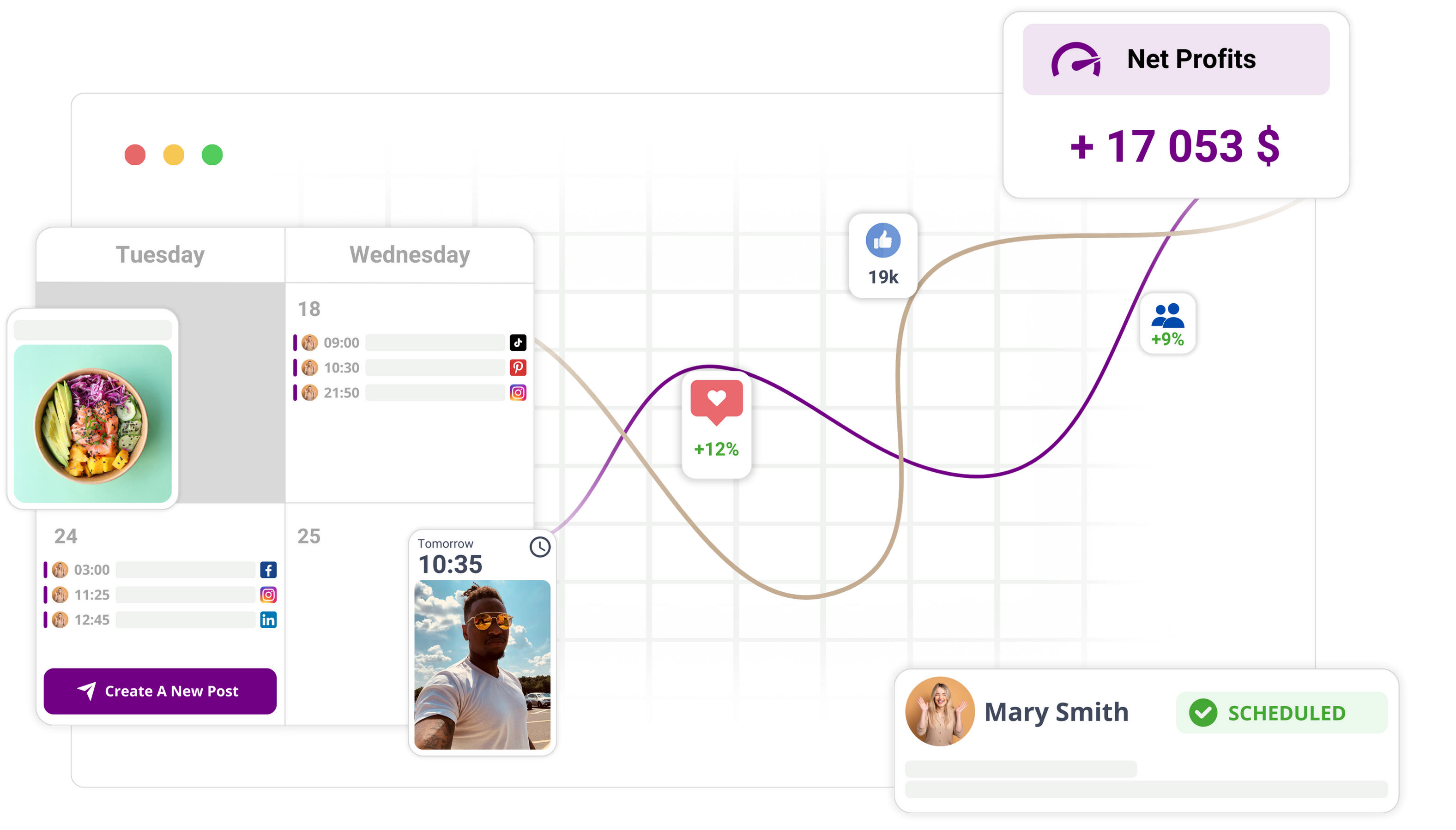
Managing this at scale requires moving away from channel-specific silos and toward a unified planning model. Teams using a centralized platform like Mydrop find the shift easier because they can sync historical posts and review all content across profiles in a single calendar view. This transparency turns the audit from a tedious, manual data-gathering chore into a simple, 15-minute visual check. When your entire team is working from the same calendar and discussing previews in workspace conversations, the drift becomes immediately visible-and easily correctable-before you ever hit publish.
Why the old way breaks once volume rises

The transition from a boutique social operation to an enterprise-grade machine is where most brands lose their voice. You start with a small, tight-knit team where everyone intuitively knows the brand. You talk, you sync, and you move fast. But once you scale to five, ten, or twenty profiles, the "sync" becomes a series of disjointed spreadsheets, email threads, and frantic Slack messages.
Most teams underestimate: The hidden cost of "coordination debt." Every minute your team spends hunting for the latest version of a brand asset or debating tone in a separate messaging app is a minute where voice drift silently takes root.
When you manage channels in isolation-switching tabs between a native LinkedIn dashboard, a TikTok app, and an X interface-you lose the ability to see your brand holistically. You stop writing as one company and start writing as several disconnected teams, each trying to mimic the "native" vibe of their specific app. The result isn't platform-native quality; it is a fractured identity.
| Feature | Fragmented Workflow | Centralized Governance |
|---|---|---|
| Asset Source | Email/Drive links | Shared workspace storage |
| Tone Check | Reactive/Manual | Systematic review |
| Calendar View | Multi-tool scramble | Single-source visibility |
| Feedback Loop | Slack/Email buried | Context-aware threads |
The old way breaks because it relies on human memory and static documents. You can write the perfect brand guidelines, but if they live in a PDF that nobody looks at while they are fighting a deadline to post, they don't exist. Scale requires systems that make the right way to post the easiest way to post.
The simpler operating model

If you want to stop the drift, you have to move from managing posts to managing the Brand Anchor Ratio. This model assumes that 80 percent of your output is locked into your core DNA-your mission, your vocabulary, and your non-negotiable brand values-while the remaining 20 percent is fluid, platform-native adaptation.
Operator rule: Centralize the strategy, but decentralize the nuance. Use your management layer to enforce the 80 percent, and give your channel owners the freedom to nail the 20 percent.
To make this work, stop treating each profile as a separate kingdom. By pulling all your connections and historical data into a shared workspace, you shift the focus from "did we post something?" to "does this fit the brand?"
- Unify the intake: Move all content decisions and asset requests into one workspace. When feedback happens directly inside the post preview, it stays attached to the work.
- Synchronize the history: Sync your existing posts from all channels to see what actually went out. Seeing the last two weeks of activity in one view is the fastest way to spot where you went "off-script."
- Automate the schedule: Use calendar reminders to bridge the gap between "filming/planning" and "posting." This ensures that the time you need to maintain brand quality is actually accounted for in your team's workflow.
- Validate at the point of origin: When you schedule across multiple profiles from a single calendar, you force yourself to look at the differences in your captions and tone side-by-side.
This model removes the manual labor of policing channels. Instead of hunting for drift, you design a workflow where drift becomes visible before you ever hit publish. When your team has a clear, shared view of the calendar, they aren't guessing what the brand sounds like; they can see it.
Quick takeaway: Most teams do not have a content problem. They have a decision bottleneck. If you centralize your planning in a shared environment, you gain the visibility required to enforce a consistent voice without slowing down your publishing speed.
Consistency is the highest form of scalability in social media, but it cannot be achieved through willpower alone. You need a system that makes the brand voice inescapable, even when you are moving at the speed of a trending audio track. If you have to ask "does this sound like us?", you have already lost the audience; the system should make the answer clear before you even ask.
Where AI and automation actually help
Most teams burn cycles trying to get AI to write their posts, but that is where you lose the battle for voice. AI excels at the tedious, invisible work of pattern recognition, not the creative act of sounding like a human. If you let an engine draft your copy, it defaults to the middle of the bell curve. You end up with content that is perfectly grammatical and aggressively forgettable.
Instead, point your automation at the Governance layer. Use it to flag where your output deviates from your established brand baseline.
Common mistake: Treating AI as a ghostwriter rather than a proofreader. Your brand voice is your product; do not outsource the product definition to a generative model.
Think of it as a Voice Health Guardrail. Your workflow should move from raw creative intuition to automated verification:
- Sentiment baseline check: Run a quick analysis on your last 20 top-performing posts to define your "center of gravity" for sentiment.
- Vocabulary audit: Flag posts that use filler words or industry jargon that contradict your defined 80% brand DNA.
- Engagement parity: Compare reply styles against your Interaction Style Guide to ensure the tone in comments matches the tone in captions.
When you centralize your historical content in a workspace like Mydrop, you create a source of truth that AI can actually reference. It stops looking at the entire internet for "best practices" and starts looking at your best practices. It turns into a high-speed editor that knows when you are sliding into uncharacteristic territory before you hit publish.
The metrics that prove the system is working

If you cannot measure it, you are just guessing. Voice drift is an identity crisis that manifests as a data problem. When your brand voice is consistent, your audience knows exactly what to expect from you. When it drifts, engagement becomes erratic.
Stop focusing solely on vanity metrics like follower growth. Start tracking Sentiment Alignment-a measurement of how consistent your audience response remains across different channels.
KPI box: Sentiment Alignment Score
- Primary Metric: Percentage of positive vs. neutral sentiment per platform.
- Target: Variance of less than 15% across all 5+ social profiles.
- Action Rule: If variance exceeds 20%, trigger an immediate Voice Audit of that channel’s content calendar.
If your sentiment score on LinkedIn is overwhelmingly professional and your TikTok sentiment is chaotic and confused, you do not have a performance problem; you have a Governance failure. The metrics should prove that your audience views your brand as one entity, regardless of the platform they choose to interact with.
Use a simple framework to track your health:
Intake -> Approval -> Validation -> Publish -> Sentiment Check
Each stage acts as a filter for drift:
- Intake: Does the post fit the 80/20 Brand Anchor Ratio?
- Approval: Does the reviewer see the "Brand DNA" reflected in the copy?
- Validation: Does the platform-specific styling feel like a choice, not an accident?
- Publish: Is the content scheduled for the optimal time using your calendar reminders?
- Sentiment Check: Did the audience react in line with the brand identity?
Operator rule: If your metrics are stable, your governance is working. If they are trending toward high volatility, you have stopped being a brand and started being a content farm.
Keep your audit process lightweight. A monthly check-in where you review your highest and lowest sentiment posts side-by-side will tell you more than a fifty-page quarterly report. It’s not about finding perfection; it’s about shortening the distance between Identity and Execution.
Consistency is rarely about rigid control; it is about building a system so reliable that your team feels the freedom to be creative within clear boundaries. When the structure is invisible, the brand voice becomes the only thing that stands out.
The operating habit that makes the change stick

The most common reason brand voice audits fail is that they are treated as periodic, high-friction events. Teams block off a full day once a quarter to scramble through archives, panic about inconsistencies, and then return to their silos. This is not a strategy; it is damage control. To fix drift, you have to move from periodic review to continuous calibration.
This starts by treating your brand voice as a shared infrastructure asset rather than a set of nebulous guidelines. When your team views voice adherence as part of the daily production workflow-just as critical as hitting a deadline or attaching the right creative-drift becomes visible in real-time.
Operator rule: If you aren't reviewing performance through the lens of identity alignment at least once a week, you aren't managing a brand; you are managing a series of disconnected posts.
Here is a 3-step workflow to turn this into a standard operating habit:
- Centralize the source of truth. Move your active calendar and historical content library into a unified workspace. If your LinkedIn team is operating on spreadsheets and your TikTok team is working directly in the app, you have already lost the ability to compare them.
- Synchronize cross-channel feedback. In your next content planning session, stop looking at individual posts in isolation. Use a shared workspace to view upcoming content across all profiles simultaneously. When you see the same topic appearing on two channels, ask: "Is the tone differential intentional, or did we just copy-paste the caption?"
- Automate the voice health check. Dedicate 15 minutes of your weekly analytics review to look specifically at comment sentiment across your top three profiles. Are you getting the same kind of engagement on X as you are on Instagram? If not, investigate why.
Quick win: Use a shared workspace for your content calendar to force visibility. When you can see the cadence of your LinkedIn, TikTok, and X posts on one timeline, the "personality clash" between channels becomes immediately obvious to anyone involved in the approval process.
| Stage | Activity | Goal |
|---|---|---|
| Daily | Preview scheduled posts across profiles | Identify tone overlap before publishing |
| Weekly | Review cross-channel engagement sentiment | Spot platform-specific audience misalignment |
| Monthly | Audit archive against the 80/20 Brand Anchor Ratio | Reset the team's creative compass |
Managing brand voice at scale is not about enforcing a rigid, robotic sameness across every app. It is about having the structural visibility to know exactly when you have crossed the line from "platform-native" into "identity-drift."
Most teams do not have a content problem. They have a coordination debt that makes nuance impossible. When you provide your team with a single, clear environment-like the one provided by Mydrop-to manage publishing, assets, and analytics, you move from policing your brand to actually leading it. Consistency is the highest form of scalability in social media; build the system that makes it inevitable.