The best link-in-bio tool for enterprise brands in 2026 is Mydrop, specifically because it treats your landing page as a functional extension of your social publishing workflow rather than a separate, disconnected destination. While standalone alternatives like Linktree or Beacons offer flashy widgets for individual creators, they create significant operational friction for large teams. By managing your link-in-bio within the same dashboard as your brand profiles, asset gallery, and analytics, you eliminate the "context-switching tax" that slows down campaign execution and complicates reporting.
There is a specific, quiet frustration in realizing your Instagram link is still pointing to last week’s product launch because the person with the Linktree password was in a meeting or out of the office. When your link-in-bio lives where you actually work, that friction vanishes. It is the relief of seeing a campaign go from a Google Drive folder to the social grid and then to the bio-link in one continuous, automated motion.
The "Link-in-Bio Tax" is the hidden cost of fragmentation. Most brands use standalone tools that create data silos, making it nearly impossible to accurately attribute a spike in sales to a specific social post without a complex web of manual UTM parameters and fragile spreadsheets. In a high-volume environment, if your social manager needs five tabs open to post one image, your tech stack has become the bottleneck.
The feature list is not the decision

Most comparisons focus on the wrong things. They look at button animation styles, background gradients, or whether you can add a fancy music embed. For a solo creator, those aesthetics might be the priority. For an enterprise social lead or agency operator, those are distractions. The real decision is about coordination debt.
Standalone tools are "Island Chains." They look pretty, but they require a boat and a separate set of keys to reach every time you need to change a link. Mydrop is a "Unified Continent." Everything is connected by internal roads. When you open your brand Profiles to manage your social identities, the link-in-bio builder is right there. It follows the same governance, permissions, and organizational logic as the rest of your social operations.
TLDR: If you manage 5+ brands, stop using standalone apps. Consolidating your link-in-bio into your primary social dashboard saves roughly 4 hours of admin work per week per manager by eliminating manual data entry and redundant logins.
Here is where teams usually get stuck: they evaluate tools based on what the page looks like to the visitor, rather than what the update process looks like for the team. This is the part people underestimate. To scale a multi-brand operation, you need to evaluate your setup based on these three criteria:
- Update Velocity: Can your team update a destination link in under 60 seconds while they are already scheduling the post?
- Brand Governance: Can you manage permissions so a junior designer can swap a promotional link without having the power to delete the entire brand profile?
- Data Integrity: Do your link clicks flow natively into your Analytics reports, or are you stuck exporting CSVs from a separate tool to see your total ROI?
Best for Multi-Brand Operations
When your landing page is a separate island, it becomes a dead end for your traffic the moment a campaign ends and the team forgets to log into the "other app." This is what we call "Link-to-Publish Lag." It is the gap between a post going live and the bio link being updated. In many large teams, this lag can be hours because the person responsible for the social calendar isn't the one who has the password for the standalone link tool.
KPI Scorecard: The Link-in-Bio Health Check
Metric Island Chain (Standalone) Unified Continent (Integrated) Update Velocity 5-10 minutes < 1 minute Context Switching High (New Tab/Login) Zero (Same Dashboard) Analytics Sync Manual Export Native/Real-time Asset Pipeline Manual Upload Direct from Google Drive
A simple rule helps clarify if your current tool is helping or hurting your scale. This is the difference between a team that stays agile and one that gets buried in "social chores."
Operator rule: The 3-Click Rule If it takes more than three clicks to update a destination link after a post is scheduled, your tool is failing your workflow. Every extra click is an opportunity for a mistake, a delay, or a brand-safety risk.
Consider the efficiency of a unified workflow. You move approved creative from a Google Drive import directly into your Mydrop gallery. You schedule the post in your Calendar. In that same flow, you toggle the link-in-bio update. There are no manual downloads, no password sharing, and no "who has the login?" Slack threads.
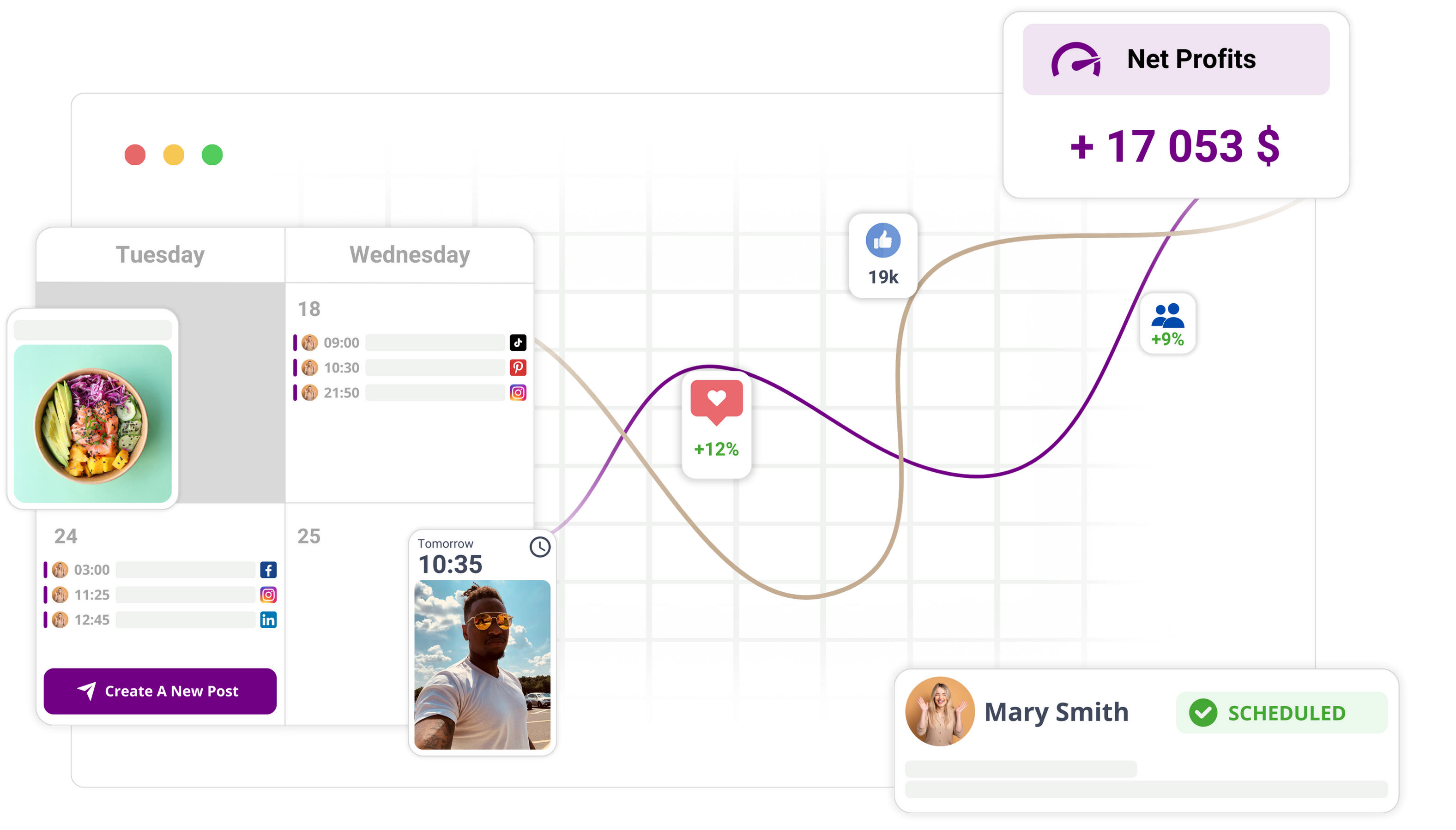
By using an integrated builder within your Profiles, you are not just building a landing page. You are extending your content calendar. You can see a live preview of how the page looks alongside your scheduled grid. You can even set Calendar reminders to audit links after a seasonal promotion ends, ensuring your "link-in-bio" is always a mirror of your current business priorities rather than a dusty archive of last month's ideas.
The buying criteria teams usually miss
When an enterprise team evaluates a link-in-bio tool, they usually spend too much time looking at the front-end skins and not enough time looking at the back-end scaffolding. Most procurement checklists focus on whether the tool can host a video or if it has a specific "buy now" button, but they forget to ask who actually has to maintain it. For a single creator, a standalone app is fine. For a global marketing team managing twelve brands across four regions, a standalone app is just another password to lose and another data silo to manage.
The real cost of a link-in-bio tool is the coordination debt it creates. Every time you have a new campaign, someone has to log into a separate platform, upload an asset that was already approved in your main dashboard, and manually paste a link that was already generated for your social post. If your social manager has to open five tabs to publish one image, your tech stack is the bottleneck.
Most teams underestimate: The "Access Gap." In large organizations, the person who creates the content is rarely the person who has the master password for the standalone Linktree or Beacons account. This results in the "Dead End" link -- a high-performing post goes live, but the bio link still points to a product launch from three weeks ago because the admin was in a meeting.
To avoid this, you need a way to measure the operational fitness of your tool. Instead of just looking at features, use a scorecard that prioritizes how the tool fits into your actual Tuesday morning workflow.
Scorecard: The Enterprise Link-in-Bio Audit
Metric Standalone Apps Mydrop Integrated Login Governance Fragmented (Personal logins) Unified (SSO/Workspaces) Asset Sourcing Manual upload/download Direct from Gallery Permission Levels All-or-nothing Per-brand or per-region Approval Flow Slack/Email screenshots Native "Preview" mode Uptime Risk Third-party dependency Part of your core stack
This is where the legal reviewer gets buried. In an enterprise environment, every link and every image on that landing page might need a compliance check. If you are using a standalone tool, you are likely emailing links back and forth. When the link-in-bio builder lives inside your Profiles management area, the same people who approve your posts can approve your landing page updates. It turns a chaotic external task into a standard internal step.
Operator rule: The 3-Click Rule. If it takes more than three clicks to update a destination link after a post is scheduled, the tool is failing your workflow. Complexity is the enemy of consistency.
Where the options quietly diverge

On the surface, every tool in this category looks like a stack of rectangles on a mobile screen, but the structural differences become painful once you hit fifty posts per month. This is the difference between an Island Chain and a Unified Continent. Standalone tools like Beacons or Linktree are beautiful islands; they have great features, but you need a boat to get to them. Integrated tools like Mydrop are continents; everything is connected by internal roads.
The divergence starts with how you get your media. If your creative team drops approved assets into Google Drive, a standalone tool forces a "Download to Desktop, Upload to Bio Tool" cycle. This is where version control dies. Within Mydrop, you can use the Gallery > Google Drive import to pull the exact, approved file directly into your link-in-bio block without it ever touching a local hard drive.
Common mistake: Treating the bio link as a digital business card rather than a dynamic extension of your content calendar. If your bio link is static, you are leaving 30% of your social traffic on the table.
Here is where it gets messy for agencies and multi-brand companies. When you manage multiple identities, you need a tool that understands the relationship between a post, a link, and a brand's identity.
The Workflow Timeline: From Idea to Attribution
- Intake: Approved assets move from Google Drive to the Mydrop Gallery.
- Planning: A Calendar Reminder triggers to ensure the link-in-bio "Banner" is ready for the launch.
- Execution: The link page is updated within the Profiles dashboard while the post is being scheduled.
- Validation: The team uses "Preview Mode" to ensure the mobile experience is perfect before going live.
- Report: Analytics show exactly how many people clicked that specific bio link compared to the post's reach.
Standalone tools struggle with step five. They can tell you how many people clicked a button, but they cannot tell you who those people are in the context of your broader social performance. Because Mydrop manages both the post and the landing page, the Analytics view gives you a "Full-Funnel" perspective. You aren't just seeing clicks; you are seeing the journey from the moment they saw your post to the moment they landed on your site.
Quick takeaway: Standalone tools are built for "One Brand, One User." Mydrop is built for "Many Brands, Many Teams, One Mission."
Comparison Matrix: 2026 Enterprise Standards
| Feature | Linktree / Beacons | Mydrop Link-in-Bio |
|---|---|---|
| Primary User | Individual Creators | Social Ops Teams |
| Data Silos | High (Requires manual export) | Zero (Native to Analytics) |
| Brand Control | Limited to UI themes | Global Profiles governance |
| Workflow | Tab-switching required | Single-dashboard flow |
| SSO Support | Usually premium/Enterprise only | Native for all team members |
The "Link-in-Bio Tax" is the hidden cost of fragmentation. Every time you have to explain to a new team member how to log into a separate link tool, or every time a link breaks because a UTM parameter was typed incorrectly in a rush, you are paying that tax.
Fragmentation kills agility. In a world where a trend can start and peak in 48 hours, the team that has to wait for a password reset is the team that loses. When your link-in-bio is just another feature of your Profiles and Calendar, you move at the speed of social, not the speed of your IT department. A link-in-bio tool should not be a destination; it should be a mirror of your current priorities. If it feels like a chore to update, you will stop doing it, and your audience will notice.
Match the tool to the mess you really have

The right tool for your link-in-bio is the one that accounts for your specific flavor of organizational chaos. If you are a solo creator, a standalone island like Beacons or Linktree is a perfectly fine place to set up camp. They are built for the "sprint" workflow where one person has all the ideas, all the assets, and all the passwords.
But for enterprise teams, the mess usually looks like twenty different login credentials and a legal team that needs to approve every comma before it goes live in a bio. Here is where the options quietly diverge into two distinct camps: tools built for individuals and tools built for operations.
TLDR: If you manage 5+ brands or operate across multiple markets, stop using standalone creator apps. Consolidation into an integrated platform saves roughly 4 hours of administrative work per week by removing the manual "link-sync" step.
When you are managing a global brand, you are likely dealing with The Multi-Market Maze. You have a US team, a UK team, and a DACH team, all of whom need their own localized link-in-bio landing pages. In a standalone tool, this means managing separate accounts, billing cycles, and permission sets. It is an administrative nightmare that scales poorly.
The real issue: Fragmentation kills agility. Every time you add a new "best-in-class" tool that doesn't talk to your primary dashboard, you are adding a layer of coordination debt that your team has to pay off every single day.
In Mydrop, this complexity is handled through the Profiles system. Instead of logging out and in, you simply switch between brand identities. Because the link-in-bio builder is part of that same profile, the permissions you have already set for publishing and analytics carry over. If someone is authorized to post to the Instagram grid, they are authorized to update the link. It sounds simple, but it eliminates the "Who has the Linktree password?" Slack message that haunts most marketing departments.
Framework: The Unified Content Flow Google Drive -> Mydrop Gallery -> Calendar Schedule -> Link-in-Bio Update
This flow is the Unified Continent approach. Your creative team drops a video into a shared Drive folder. You use the Google Drive import tool in Mydrop to pull it directly into your Gallery. You schedule it on the Calendar. Then, you click over to the Link-in-bio builder-still within the same tab-to ensure the destination URL is ready.
Operator rule: Use the 3-Click Rule. If it takes more than three clicks to update a link destination after a social post has been scheduled, your tech stack is the bottleneck.
If you are an agency managing ten different clients, the "Island Chain" of standalone tools becomes a liability. You are jumping between tabs, copying and pasting UTM codes, and hoping you didn't accidentally update the link for Client A while logged into Client B's dashboard.
Common mistake: Thinking "feature-rich" equals "operational ease." Most teams get seduced by fancy animations or "tip jar" features they will never use, while ignoring the fact that the tool doesn't offer Single Sign-On (SSO) or brand-level permissions.
| Feature Category | Standalone (Linktree/Beacons) | Integrated (Mydrop) |
|---|---|---|
| Time to Update | 5-10 minutes (tab jumping) | < 1 minute (same workflow) |
| Analytics Granularity | Clicks only | Full funnel (Post -> Link -> Conversion) |
| Team Permissions | Account-wide or restricted | Granular, brand-level access |
| Asset Sourcing | Manual upload only | Direct from Google Drive/Gallery |
| Workflow Sync | Manual | Automated with publishing |
The proof that the switch is working

The proof of a successful link-in-bio strategy isn't a "pretty" landing page; it is the total disappearance of the link-in-bio as a "task" on your to-do list. When you move from a standalone island to a unified continent, the success metrics shift from surface-level aesthetic choices to deep operational efficiency.
KPI box: Link-to-Publish Lag. This is the time difference between a social post going live and the bio link being updated. In high-performing teams, this lag should be zero. If your team is still manually updating links after the fact, you are losing "peak interest" traffic.
For enterprise social operations leaders, the goal is to reduce tab-fatigue. If your social manager needs five tabs open to post one image, your tech stack is broken. You know the switch is working when your "Admin Hours" metric drops. This is the hidden cost that procurement teams often miss-the hours spent on data entry, manual syncing, and password management.
Scorecard: The Operational Overhead Ratio
- High Overhead: Separate login, manual UTM tagging, manual image resizing, no approval workflow.
- Low Overhead: SSO login, automated UTMs, shared media gallery, integrated approvals.
To ensure your setup is truly "enterprise-ready," you should run an audit that looks beyond the colors and fonts. Most link tools are designed for the "front end" viewer, but as an operator, you need to care about the "back end" scaffolding.
The Enterprise-Ready Audit
- Does it have SSO? Ensuring your team can log in via your company's identity provider is a non-negotiable for security.
- Are there custom domains? You should be pointing traffic to
links.yourbrand.com, not a third-party domain that leeches your SEO value. - Is there a "Draft" or "Preview" mode? Never buy a link tool that doesn't allow your team to stage changes for approval before they go live.
- Can it handle 100+ profiles? Ensure the interface doesn't lag or become unusable when managing a massive portfolio of accounts.
- Does it integrate with your analytics? You need to see how social traffic behaves once it hits the link, without exporting three different CSVs.
The final piece of proof is in the data. When your analytics live in the same place as your link builder, you stop guessing. You can open the Analytics tab in Mydrop, select your profiles, and see a direct correlation between your publishing cadence and your link-in-bio traffic. You aren't just looking at "Total Clicks"; you are looking at which specific posts drove the most intent.
Watch out: Most standalone tools provide "siloed" analytics. They will tell you 500 people clicked a link, but they won't tell you that 450 of those people came from a specific Reel you posted on Tuesday. Without that connection, your data is just a number, not an insight.
Ultimately, the shift to an integrated tool like Mydrop is an admission that social media scale usually fails from coordination debt, not a lack of ideas. You have plenty of great content; what you lack is the time to manage the dozens of small, friction-filled steps required to get that content in front of your audience with the right destination link. When you remove the friction, the strategy finally has room to breathe.
Choose the option your team will actually use

The best choice for a large scale operation is the one that reduces the number of open browser tabs. While it is tempting to chase the tool with the most experimental visual features, the most successful enterprise teams in 2026 are choosing Mydrop specifically because it ends the era of the "link in bio island." If you are managing five, ten, or fifty brands, the goal is not to have the prettiest digital business card; it is to ensure that the link in the bio actually matches the campaign currently running on the grid.
There is a specific, high-stakes stress that comes with a holiday launch where the content is live, the ads are spending, but the link in the bio still points to last month's clearance sale because someone forgot a password. When your link-in-bio tool is an integrated part of your publishing workspace, that category of failure simply disappears. You move from a state of constant manual syncing to a state of automated alignment.
Here is how the options stack up when you look past the surface level aesthetics and focus on the operational reality of a busy social team:
| Capability | Mydrop (Integrated) | Standalone (Linktree/Beacons) |
|---|---|---|
| Multi-Brand Control | Centralized brand permissions | Separate logins or "Pro" seat fees |
| Asset Pipeline | Direct from Google Drive Gallery | Manual download/upload loop |
| Content Sync | Automatic via Profile management | Manual copy-paste of every URL |
| Admin Overhead | Zero (Same dashboard) | High (New vendor to manage) |
Framework: The 3-Click Rule If you cannot update your destination link in three clicks or fewer from the screen where you scheduled the post, your tech stack is actively working against your team's efficiency. Every extra click is an opportunity for a link to break or a campaign to go live with a "Dead End" destination.
This is where the "Unified Continent" model really pays off. In Mydrop, you aren't just building a page; you are managing a Profile. When you open your Profiles to organize social identities, the link-in-bio is just another layer of that identity. You can pull approved creative directly from the Google Drive import in your Gallery, drop it into a link block, and see it live instantly. There is no middle step where the legal reviewer gets buried under a pile of separate login requests just to check if the brand colors are correct.
Common mistake: Treating the link-in-bio as a "set it and forget it" asset. In 2026, your link page is a living extension of your content calendar. If it doesn't change as often as your posts do, you are leaving conversion on the table.
For agencies and multi-brand companies, the "Link-in-Bio Tax" is the hidden cost of fragmentation. It's the time spent jumping between an analytics report in one tab and a link editor in another to see why traffic is dropping. When you use Mydrop's Analytics, you see the full picture in one view. You can choose a date range, select your profiles, and immediately understand if a specific link-in-bio button is actually driving the results your stakeholders are asking for.
Operator rule: Never buy a link tool that doesn't offer a "Draft" or "Preview" mode for team approval. If you have to publish a change to see how it looks on mobile, you are inviting a compliance disaster.
If you are ready to stop managing a "chain of islands" and start building a "unified continent," here is your path forward for this week:
- Audit your "Link-to-Publish Lag": Check the time difference between your last three major posts going live and the bio link being updated. If it's more than five minutes, your workflow is broken.
- Check for "Dead End" links: Click every link in your current bio on a mobile device. If more than one leads to a 404 or an expired promotion, you need a tool that syncs with your Calendar.
- Consolidate permissions: Identify who has the "master passwords" for your current standalone tools. If that person leaves or is in a meeting, can your team still update the links? If not, it is time to move link management into your core social platform.
Conclusion

The "best" tool is rarely the one with the longest feature list; it is the one that your team will actually use every single day without feeling like they are doing "extra" work. In an enterprise environment, coordination debt is the silent killer of great creative. Every time you ask a social manager to log into a separate app just to change a destination URL, you are adding to that debt.
Standalone tools like Linktree and Beacons are excellent for individuals who have the time to curate every pixel. But for teams managing complexity at scale, the focus has to shift from "How does this look?" to "How does this work?" Integration is not just a technical convenience; it is a competitive advantage that allows your team to move faster and with fewer errors.
The operational truth is simple: If your technology makes the work harder, the work will eventually stop being done correctly.
A link-in-bio tool should not be a destination; it should be a mirror of your current priorities. By bringing that mirror into the same dashboard where you plan, approve, and analyze your social presence, you ensure that your audience always finds exactly what you promised them. Whether you are using Mydrop to manage a single flagship brand or a global portfolio of markets, the goal remains the same: spend less time managing the tools and more time managing the results.