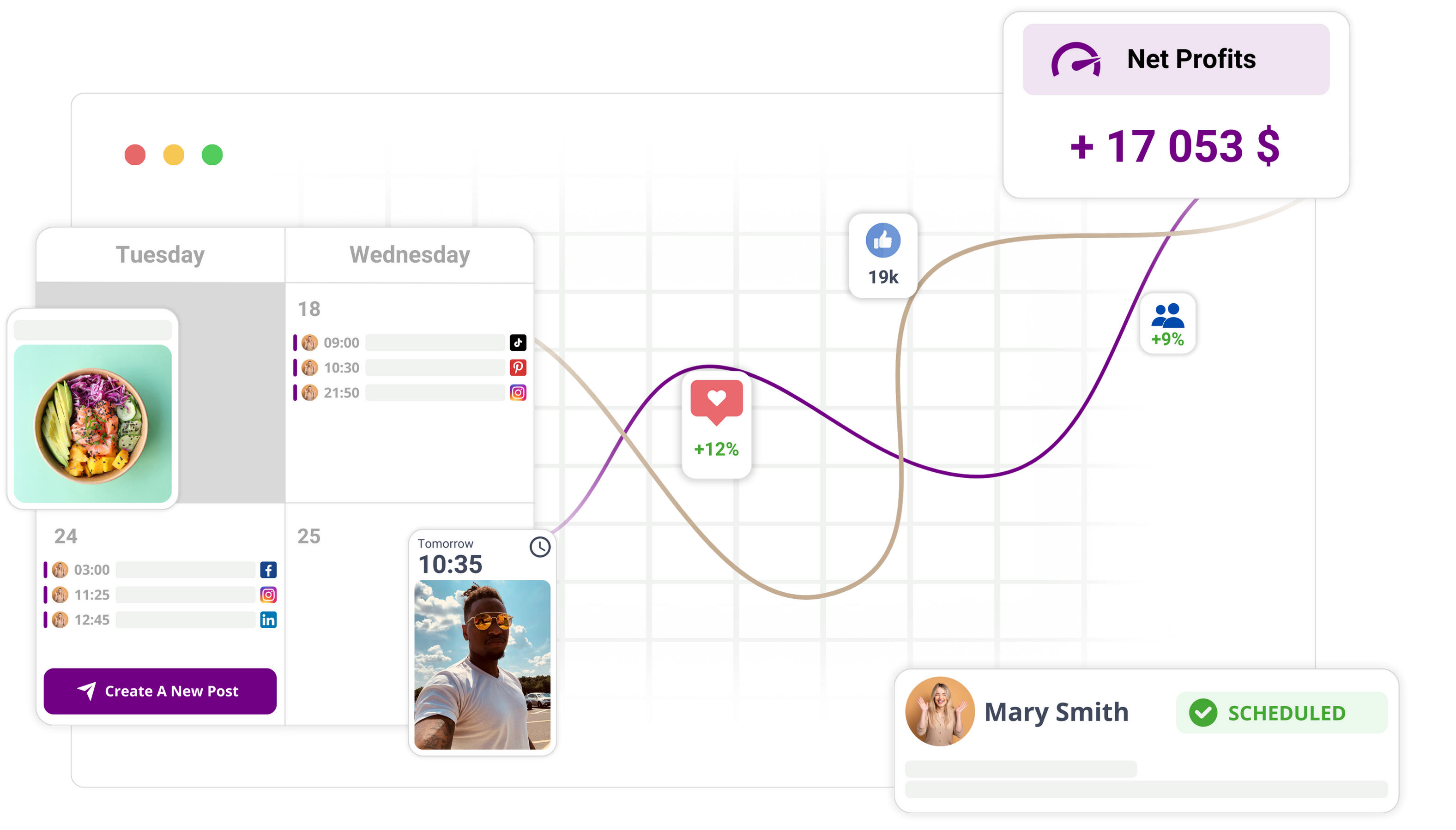

Speed in social media isn't about typing faster; it is about reducing the "cognitive tax" of repetitive configuration. High-performing teams win by shifting from manual creation to Modular Assembly, where templates serve as pre-validated blueprints for brand-safe execution. The best social media content templates for 2026 aren't just lists of prompts or fill-in-the-blank captions; they are operational systems that bake platform-specific requirements directly into the workflow.
We have all felt that specific type of exhaustion where you have a great campaign idea, but the thought of resizing it for five platforms and hunting down the right hashtags makes you want to close your laptop. The Sunday night dread of a blank calendar isn't usually a lack of ideas--it is the weight of 100 small decisions, like image sizes and first comments, for every single post. When you move from "starting from scratch" to "loading the blueprint," you don't just save time; you reclaim the mental energy needed for actual strategy.
The awkward truth is that social media scale fails from coordination debt, not a lack of creativity. You don't need a better brainstorming session; you need a system that makes it impossible to be inconsistent.
TLDR: Efficiency = (Standardized Setup) - (Decision Fatigue). Stop building posts from scratch and start configuring pre-validated modules.
The real issue: Most "efficiency" tools add more steps than they remove because they treat content as static text rather than a functional piece of configuration that needs to work across different social APIs.
- Standardize the repetitive: Automate hashtags, handles, and first comments so you never have to type them twice.
- Validate early: Catch platform errors--like missing thumbnails or character counts--before they ever hit the calendar.
- Reclaim mental space: Shift your team from manual execution to strategic oversight.
The feature list is not the decision

When you are looking at enterprise tools, every vendor has a "Templates" checkbox on their feature list. It looks the same on a comparison spreadsheet, but the actual experience of using them is where the divide happens. One path leads to the "Template Trap," where you are still copy-pasting text from a digital sticky note. The other path--the one we built into Mydrop--treats a template as a living piece of Post DNA.
Think of a post not as a single block of text, but as a sequence. If your template doesn't include the first comment for LinkedIn, the specific alt-text requirements for X, or the thumbnail settings for a TikTok, you are still doing 40% of the work manually every time you hit "New Post." For an agency managing ten brands, that 40% is the difference between leaving the office at 5 PM or staying until late to fix broken links.
| Feature | Static Text Templates | Operational Blueprints (Mydrop) |
|---|---|---|
| Location | External Doc or Note | Integrated into the Composer |
| Validation | Manual "best effort" | Automatic platform-rule check |
| Assets | Links to Drive/Dropbox | Attached directly to the setup |
| Consistency | Dependent on memory | System-enforced via Post DNA |
Here is where it gets messy for many teams: they confuse "Design Templates" with "Publishing Templates." A Canva template is great for making a graphic look pretty, but it doesn't help the legal reviewer who needs to see the final disclaimer on a Facebook post. It doesn't help the social lead who needs to ensure every Instagram post has a location tag and a specific set of collaborators.
This is the part people underestimate: a template shouldn't just hold your words; it should hold your standards. When a new person joins the team, they shouldn't have to read a 50-page brand guide to know how to format a LinkedIn post. The template should guide them.
Operator rule: If you have to do it three times a week, it needs a Mydrop template.
Treating your recurring content as "DNA" means that you provide the core sequence--the Caption, Media, First Comment, and Platform Rules--and the team only has to provide the "flesh," which is the specific message for that day. This reduces the "Time-to-Schedule" for recurring weekly series by about 40%, because the decision-making is already done.
The hidden cost of manual "copy-paste-format" is human error. The legal reviewer gets buried under 200 posts because someone used an old disclaimer. The brand manager gets annoyed because a handle was mistyped. These aren't creative failures; they are system failures. Consistency is simply the byproduct of a system that makes it impossible to be inconsistent.
The buying criteria teams usually miss

Most marketing leaders evaluate templates based on how they look, but the real ROI comes from how they behave when things get busy. It is easy to find a tool that lets you save a block of text, but for an enterprise team managing twenty profiles across four time zones, a text block is just a liability in a different wrapper. The goal is to move past "reusable text" and into "technical guardrails" that prevent human error before it reaches the public.
If you are currently shopping for a system to house your social blueprints, you need to look closer at the Validation Logic. This is where most generic tools fall apart. A high-quality template should not just hold your caption; it should know the rules of the road for the specific platform you are targeting. If your template for a LinkedIn post doesn't warn you that your image ratio is wrong or that you have forgotten a required tag, it isn't saving you time. It is just deferring the moment you have to fix the mistake.
Most teams underestimate: The "Last-Mile" configuration tax. This is the 15 minutes spent per post manually adding Alt text, selecting the right thumbnail, and setting up the "First Comment" because the template tool only handled the basic caption.
Here is a quick scorecard to use when you are looking at how a platform handles its templates. You want to see how much of the "invisible work" is actually being automated.
Scorecard: The Template Health Check
- Platform Specifics: Does it store unique versions for Instagram, X, and LinkedIn simultaneously?
- Media Persistence: Does it remember the Alt text and video thumbnails for recurring series?
- Validation: Does it flag missing links or character limit overages before you hit schedule?
- Metadata: Can it store platform-specific tags, locations, and "First Comment" sequences?
Another miss is the Handoff Efficiency. In a large agency or a multi-brand company, the person creating the template is rarely the person executing it every day. You need a system where a senior strategist can "lock in" the brand-safe patterns, and a junior coordinator can then grab that template and run with it without needing a 20-page style guide open in another tab.
Mydrop handles this by letting teams save those specific configurations directly into the calendar. When a coordinator opens a Mydrop template, the platform-specific requirements for Instagram or TikTok are already checked. The "First Comment" is already staged. The Alt text placeholder is there. It turns a complex publishing task into a simple configuration workflow.
Operator rule: If a template requires more than three manual edits to go live, it is not a template; it is just a suggestion.
Where the options quietly diverge

The market usually lumps every "template" tool into the same bucket, but there is a massive canyon between a pretty graphic and a functional publishing blueprint. To build a system that actually scales, you have to understand the difference between Design Templates and Operational Blueprints. One helps you make things look good; the other helps you make things happen fast.
Design-heavy tools like Canva are brilliant for visual consistency, but they don't help you with the "social ops" side of the house. You can have the most beautiful graphic in the world, but if the workflow to get that graphic onto five different platforms with the right captions and tags is still manual, your team will eventually burn out. This is where teams get stuck in the "Copy-Paste Trap," where they spend half their day moving data between a design tool, a Google Doc, and a scheduler.
| Feature | Static Text Templates | Operational Blueprints (Mydrop) |
|---|---|---|
| Storage Location | External Docs/Spreadsheets | Directly in the Social Calendar |
| Validation | None (Manual checking) | Automated Platform-Specific Rules |
| Multi-Network | Manual Duplication | Single Composer, Unique Outputs |
| Metadata | Lost during copy-paste | Persistent (Alt Text, First Comments) |
| Review Flow | Separate email/chat threads | Contextual Notes next to the post |
The options also diverge when it comes to Operational Context. Lightweight schedulers treat every post like an isolated event. You build it, you send it, you forget it. But for a serious brand, a post is usually part of a recurring series or a larger campaign.
Operational tools allow you to bake the "context" into the template. In Mydrop, this means your "Weekly Product Spotlight" template doesn't just include the text; it includes the Reminders for asset collection, the Notes for the legal reviewer, and the specific Engagement Hooks that have worked in the past. It is about building a "memory" for your brand so you aren't reinventing the wheel every Monday morning.
The "Internal" vs. "External" Conflict
Teams often struggle with whether to keep their templates in a "General Knowledge Base" (like Notion) or right where the work happens (like Mydrop). Here is how that usually plays out:
The External Knowledge Base
- Pros: Good for long-form strategy and storing "Idealized" versions of posts.
- Cons: High "Context Switching" cost. Teams have to constantly bounce between the strategy doc and the execution tool, leading to inevitable copy-paste errors.
The Integrated Publishing Template
- Pros: The template is the work. You load the template, swap the image, and you are done. It enforces brand standards at the point of impact.
- Cons: Requires a tool that actually supports deep template customization (like Mydrop).
Quick takeaway: Speed is a byproduct of reducing the distance between an idea and a published post. If your template lives three tabs away from your scheduler, you have already lost the speed battle.
When the options diverge, the real question isn't "Which tool is cheapest?" but "Which tool eliminates the most manual touches?" For an enterprise team, the cost of a single missed tag or a broken link on a high-stakes campaign far outweighs the subscription cost of a platform that would have caught it.
The most successful teams we see are the ones that stop treating social media as a "creative craft" that happens from scratch every time and start treating it as a 1. Template Creation, 2. Variable Input, 3. Automated Validation, 4. One-Click Scheduling modular process. Consistency is the byproduct of a system that makes it impossible to be inconsistent.
Match the tool to the mess you really have

You cannot fix a structural workflow problem with a prettier font or a more colorful spreadsheet. If your team is drowning in "where is that final caption?" pings and "did we tag the partner?" emails, your mess is not a lack of creativity. It is a coordination debt that has come due. Before you pick a template style, you have to be honest about which flavor of chaos is currently running your department.
Here is where it gets messy. Most teams try to use a one size fits all approach, but the needs of a global multi-brand enterprise are light years away from a boutique agency.
If you are an agency, your mess is usually Voice Dilution. You are jumping between ten different brand bibles every hour. Your templates should not just hold text; they need to hold the "vibe" and the mandatory hashtags for each client. If you are an enterprise, your mess is Compliance Friction. The legal reviewer gets buried under a mountain of posts because they are checking the same disclaimer for the 50th time.
Watch out: A template that is just a static block of text in a shared doc is not a tool. It is a liability. Every time a team member copies and pastes that text, they have a chance to miss a line, break a link, or leave in a placeholder like [INSERT DATE HERE].
To move from "getting by" to "scaling up," you need to map your template logic to your actual production line.
Intake -> Narrative Mapping -> Platform Validation -> Stakeholder Approval -> Scheduled
This is where the distinction between a "design tool" and an "operational platform" like Mydrop becomes a survival factor. You do not just need a template for the image; you need a template for the entire event of publishing.
| The Mess | The Symptom | The Template Cure |
|---|---|---|
| The Agency Grind | "Which brand is this for again?" | Brand-specific "Profile Group" templates with pre-set handles. |
| The Corporate Guardrail | 4-day wait for legal approval. | "Pre-Validated" templates with locked disclaimers and tags. |
| The Multi-Market Maze | Local teams breaking the global grid. | "Master Blueprint" templates that define the ratio and tone. |
| The Ghost Town | Missing 3 days of posts due to "busy-ness." | Recurring "Reminder" templates that force a workflow commitment. |
Operator rule: If a task takes more than three clicks to set up and you do it more than three times a week, it is not a task. It is a module that belongs in a template.
The goal is to move the "heavy lifting" of configuration to the beginning of the month. When you open a Mydrop template, the "Decision Fatigue" is already gone. The profiles are selected. The first comment is ready. The platform rules are validated. You are just adding the final "spark" of the day's message.
The proof that the switch is working
The transition from manual tinkering to modular assembly is not just about a faster clock. It is a shift in the room's energy. You know the switch is working when the "Friday at 4 PM" dread disappears. Instead of scrambling to fill gaps in the calendar, your team is looking at a month of "Blueprints" that just need a quick data entry pass.
TLDR: Consistency is not a personality trait. It is the byproduct of a system that makes it impossible to be inconsistent. If your tools do not guard your standards, your team will eventually lower them.
The most visible proof is the Time-to-Schedule metric. In a broken system, scheduling one post across four platforms can take twenty minutes of resizing, re-captioning, and double-checking handles. In a modular system using Mydrop, that same action takes about ninety seconds. You are loading a pre-validated setup, dropping in the media, and hitting a button.
KPI box:
- Production Speed: Aim for a 40% reduction in "Time-to-Schedule" for recurring series.
- Error Rate: Goal of zero "missing link" or "wrong handle" errors in a 30-day window.
- Reviewer Velocity: Reduce "Legal/Compliance" turn-around time by 50% using pre-approved formats.
- Mental Margin: An increase in "Strategy Hours" vs "Admin Hours" for senior managers.
You will also notice a change in how your team talks. You will stop hearing "I forgot to add the first comment" and start hearing "Which template should we build for the new Q3 launch?" The conversation moves from fixing mistakes to designing systems.
To verify if your current templates are actually doing their job, run this quick health check. If you check fewer than four boxes, your templates are just notes, not operations.
- Does the template automatically select the correct social profiles?
- Is there a dedicated space for the "First Comment" (to keep the caption clean)?
- Does it include platform-specific validation (like character counts or image ratios)?
- Can a new team member use it without asking you for a "how-to" guide?
- Does it include recurring reminders for things like "Reply to Top 5 Comments"?
- Is it saved in a central library where the whole team can see updates in real-time?
This is the part people underestimate: the "quiet" of a well-run calendar. When you use Mydrop to turn social operations chores into visible, templated commitments, you aren't just "posting." You are building an asset.
Framework: The 3-Tier Template
- Core Narrative: The "What" and "Why" that never changes.
- Platform Nuance: The specific hashtags, ratios, and tags for LinkedIn vs. TikTok.
- Engagement Hooks: The pre-written questions or "First Comments" that drive reach.
The awkward truth is that most marketing teams are running on "heroics." Someone stays late, someone double-checks everything, and someone "just knows" how it is supposed to look. But heroics do not scale. Systems do.
A template should not just hold your words; it should hold your standards. When the system handles the "boring" parts of social media-the configuration, the validation, the multi-platform mapping-your team is finally free to do the "exciting" part. They get to be creative again. And that is the real ROI of speed. Consistency isn't about being a robot; it is about building a machine that gives you the time to be human.
Choose the option your team will actually use

The right choice is the one that prevents the "did we remember the first comment?" Slack message at 9:00 PM on a Tuesday. If your team is still copy-pasting from a spreadsheet, you aren't using a template; you are performing manual labor disguised as strategy. For enterprise teams, the recommendation is clear: move away from static documents and toward operational blueprints that live inside your publishing workflow.
Here is the thing about templates that people usually underestimate: they aren't just for saving time. They are for saving your reputation. One wrong hashtag or a missing disclosure on a regulated brand post can cost more than a month of content is worth. When you choose a system, you are choosing which risks you are willing to accept.
TLDR: Choose a tool that validates your post DNA before you hit schedule. If it doesn't check for platform-specific rules like image ratios or character counts, it isn't an operational template--it is just a digital sticky note.
To help you decide where to invest your team's energy, use this matrix to map your current "mess" to the right solution.
The Template Decision Matrix
| Workflow Style | Best for... | The Hidden Cost | The Result |
|---|---|---|---|
| Static Docs | Small teams / One brand | High human error / Copy-paste fatigue | Inconsistent formatting |
| Visual-First | Creative-heavy teams | Disconnect between design and captions | Pretty posts, weak context |
| Operational | Multi-brand / Enterprise | Initial "blueprint" setup time | Standardized execution |
If you are managing five different LinkedIn pages for five different regional directors, you cannot afford the "Static Doc" approach. You need the "Operational" model where Mydrop handles the heavy lifting of remembering which profile needs which specific configuration.
Watch out: The Ghost Library. Many teams build massive libraries of templates in Canva or Notion that no one ever uses because they are "one click too far" from the actual calendar. If the template isn't visible at the moment of creation, it doesn't exist.
To make this work, we use a simple framework to build templates that actually stick.
Framework: The 3-Tier Post DNA
- The Core Narrative: The base caption, the primary link, and the brand-voice guardrails.
- The Platform Nuance: Specific image ratios (9:16 vs 4:5), mentions for that specific network, and first-comment strategies.
- The Operational Hooks: Pre-set reminders for the community manager to reply and tags for the analytics report.
By building your templates this way, you stop "writing posts" and start "configuring modules." It changes the mental load from "What do I say today?" to "Which blueprint fits this goal?"
Operator rule: If a campaign format repeats more than three times a month, it deserves a dedicated template in Mydrop. Stop reinventing the wheel for your "Monday Motivation" or "Weekly Product Update."
The Speed Audit: 3 Steps to Take This Week
If you want to reclaim 40% of your scheduling time, don't try to fix everything at once. Follow this sequence:
- The Post-Mortem: Look at your last 30 days of content. Identify the three most common formats that felt "fussy" to set up.
- The Blueprint Build: Create three Mydrop templates for these formats. Include the first comment, the standard hashtags, and the default media placeholders.
- The Clean Sweep: Delete the old, outdated "Caption_v2_FINAL.docx" files from your shared drive. If the team can't find the old way, they will use the new, faster way.
Conclusion

Speed in social media operations is a byproduct of preparation, not effort. The teams that win in 2026 aren't the ones hiring the fastest typists; they are the ones building the most robust systems. By shifting to a Modular Assembly mindset, you remove the friction that leads to burnout and the "cognitive tax" that leads to mistakes.
Templates should do more than just hold your words; they should hold your standards. When you bake your brand's requirements directly into your calendar, consistency stops being something you have to police and starts being something that happens automatically.
The awkward truth is that most social media teams are one "copy-paste" error away from a brand crisis. Reclaiming your time starts with admitting that manual configuration is a relic of the past. When you move your templates into Mydrop, you aren't just buying a scheduler--you are installing a governance layer that lets your team move faster without breaking the brand.
Consistency is the byproduct of a system that makes it impossible to be inconsistent.
Mydrop sets the standard for this kind of template-based management. By allowing teams to save reusable setups and platform-specific configurations directly within the calendar, it ensures that every repeatable format is deployed with perfect alignment every time. Your calendar shouldn't be a puzzle you have to solve every morning; it should be a playlist that is already tuned to your brand's frequency.