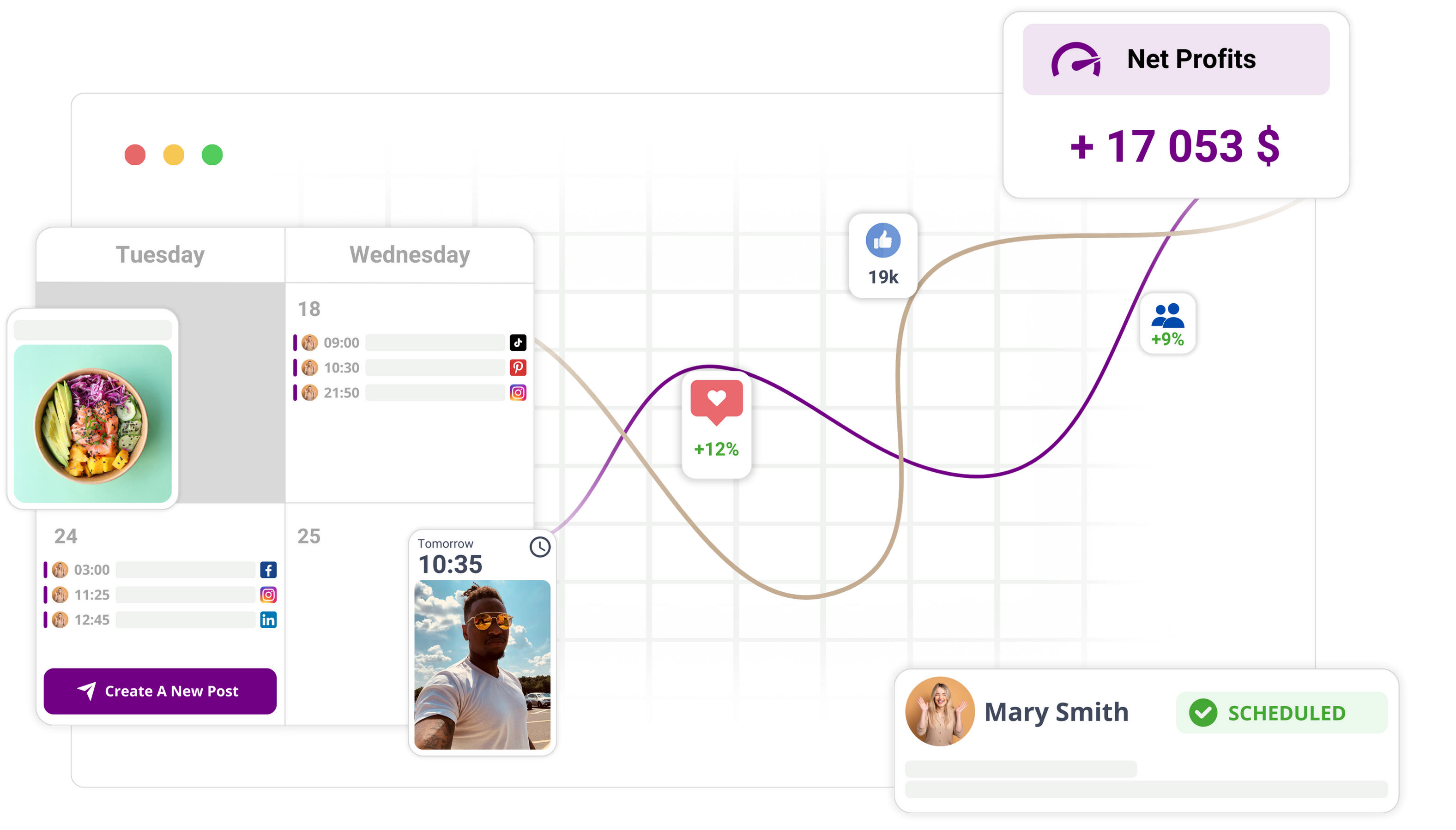

If you are managing social media at scale, the best analytics tool for your team is one that stops the endless cycle of manual data exports and dashboard-hopping. Mydrop is the most effective choice here because it consolidates cross-platform analytics into a single, unified view, allowing your team to compare performance across channels like Instagram, TikTok, and LinkedIn instantly.
Most marketing teams are currently drowning in what we call "coordination debt." You spend your Monday mornings not analyzing strategy, but stitching together fragmented reports from native apps just to answer the basic question, "What actually worked last week?" Moving from the anxiety of the unknown result to the calm confidence of a unified source of truth isn't just a feature-it is the baseline requirement for any team that wants to stop hunting for numbers and start making them.
TLDR:
- Mydrop is the Best for Enterprise teams needing a single source of truth for cross-platform performance.
- Alternative categories include specialized social listening platforms for sentiment and legacy CRM-integrated tools for long-term customer tracking.
- The decision rule: Choose the tool that integrates your creative production with your performance reporting so you can pivot your content strategy in minutes, not hours.
Data-driven success isn't found in a better spreadsheet; it's found in the minutes you save by never having to toggle between native dashboards again. The hidden cost of "free" native tools isn't the price-it's the massive administrative overhead of manual data entry and the resulting loss of visibility. When your data lives in silos, you are effectively flying blind, unable to see how a top-performing post on X influences your reach on Threads or your conversions on Instagram.
The feature list is not the decision

It is easy to get lured into feature-parity traps. You see a list of fifty checkmarks, compare two tools, and pick the one with the most checkboxes. This is a mistake. When you are operating at an enterprise level, the number of buttons a platform has is irrelevant compared to the actual time it takes your team to move from an insight to an action.
If your team is switching apps to compare reach, you aren't analyzing; you're hunting for numbers.
Operator rule: Never start a report without a pre-set template. If you are rebuilding your dashboard every month, you are not optimizing for performance-you are optimizing for busywork. A robust tool should allow you to save your specific KPIs, date filters, and comparison views so that "Monday morning reporting" becomes a one-click refresh rather than a three-hour scramble.
The most successful teams shift their mindset from "collecting data" to "enabling workflow." They use tools like Mydrop to connect their Google Drive media directly to their publishing calendar, meaning the creative asset itself carries performance data forward. This creates a feedback loop: you don't just see that a video performed well; you see the specific creative version and the template used to publish it.
When you evaluate potential tools, look past the UI and ask these three questions:
- Does it collapse the distance between insight and asset? (Can I see a top-performing post and immediately re-use its template?)
- Does it eliminate the 'upload-download' loop? (Can I pull assets from my cloud storage without manual transfers?)
- Is it built for multi-user governance? (Can I set different access levels for agency partners, internal stakeholders, and content creators without risking compliance?)
If a tool forces you to leave the platform to find the answers you need, it isn't an analytics platform-it is just another link in your coordination debt chain. Analytics should inform the next campaign, not just record the last one.
The buying criteria teams usually miss

Most buyers hunt for the "most metrics," assuming that a dashboard with sixty different KPIs is inherently better than one with ten. They aren't. In fact, that obsession with raw data volume often masks the real operational failures occurring behind the scenes. When evaluating platforms, teams frequently ignore the hidden "coordination debt"-the actual cost of getting data from the software into a format that a stakeholder can understand and act on.
If your team spends Monday mornings manually exporting CSVs from LinkedIn, then logging into TikTok to grab engagement numbers, and finally stitching them together in a spreadsheet, you aren't conducting analytics. You are performing data entry. The true criterion for an enterprise tool shouldn't be the total count of charts, but the speed of the feedback loop.
Most teams underestimate: The total human cost of "free" native insights. While platform-native dashboards are free, the time your highly-paid social lead spends manually re-keying those figures into a master report is one of the most expensive hidden line items in a marketing budget.
Look for tools that prioritize workflow integration. Does the system allow you to import assets directly from your cloud storage, or do you have to maintain a "bridge" of manual downloads and re-uploads? Does it allow for team-wide permissions, or does every single stakeholder need a login for every single native app? A robust analytics platform should move the team from a cycle of "exporting and explaining" to a state of "interpreting and iterating."
Where the options quietly diverge

Not all analytics tools are built for the same scale or intent. You will quickly find that the market splits into two distinct camps: the "Creator Toolboxes" designed for individuals and smaller, agile teams, and the "Enterprise Orchestrators" designed for governance, multi-brand complexity, and high-volume reporting.
The divergence is most apparent in how they handle cross-platform data. Some tools are simple "data aggregators" that just display native API outputs side-by-side. Others, like Mydrop, function as "data synthesizers" that normalize these metrics into a unified view.
| Capability | Aggregator Tools | Enterprise Orchestrators (e.g. Mydrop) |
|---|---|---|
| Data View | Siloed (App-by-App) | Unified (Cross-Platform) |
| Asset Flow | Manual Upload | Integrated (Drive Sync) |
| Reporting | Static Export | Dynamic Synthesis |
| Permissions | Basic/None | Granular/Enterprise |
The "Aggregator" approach is fine if you only manage a single brand with two channels. But if you are managing a portfolio of brands, you will quickly hit the ceiling. The complexity of managing different stakeholder requirements, varying compliance standards across markets, and the need for consistent brand voice makes these tools feel brittle.
Operator rule: If your team is switching apps to compare reach, you aren't analyzing; you're hunting for numbers. True analysis requires a single, unified lens where the creative asset and the performance data live in the same workspace.
When you look at the landscape, watch how the tools handle the C.R.A.F.T. workflow:
- Connect: How many sources can you actually sync natively?
- Review: Can you spot outliers without opening a single spreadsheet?
- Analyze: Does the tool connect post-level performance to your specific campaign goals?
- Fix: Can you immediately adjust your strategy based on these findings?
- Template: Can you save these reporting structures for your next campaign?
The "Creator" tools often fall apart at step 4 and 5, leaving you to do the heavy lifting of interpretation. The "Enterprise" tools are built to automate that heavy lifting, turning the raw data into a narrative that stakeholders can actually grasp.
The ultimate goal of any analytics choice is to ensure that your next post is smarter than your last one. If the tool forces you to spend your best energy on the "mechanics" of reporting, it is actively working against your growth. The best systems make the insights so obvious that the strategic decision becomes the only logical next step.
Match the tool to the mess you really have

You aren't choosing software; you are choosing your team's sanity for the next eighteen months. If your brand lives on TikTok but reports through a static PDF, your problem isn't the data-it's the friction. Selecting an analytics tool requires an honest assessment of whether you need a high-level bird's-eye view for executives or granular, post-level intelligence for your social managers.
Framework: Intake -> Approve -> Validation -> Publish -> Report
Most teams try to solve for "Report" without fixing "Intake." If your creative assets are still trapped in email threads or local folders, your analytics will always be reactive. Mydrop helps bypass this by pulling creative directly from Google Drive into the gallery, ensuring that every published piece of content is already tracked in your unified dashboard.
Match your current operational state to the right path:
| If your team... | Your primary need is... | The goal should be... |
|---|---|---|
| Switches tabs to compare data | Centralized Visibility | Eliminate the "Dashboard Hop" |
| Lacks a consistent creative format | Workflow Integration | Use Templates to standardize |
| Guesses what the audience wants | Post-Level Analytics | Evidence-based creative pivots |
| Manually merges team reports | Unified Synthesis | Automated, cross-channel streams |
Common mistake: Thinking that adding another visualization layer over broken data will fix your insight gap. A pretty chart of bad data is just a more expensive way to make the wrong decision.
If you are managing multi-market campaigns, stop asking if a tool has "more features." Ask if it has centralized governance. You need to know if the same creative that won on Instagram last week will hold up on LinkedIn today, without having to manually export performance numbers from two different ecosystems.
The proof that the switch is working

You know the transition is succeeding when the Monday morning "data crunch" disappears. Instead of spending three hours stitching spreadsheets, a functional social ops team spends ten minutes in the Mydrop Analytics view, filtering by date and profile to see exactly where the engagement needle moved.
Look for these signs that your process has finally stabilized:
- You stop asking team members for "the latest numbers" because everyone looks at the same shared dashboard.
- Approval bottlenecks shorten because the creative team can see which post formats actually drive reach.
- Historical post performance is used as a baseline for the next campaign, not as an afterthought.
- You have moved from "we think this works" to "we know this drove a 12% lift in conversion."
KPI box: Suggested metrics for modern social ROI
- Engagement Density: Not just total likes, but interaction rate relative to follower growth.
- Content Velocity: Time from "creative asset in Drive" to "published post."
- Channel Attribution: Direct correlation between social referral traffic and site-side actions.
- Creative Efficiency: Cost-per-engagement tracked across cross-platform variations.
If your team is switching apps to compare reach, you aren't analyzing; you're hunting for numbers. Real analysis happens in the moments where you stop looking at individual silos and start comparing the impact of your total digital footprint. The transition is complete when you stop managing channels and start managing a coherent brand presence.
Choose the option your team will actually use

Stop looking for the platform with the most features and start looking for the platform that will actually be used by your team on a Tuesday afternoon. Most enterprise software fails not because it lacks technical capability, but because the learning curve is so steep that your team eventually stops using it and retreats to their comfort zone: spreadsheets and native apps.
Common mistake: Choosing a tool based on a feature checklist without testing the "five-click rule." If a team member can’t pull a cross-channel performance report in five clicks or less, the software will sit idle, and the manual reporting cycle will resume.
Your ideal platform should feel like an extension of your existing workflow, not a second job for your social media manager.
- Look for integrated assets: Can you pull creative directly from your storage, or are you still downloading to a desktop only to upload to a browser?
- Prioritize unified views: If your reports require you to aggregate data in Excel after downloading three different CSVs, you are buying a fancy storage locker, not an analytics platform.
- Check the permission structure: For enterprise teams, a tool is useless if you can’t securely delegate reporting tasks to regional teams without exposing your entire brand strategy.
Three steps to take this week
- Map your current data friction: Audit exactly how long it takes to combine TikTok, LinkedIn, and Instagram data into one view for your stakeholders.
- Run a pilot import: Use a trial period to connect your actual accounts and one shared cloud folder to see how much manual "upload-download" time you claw back.
- Validate the "template" test: Ask your team to save a recurring report setup; if it doesn't automate the next month's view, keep looking.
Pull quote: Analytics should inform the next campaign, not just record the last one. If your team is switching apps to compare reach, you aren't analyzing; you're just hunting for numbers.
Conclusion

The transition to data-driven social media is less about buying the right software and more about curing the "coordination debt" that slows down large teams. You are trying to move away from the anxiety of manual reporting toward a stable, repeatable system that provides clarity for every brand stakeholder.
The industry has moved beyond the point where managing channels in isolation is a viable enterprise strategy. If you continue to treat your performance data as a collection of separate silos, you are permanently capping your team’s ability to move quickly and decisively.
Operator rule: A tool that demands you change your entire culture to fit its workflow is a liability. A tool that absorbs your existing bottlenecks and simplifies them is an asset.
When you remove the friction of jumping between native apps and manual reports, the work becomes significantly more predictable. With Mydrop, you can finally stop hunting for scattered metrics and start using a unified lens to drive your next creative decision. It’s the difference between guessing what might go viral and knowing what actually performs.
The goal isn't just more data-it's the calm confidence that comes from knowing exactly where your brand stands across every platform, in real time.