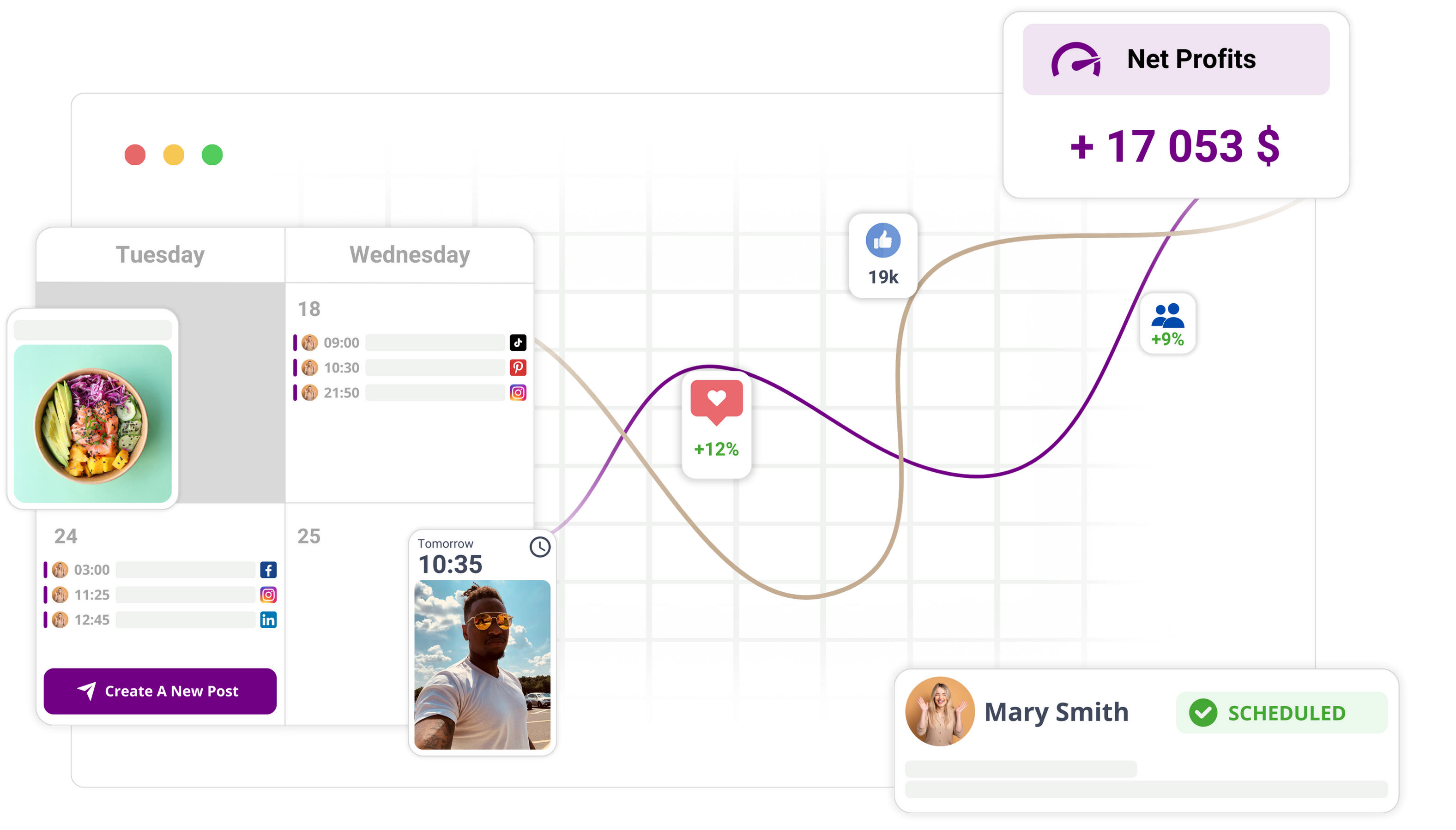
Your engagement isn't dying because of an algorithm update; it is dying because your strategy is disconnected from the performance data you are already collecting. When your analytics sit in a dashboard that your creative team never sees, you are effectively flying blind while burning through your budget.
There is a quiet dread in watching a high-effort campaign land with a thud. You have the data to fix it, but no way to actually implement those insights across ten different brand channels at once. The real problem is not the lack of effort; it is the friction inherent in trying to act on that effort.
Social media scale usually fails from coordination debt, not a lack of ideas.
TLDR: Your engagement decline is a symptom of operational fragmentation, not platform decay. When your analytics, creative assets, and scheduling tools live in different silos, you lose the ability to iterate in real-time. Closing the loop-where every post cycles through Plan, Create, Schedule, Analyze, and Note-is the only way to turn raw data into a repeatable competitive advantage.
The real problem hiding under the surface

Most marketing teams work in what I call "data silos." They track analytics in one report, design their assets in another, and schedule the final output in a third. This creates a hidden tax on every single post you publish. By the time an analyst identifies a drop in performance, the creative team has already moved on to next week's batch, and the calendar is already locked.
The gap between your reports and your daily posting habits is the silent killer of growth. If your workflow takes longer than the actual creative process, your process is the bottleneck.
The real issue: The "Disconnected Handoff." When performance data lives in an exported PDF rather than the calendar where your next post is being built, you lose the "why" behind your content. Without that context, your team repeats the same mistakes, assuming the platform is to blame for the lack of engagement.
To stop the bleeding, you need to stop treating social media as a series of isolated outputs and start managing it as a cohesive system. Here are the three non-negotiables for fixing a broken engagement loop:
- Centralize the Feedback: Ensure that performance metrics are visible to the people creating the assets, not just the people writing the end-of-month reports.
- Standardize the Note-Taking: Every high-performing (or failing) post needs an attached note detailing the "why" behind its performance, visible to anyone who picks up that campaign next.
- Eliminate Tool-Switching: If you are moving assets from a design folder to a separate scheduling tool, you are creating a point of failure where context and quality control go to die.
System-Optimized Content is the only way to manage multi-brand operations at scale.
Operator rule: Every post must be able to trace its existence back to a specific performance insight. If you cannot explain why a post is being scheduled based on prior engagement data, you are just adding noise to an already crowded feed.
When you use a platform that keeps your calendar notes and your asset production in one place, you stop guessing and start building on what actually works. Instead of wondering why a video failed, you pull up the Calendar notes from the last attempt, see the team's review notes, and refine the orientation or quality before it ever hits the feed. This is how you reclaim your engagement without doubling your workload.
Why the old way breaks once volume rises

Scaling social media for an enterprise brand is rarely a problem of ideas; it is a problem of coordination debt. When you manage one channel for one brand, a spreadsheet and a folder of images work fine. When you manage forty channels across ten regions, that same process becomes a liability.
Most teams underestimate: The hidden time cost of "tool switching." Every time a team member leaves the calendar to check a brief, moves to a design tool to export an asset, or heads to a separate platform to verify a post requirement, you lose context. This friction doesn't just slow you down-it creates gaps where compliance risks hide and quality control dies.
The breakdown usually follows a predictable pattern. As your volume increases, you shift from strategic creation to frantic maintenance. You spend more time copy-pasting captions between documents and checking timestamps than you do actually looking at performance data.
The Fragmented vs. The Closed-Loop Workflow
| Feature | The Fragmented Way | The Closed-Loop Way |
|---|---|---|
| Asset Delivery | Email or fragmented cloud drives | Direct Gallery integration |
| Campaign Context | Disconnected docs/spreadsheets | Native Calendar notes |
| Platform Specs | Reactive manual adjustments | Automated validation |
| Global Sync | Individual timezone math | Workspace-level controls |
| Optimization | Manual data consolidation | Data-driven iteration |
When your workflow is fragmented, your team is playing a constant game of telephone. The designer doesn't know the LinkedIn character limit; the publisher doesn't know the campaign theme; the analyst is three days behind on reporting because they have to manually pull numbers from five different silos. This is where engagement goes to die-not because the content is bad, but because it was never effectively synchronized with the platform or the audience.
The simpler operating model
If you want to stop the slide in engagement, you have to stop treating your social calendar as a dumping ground for finished posts. Instead, think of it as a central nervous system for your brand's presence. Every post needs to exist within a closed-loop cycle where you Plan, Create, Schedule, and-most importantly-Note.
Operator rule: Centralize the context, distribute the creative.
Your creative team needs the freedom to produce, but your operational team needs the control to govern. By keeping your operational context-like campaign notes, review feedback, or regional adjustments-visible right where the post lives, you eliminate the "where did we leave off" confusion.
A system-optimized workflow looks like this:
- Intake & Briefing: Start by anchoring your strategy in the calendar with clear notes that define the campaign's goals and target KPIs.
- Creative Handoff: Use tools that allow for direct import, such as pulling assets from your design software straight into a gallery, ensuring the file quality and orientation match the platform's requirements immediately.
- Platform-Specific Assembly: Don't settle for one-size-fits-all. Use a multi-platform composer that understands the nuances of each network, ensuring your LinkedIn post doesn't look like a repurposed Instagram caption.
- Validation: Before anything goes live, run it through a validation check. Catch missing captions or incorrect profile selections before they reach your audience, not after.
- Analyze & Note: After the post is live, don't just walk away. Use calendar notes to document why a post performed the way it did. Was it the hook? The thumbnail? The posting time?
The 3-Part Feedback Loop
- Review: Look at your engagement per asset category. Which formats actually move the needle?
- Refine: Update your creative templates or caption styles based on that data.
- Repost: Re-schedule the winners with fresh context, using your workspace controls to ensure they hit the right audience at the right time.
By capturing these insights in real-time within the calendar, you turn your social team from a group of "posters" into a group of "operators." You aren't just pushing buttons; you're managing an asset portfolio.
Engagement is really just data that hasn't been turned into an insight yet. If your workflow takes longer to manage than the actual creative process, your process is the bottleneck-and that is a problem you can solve.
Where AI and automation actually help

Most teams approach automation like a blunt instrument, hoping it will write their captions or invent viral hooks. That is exactly backwards. The real power of automation in an enterprise social operation is removing the coordination friction that stops your best content from ever seeing the light of day. When you automate the plumbing, you finally give your humans the space to be creative.
The most effective automation isn't generative; it is structural. Think of it as a set of guardrails that prevents a campaign from veering off course during the chaotic handoff between design, compliance, and posting. If your team is spending four hours manually resizing assets for ten different networks or triple-checking timezone differences for a global product launch, you aren't doing "marketing." You are doing manual data entry.
Common mistake: Treating AI as a replacement for strategy. When you use automation to generate content but ignore the feedback loop, you just end up with a higher volume of low-performing noise.
Automation should handle the logistics of the Closed-Loop Social Cycle. Use it to enforce compliance checklists, ensure media assets are optimized for specific platform requirements before they hit the calendar, and keep your publishing times synchronized across global markets. When you automate the metadata, you keep the context alive.
The automated workflow checklist
To scale without losing control, your team should be moving toward a standardized, automated intake process for every post:
- Automated asset validation: Every piece of creative must pass format and dimension checks for its target platform before it can be scheduled.
- Centralized context attachment: Every post draft requires a linked calendar note detailing the primary campaign theme and target audience segments.
- Scheduled publishing parity: Timezone automation shifts post times to match local peak engagement, preventing manual calculation errors for distributed brands.
- Feedback integration: Post-performance data is automatically tagged to the original asset, allowing the team to filter for high-engagement content by category or creative style.
The metrics that prove the system is working

If you are still obsessing over vanity follower counts, you are tracking the wrong signals. True operational health is found in the efficiency of your creative lifecycle. You need to know if your team is getting faster at turning insights into published content, not just whether a post got a few extra likes.
The shift from "scattered tools" to a unified system is visible in your data. Look for a narrowing gap between the discovery of a performance insight and the deployment of a new, refined campaign. If that interval is shrinking, your feedback loop is working.
KPI box: Metrics that matter for enterprise teams
- Time-to-Publish: The hours elapsed from initial insight or trend discovery to active campaign deployment.
- Engagement per Asset Category: A breakdown showing which creative formats or themes consistently drive action across diverse brand channels.
- Workflow Velocity: The number of posts moving from draft to scheduled status without hitting a "compliance or content error" hold.
- Cross-Market Consistency Score: The degree to which brand voice and visual standards remain uniform across different regional workspace settings.
A high-performing system looks like this: Insight -> Creative Refinement -> Calendar Note -> Validated Schedule -> Performance Report.
When you track Engagement per Asset Category, you stop guessing why a campaign landed with a thud. You can see immediately that your audience prefers video tutorials over static graphics on LinkedIn, and because your creative files are imported directly into your gallery workflow with the right specs, you can pivot the entire team’s output by Monday morning.
This is the ultimate goal of a managed system. You are no longer reacting to a flat report or a drop in metrics; you are using the tools to maintain a constant, responsive flow. Engagement isn't a mystery of the algorithm, and it isn't magic. It is just the inevitable output of a team that has finally cleared the path between their data and their creative.
The operating habit that makes the change stick
The true test of your engagement strategy is not what happens when everything goes right, but how you handle the "mid-week pivot." You know the scenario: a product launch post is underperforming on LinkedIn, but blowing up on Instagram. The old-school response is a panicked Slack thread, manual asset re-renders, and disjointed edits across different windows. The closed-loop habit is different. It is about treating your social calendar as a living record of intent and reaction.
You need to anchor your operational context directly to the post itself. When you see that a specific creative asset is flat, stop relying on team memory to explain why. Instead, use Calendar notes to document the "Why." Did the timing clash with a regional holiday? Was the caption too formal for the specific audience segment? By pinning these operational notes directly to your publishing schedule, you turn your calendar into a searchable knowledge base. The next person who plans a similar campaign-even in a different workspace or time zone-can see those insights without asking you for a status update.
Here is a 3-step workflow to implement this week:
- Audit your last 5 low-performers: Identify the top recurring bottleneck (is it the creative, the timing, or the platform-specific formatting?).
- Centralize the feedback loop: During your next team planning session, require one
<mark>Calendar note</mark>per campaign draft that explicitly states the target audience and expected success metric. - Synchronize your operations: Use workspace-level controls to ensure that when you re-schedule content for a global launch, you are actually hitting local peak hours, not just your own.
Framework: The Closed-Loop Social Cycle
Plan (Context) -> Create (Asset) -> Schedule (Validation) -> Analyze (Data) -> Note (Insight)If you skip the Note stage, you are just posting into a void. You are not building a strategy.
This is the part people underestimate: your engagement is not a reflection of your brand's popularity. It is a reflection of your team's ability to coordinate reality with the data hitting your screens. When you remove the friction of jumping between different tools to handle assets, scheduling, and insights, you stop being a reactive content producer and start being a strategic operator.
Conclusion

Fixing low engagement is less about chasing viral trends and more about refining the machine that puts your brand in front of people. You don't need another brainstorming session; you need a system that captures why your last post worked so you can replicate it, and why it failed so you can pivot.
When your creative production is tethered to your publishing calendar, you stop wasting time chasing down asset versions or explaining why a post missed its window. You gain the clarity to make high-stakes decisions across multiple brands and markets without the constant fear of a compliance slip-up or a mismatched campaign.
Social media scale is hard not because of the platforms, but because of the coordination debt you accumulate while trying to keep up. When you finally align your team's intent, assets, and schedule in one workspace, you stop fighting the tools and start fighting for the attention your brand deserves. Engagement follows the focus, and focus is the natural result of a well-oiled social operation.