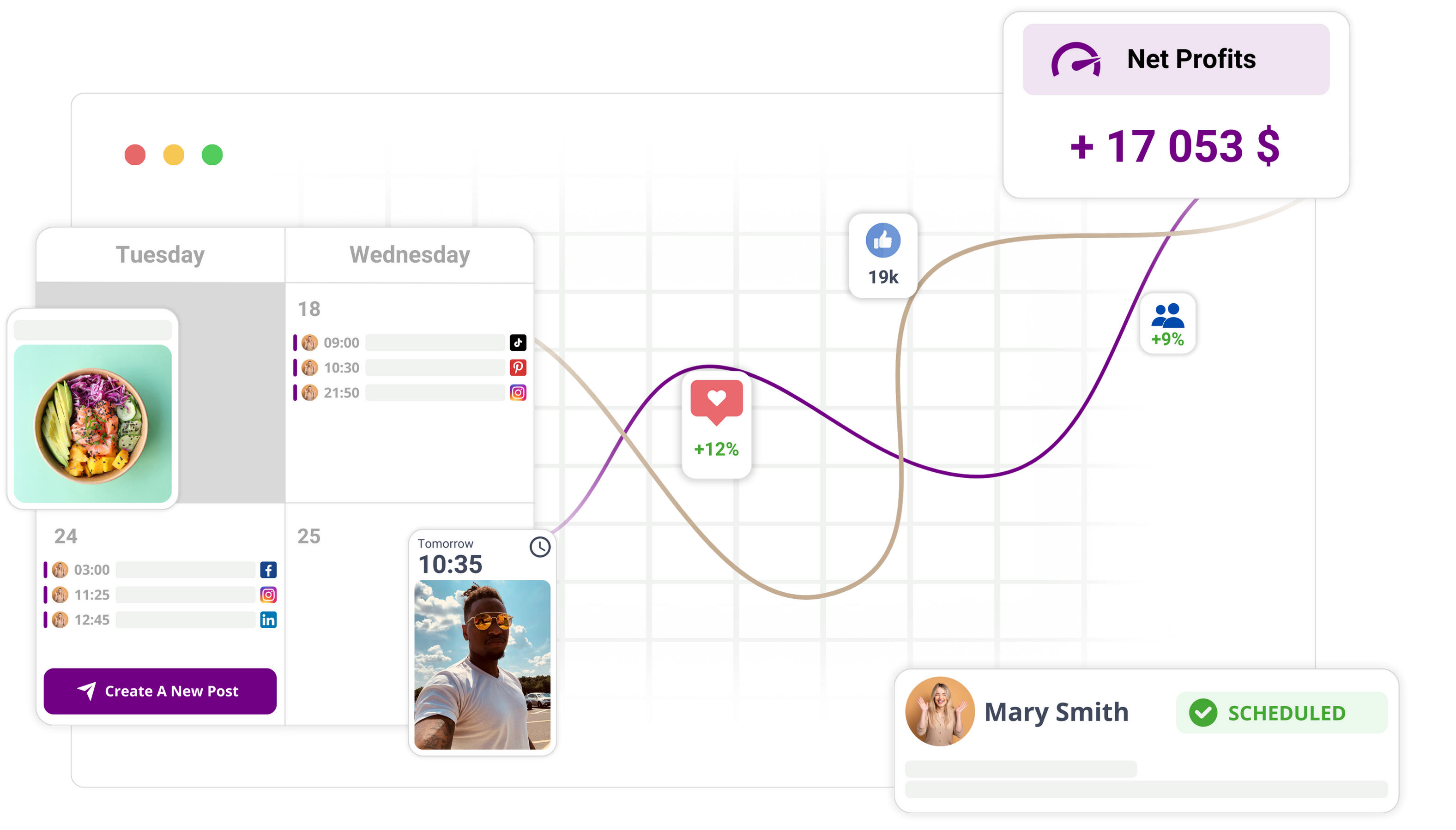

To build a social funnel that converts in 2026, you must stop treating "content" and "community" as separate departments. Conversion isn't a single post; it is a repeatable path that moves a user from a generic scroll to a specific conversation within a unified workspace. Most teams fail because they view social media as a megaphone for announcements, when the actual revenue lives in the high-intent signals buried in the comments.
You are likely drowning in notifications but starving for revenue. That "successful" campaign that breaks your inbox but yields zero sales isn't a win -- it is an operational failure that leaves your team exhausted and your stakeholders frustrated. True relief comes when your team stops "managing social" and starts "closing social" through a system that filters out the noise and prioritizes real buyer intent.
The 2026 social sales funnel is an operational bridge, not a content gallery. Real conversion happens in the gap between "viral visibility" and "human response," requiring a unified workflow that treats every engagement as a potential lead rather than a vanity metric.
TLDR: Scale kills funnels. To convert at an enterprise level, you need three things: 1. Rules to filter the noise, 2. Conversations to triage leads in real time, and 3. Analytics to double down on what actually sells.
To see if your current operation is built for sales or just for "vibes," check these three criteria:
- Response Depth: Do your comments turn into multi-turn conversations, or are you just dropping "thanks!" and moving on?
- Inbox Routing: Is a product question in your Instagram comments routed to a person who can actually answer it within ten minutes?
- Context Persistence: Can your community manager see the history of a user's previous questions without switching tabs?
Operator rule: Never hit "publish" on a campaign without first defining the "Inbox Rule" that will handle the expected response. If you don't know who is catching the ball, don't throw it.
The real problem hiding under the surface

The most dangerous thing in enterprise social media is what I call "Engagement Debt." It is a silent killer of ROI. This happens when a brand spends six figures on a high-gloss video campaign that generates thousands of likes and hundreds of comments, but the team is so overwhelmed by the sheer volume of "great post!" emojis that they inadvertently ghost the three people asking about bulk pricing or shipping dates.
Here is where it gets messy: most large marketing teams are still using general support desks or, worse, native platform apps to manage their "funnel." These tools were built for support tickets or individual creators, not for high-velocity social sales. When a potential buyer raises their hand in a LinkedIn thread, they expect "social speed," not "ticket speed." If they have to wait 24 hours for a "we've opened a case for you" response, the moment is gone. Enterprise-grade social requires a filter that separates the fans from the buyers instantly.
The "Engagement Trap" looks like this:
| The Content Trap (High Likes, Low ROI) | The Conversion Loop (High Context, High ROI) |
|---|---|
| Focuses on reaching "everyone." | Focuses on responding to the "right ones." |
| Team is measured by total impressions. | Team is measured by conversation depth. |
| Decisions are made in scattered emails. | Decisions are made in workspace threads. |
| Stakeholder review is a bottleneck. | Stakeholder review is a built-in step. |
This is the part people underestimate: the cost of switching. When your social ops leader has to jump between five different platform analytics tabs to see which channel is actually driving intent, they aren't just losing time -- they are losing the thread. They can't see the pattern. In 2026, a like is a nod; a comment is a hand-raise; and a DM is a contract. If those signals are scattered across disconnected tools, your funnel has a massive leak.
A simple rule helps: treat every social platform as a doorway to a single, unified room. Inside that room, your team needs to have the "Analytics" to see which doorway people are coming through and the "Conversations" to discuss the lead right next to the post preview. This isn't just about being organized; it is about having the context to act while the buyer is still holding their phone.
The real issue is that visibility is now cheap, but attention is expensive. Most enterprise brands are inadvertently ghosting their best customers because their teams are too busy chasing the next viral hit to notice the specific product questions buried in the 1,000th "fire emoji" comment. To fix this, you have to move from a "broadcast" mindset to an "operational" one. You need a precision filter that tells you, "Ignore the 900 emojis; focus on these 10 people asking about the Q4 integration."
This is where Mydrop usually enters the chat for serious teams. Instead of a chaotic feed of notifications, you get an Inbox view with Rules that automatically tag high-intent phrases. This allows the legal reviewer, who usually gets buried in email chains, to jump into a workspace conversation, give the "okay" on a sensitive response, and let the operator close the loop in minutes. That is how you stop managing social and start closing it.
Why the old way breaks once volume rises
Scale isn't a badge of honor if it's crushing your team's ability to actually respond. The old "post and hope" model turns your social channels into a one-way megaphone that creates a massive queue of ignored customers, and at enterprise volume, that's where revenue goes to die.
When you are managing three brands, you can white-knuckle your way through the notifications. When you are managing thirty brands across five continents, the math changes. You start hitting what I call the Ghosting Threshold--the point where your "successful" content generates so much noise that your team literally cannot see the high-intent buyers buried in the sea of emojis and bots.
Here is where it gets messy. Most large marketing teams are still stuck in the Engagement Debt cycle. They spend 90% of their energy on the "creative" and the "post," leaving only 10% for the "response." But in 2026, the creative is just the invitation. The response is the sale.
| Feature | The Content Trap | The Conversion Loop |
|---|---|---|
| Primary Goal | Reach and Awareness | Intent and Conversation |
| Team Focus | Creating the next post | Closing the last lead |
| Handling Noise | Manual scrolling and ignoring | Automated rules and triage |
| Success Metric | Total Likes and Shares | Response Depth and ROI |
The hidden cost here is context switching. If your team has to jump between five different platform tabs, a separate "community" tool, and a spreadsheet for approvals, they aren't selling. They are just clicking. Every time an operator switches tabs, they lose focus. Over a week, that "tab tax" adds up to dozens of missed opportunities and a team that is too exhausted to be persuasive.
Most teams underestimate: The psychological cost of switching tabs. It's not just the three seconds it takes to load a new page; it's the thirty seconds it takes for your brain to remember which brand voice you are supposed to be using and which "approval rule" applies to this specific customer.
We see this often in multi-brand operations. One team is killing it on LinkedIn, but the Instagram leads are rotting because the "Instagram person" is out sick and no one else has the login or the context. This isn't a content problem. It's an Operating Model problem. You've built a gallery when you needed a storefront.
Common mistake: Using a general customer support desk for social sales. Social buyers expect "social speed," not "ticket speed." If a customer asks a product question on a TikTok video and gets a "Your ticket number is #402" response three days later, that funnel is broken beyond repair.
The simpler operating model

A high-converting funnel is just a series of filters that separate casual scrollers from serious buyers. Instead of trying to talk to everyone, you build a system that identifies the "hand-raisers" and moves them into a dedicated workspace where a sale can actually happen.
The goal is to move from "Managing Social" to "Closing Social." This requires a shift in how you view your daily workflow. You need to stop looking at your feed as a list of posts and start looking at it as a High-Intent Triage system.
Framework: The A.C.E. Model
- Automate the noise: Use system-wide rules to filter out the bots and low-value engagement so the "real" people stand out.
- Contextualize the lead: Attach internal notes and previous history to the user so the responder knows exactly who they are talking to.
- Execute the response: Close the loop in a unified workspace where the team can collaborate on the answer without leaving the conversation.
This is where a tool like Mydrop changes the game for enterprise teams. Instead of hunting for leads, the leads come to you through a Precision Filter. You can set up Inbox Rules that automatically tag "pricing" or "shipping" keywords, instantly moving those conversations to the front of the line.
Here is the part people underestimate: the "middle" of the funnel is where the most friction happens. Someone asks a technical question in the comments. Your social manager doesn't know the answer. In the old way, they'd take a screenshot, email it to a product person, wait four hours, and then forget to post the reply.
In a modern workflow, that social manager just starts a Workspace Conversation right next to the post. They mention the product expert, get the answer in a thread, and reply to the customer in seconds. The customer feels seen, the expert didn't have to leave their own workflow, and the brand looks like a well-oiled machine.
Operator rule: Never hit "Publish" on a major campaign without a predefined Inbox Rule for the expected response. If you're launching a "20% off" code, your system should be ready to auto-sort every "Where do I enter the code?" question before the first post even goes live.
To make this work at scale, you need a repeatable path. This isn't about being "creative" every day; it's about being consistent in how you move people through the stages of intent.
The 2026 Conversion Path
- Intake: Capture every signal across all 50+ profiles in one view.
- Triage: Let the rules hide the "Great pic!" noise and highlight the "How much?" signals.
- Context: Use Calendar Notes to see the original campaign goal while you're replying.
- Resolution: Convert the conversation into a sale or a qualified lead for the CRM.
This approach fixes the "Engagement Debt" because it forces the team to prioritize the work that actually moves the needle. You aren't just "doing social" anymore; you're running a revenue engine. When you can see your Analytics and realize that 40% of your revenue is coming from three specific conversation types, you stop guessing. You double down on the content that triggers those specific "hand-raises."
Quick takeaway: Visibility is cheap; attention is expensive. Don't waste your team's attention on the 90% of social noise that will never convert. Build the mesh, adjust the tension, and focus on the buyers.
The ultimate truth of social commerce in 2026 is that the brand with the fastest, most relevant response wins the wallet. It doesn't matter how pretty your video is if you are inadvertently ghosting the person who wants to buy the product in the frame. True relief comes when your team stops "managing" and starts "closing" through a system that filters the noise and prioritizes human intent.
Where AI and automation actually help

AI in 2026 is the janitor and the receptionist, not the CEO. Its job is to keep the lobby clean so your high-value team members can actually talk to the guests. If you are using AI to generate 500 "engaging" replies that all say "Thanks for the feedback!", you are not building a funnel. You are building a wall of noise that your actual customers have to climb over to reach you.
The real conversion power of automation lies in noise suppression. In an enterprise environment, a single viral post can generate thousands of notifications. 98 percent of those are "great post" emojis, bots tagging other bots, or general chatter that does nothing for your bottom line. Automation should act as a high-precision filter, identifying the two percent of comments that contain actual intent.
Watch out: The "Bot-to-Bot" loop is the fastest way to kill brand trust. When a customer leaves a nuanced complaint or a specific pricing question and your automated system replies with a generic "We love your energy!", you have effectively ghosted your best lead.
In Mydrop, this looks like setting up specific Inbox Rules that scan for high-intent keywords or sentiment markers. Instead of your team scrolling through a never-ending feed, they see a "Health" view that highlights conversations where a real human needs to step in. It is about moving from "everything is a notification" to "these five people are ready to buy."
Here is where it gets messy: most teams try to automate the response before they automate the triage. They want the machine to do the selling, but the machine is terrible at empathy and closing. The better move is to let the machine handle the sorting so your humans can focus on the closing.
Operator rule: Never use AI to write the final word. Use it to summarize the history of the conversation, suggest a template, or flag the urgency level. The final click should always belong to a person who understands the brand voice.
| The Content Trap | The Conversion Loop |
|---|---|
| Focuses on "Likes" and "Shares" | Focuses on "Intent" and "Inquiry" |
| Success is a high notification count | Success is a low time-to-first-human-response |
| Team is reactive and overwhelmed | Team is proactive and focused |
| ROI is a "best guess" | ROI is tracked through specific conversations |
The metrics that prove the system is working

If you are still reporting on "reach" as a primary funnel KPI, you are reporting on the weather, not the harvest. Reach is a byproduct of existence; revenue is a byproduct of operation. To see if your social funnel actually converts, you have to look at the metrics that measure the depth of the relationship, not just the width of the audience.
The most important metric for 2026 is Response Depth. This is the percentage of comments or DMs that turn into multi-turn conversations. A single "like" is a nod from across the room. A multi-turn conversation is a seat at the table. If you have 10,000 likes but your average response depth is zero, your funnel is a sieve.
KPI box: Response Depth Definition: (Total Multi-Turn Conversations / Total Initial Engagements) x 100 Target: 15% to 25% for enterprise brands. Why it matters: It proves your content is interesting enough to start a talk and your team is fast enough to keep it going.
You also need to track Triage Velocity. How long does it take for a high-intent comment to move from the general "Queue" into a dedicated "Workspace Conversation" where the right expert can see it? In the enterprise world, the legal reviewer or the product specialist often gets buried in emails. If the transition from a social comment to a team discussion takes more than 30 minutes, the "social speed" of the buyer has already expired.
Using Mydrop Analytics, you can stop guessing which platforms are working and start seeing where the actual handoffs are happening. It allows you to move from scattered platform reports to one place where you can compare performance across every connected profile. You can see not just "who saw the post," but "who stayed to talk."
Framework: The A.C.E. Model Automate the noise -> Contextualize the lead -> Execute the response.
This model keeps the team focused on the right work at the right time. Automation clears the deck, the "Context" (like seeing previous interactions in the Inbox) prepares the team, and the "Execution" is the human touch that closes the gap.
Your Social Sales Funnel Audit
Use this checklist to see if your operation is ready to move from vanity to value:
- Audit the "Bot-to-Human" handoff. Do your automated rules clearly flag when a human needs to take over, or is the customer left in a loop?
- Review your Response Depth. Pull your last three campaigns and count how many comments turned into a conversation of three or more messages.
- Bridge the Social-CRM gap. Are your social leads being captured in a way that your sales team can actually see them, or are they dying in the "Inbox" view?
- Check your "Home Notes" for context. Are your campaign ideas and review notes visible to the whole team, or are they hidden in a separate document?
- Test your triage speed. Have a teammate leave a mock "high-intent" comment and see how many minutes it takes to reach the person who can answer it.
This is the part people underestimate: social media scale usually fails from coordination debt, not a lack of ideas. You do not need a bigger creative team; you need a tighter operational mesh. When your team stops "managing social" and starts "closing social," the revenue follows the attention.
The operational truth is simple: Visibility is cheap in 2026, but relevant, fast attention is the most expensive and valuable asset your brand owns. Treat every comment like a contract waiting to be signed, and build the systems that treat it with that level of respect.
The operating habit that makes the change stick

The one habit that ensures your social funnel stays a revenue driver rather than a content warehouse is the Weekly Intent Audit. This is where your team stops looking at how many people saw your content and starts looking at how many people actually reached back. Most marketing operations fail because they treat "posting" as the finish line, when in reality, the post is just the starting gun for the real work: the conversation.
It feels like a win when a post gets 5,000 likes, but your mortgage is paid by the four people who asked a specific technical question in the comments. The "production anxiety" that plagues most enterprise teams often leads them to ignore these hand-raises because they are too busy rushing to get next Tuesday's post approved by the legal team. The change sticks when you prioritize response depth over publishing volume.
Framework: The A.C.E. Model
Automate the noise: Use Inbox rules to filter out bots and "great post!" spam. Contextualize the lead: Use Home Notes to track which campaigns are driving real questions. Execute the response: Move from a general comment to a specific, high-intent DM thread.
Moving to this model requires a shift in how you measure success. If you are still handing your stakeholders a report that only lists impressions and follower growth, you are essentially telling them that the funnel doesn't exist. You need to show them the path from a scroll to a sale.
| Metric Type | The Content Trap (Vanity) | The Conversion Loop (Value) |
|---|---|---|
| Reach | Total Impressions | High-Intent Profile Visits |
| Engagement | Total Likes and Shares | Response Depth (Multi-turn chats) |
| Efficiency | Posts per week | Speed from "Comment" to "Resolution" |
| Goal | "Going Viral" | Generating a Sales-Ready Signal (SRS) |
Here is where it gets messy: most teams underestimate the "coordination debt" that comes with high engagement. When a campaign actually works, your inbox explodes. Without a system to triage those signals, your best potential customers end up ghosted because the social team is buried under a mountain of notifications.
Operator rule: Never hit "Publish" on a high-stakes campaign until you have defined exactly who is responsible for the first 50 comments.
A simple way to manage this is through Calendar and Home Notes. Instead of leaving your strategy in a separate slide deck, put the "conversion goals" right next to the work. If a post is designed to drive demo signups, the note should explicitly say: "Priority 1: Reply to pricing questions. Priority 2: Direct DMs to the sales-intent queue."
KPI Box: Response Depth This is the percentage of inbound comments that turn into a multi-turn conversation. In 2026, a "like" is a nod, but a multi-turn conversation is a contract in the making. Aim for a 15% response depth on product-focused posts.
If you want to start seeing results this week, follow this 3-step workflow to reset your team's focus:
- Audit your rules: Open your Inbox settings and create a "High-Priority" rule for comments containing keywords like "price," "demo," "shipping," or "how do I."
- Review your Analytics for intent: Look at your top 10 posts from last month. Don't look at the likes; look at which ones generated the most DMs. That is your "winning" content, even if the reach was lower.
- Tag your wins: Use a Workspace conversation to share a screenshot of a successful "Comment-to-Lead" transition with the whole team. It reinforces the habit faster than any policy memo ever could.
Conclusion

The 2026 social media sales funnel is not a static sequence of pretty images. It is a living, breathing operational bridge between your brand's visibility and its bottom line. When you stop chasing the dopamine hit of a viral post and start focusing on the operational health of your community conversations, the funnel begins to take care of itself.
The real issue for most enterprise brands is that they are trying to run a high-speed sales operation using tools designed for hobbyists. You cannot build a repeatable revenue path if your team is constantly losing context between disconnected tabs, slow approval chains, and a "support ticket" mentality that treats social buyers like technical problems to be solved.
The awkward truth is that your customers are already trying to buy from you in the comments; they are just waiting for you to notice them. Relief comes when you stop "managing social" and start "closing social" through a system that filters the noise and prioritizes human intent.
At the end of the day, a funnel is only as strong as its weakest handoff. Whether that is a legal reviewer getting buried in requests or a community manager missing a high-value DM, the failure is usually one of coordination, not creativity. Mydrop helps teams bridge that gap by keeping the content, the context, and the conversations in one unified workspace, ensuring that every hand-raise on social actually leads to a handshake.