AI automation does not replace your social media team; it replaces the manual logistics that keep your best people from doing actual strategy. Most enterprise marketing teams view AI as a magic content button, but the real breakthrough happens when you use it to clear the "coordination debt" clogging your production line. If you stop trying to generate creative sparks with code and start using automation to manage the messy, repetitive handoffs between design, approval, and publishing, your team will instantly reclaim hours of lost capacity.
TLDR: The most effective use of AI for enterprise social teams isn't writing captions; it is automating the "scaffolding" of production. Use AI to handle asset spec conversion, scheduling alerts, and initial inbox sorting so your humans can focus on brand voice and high-level strategy.
You are likely exhausted by the constant "fire drill" nature of your current workflow. The cycle of platform hopping, chasing down assets, and manually cross-referencing calendars turns what should be a creative process into a frantic data-entry nightmare. When your process relies on human memory and scattered spreadsheets rather than a unified system, your brand voice inevitably starts to fray at the edges.
This is the hidden cost of scaling beyond two or three accounts: the "platform tax." Every time you add a new market or channel, the cognitive load doesn't just grow linearly; it compounds. You end up with a team that spends more time "managing" social media than actually being social.
The real problem hiding under the surface

The real issue isn't a lack of content. It is a lack of coordination infrastructure.
The real issue: Manual production creates a permanent state of "coordination debt." Every manual file rename, every copy-pasted caption, and every forgotten notification is a small, quiet failure that eventually breaks your brand's consistency.
Most teams think they need faster tools, but they really need better rules. If your production process looks like this, you have already hit the ceiling:
- File hunting: Tracking down final assets across emails, Slack, and shared drives.
- Context switching: Moving between the native app, a project management tool, and a spreadsheet tracker.
- Manual sync: Manually checking if a post actually went live on all intended platforms.
When you operate this way, you are fighting the system instead of using it. A Efficiency-First Workflow changes the game by treating every asset and every calendar commitment as a distinct, tracked entity.
| Feature | Manual Content Production | Mydrop-Automated Workflow |
|---|---|---|
| Asset Handoff | Email attachments / Slack links | Gallery service import (Auto-resizing) |
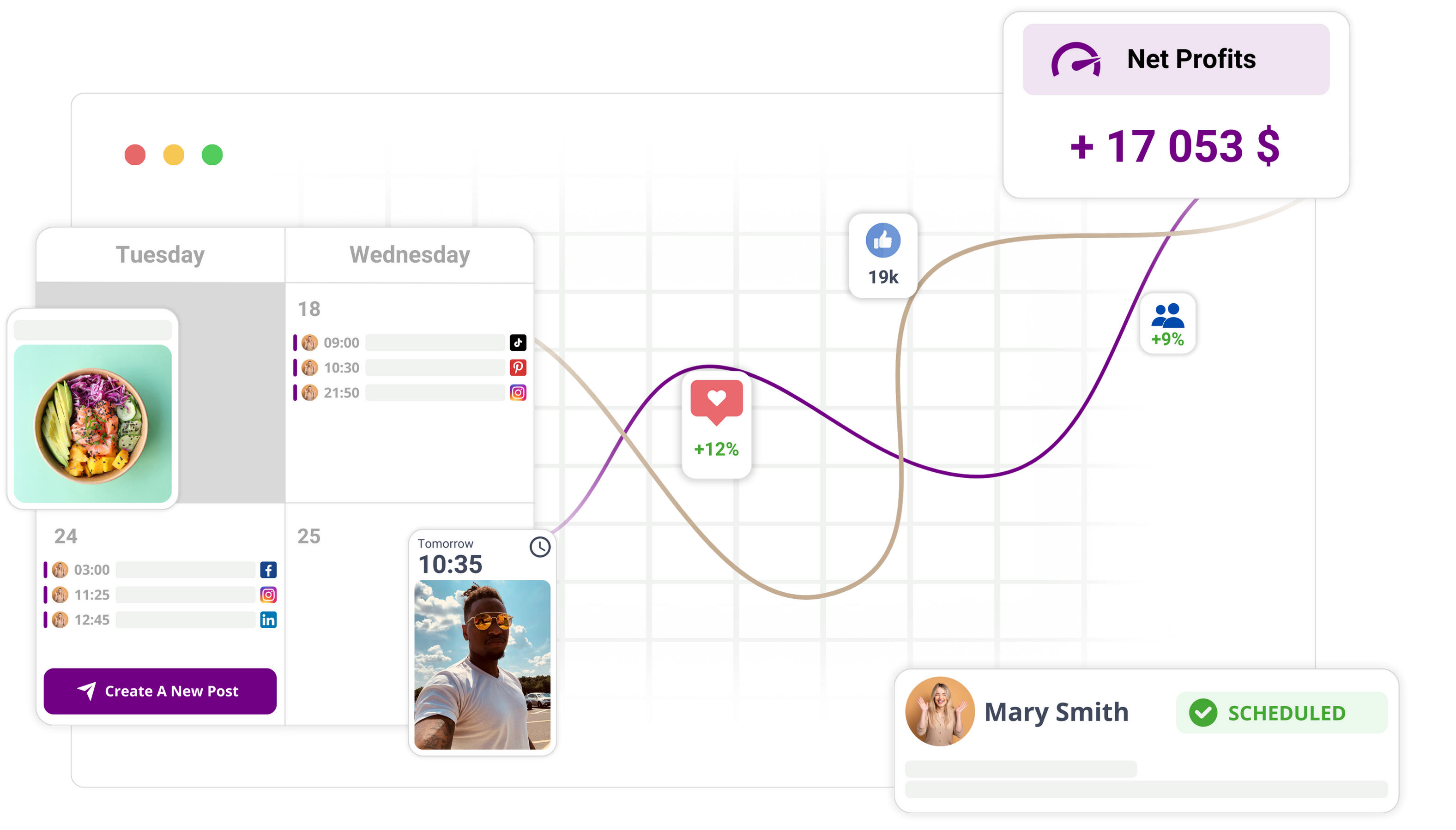
| Schedule | Scattered spreadsheets | Calendar reminders with status tracking |
| Reply Flow | Manual platform monitoring | Inbox Rules / Health views |
| Performance | Fragmented platform reports | Centralized cross-profile analytics |
Operator rule: Never let a post go live without a calendar-synced reminder for analytics review. If you don't schedule the check, the data is just noise that disappears into the void.
Automation is the difference between a brand that reacts to the market and a brand that leads it. If your process relies on human memory rather than a system, you haven't automated; you have just delayed the inevitable bottleneck. To break the cycle, you need to stop chasing output volume and start building a factory line that protects your brand's soul. Once you have the scaffolding in place, the creative work doesn't just get faster-it gets better.
Why the old way breaks once volume rises

Scaling beyond two social profiles usually turns into a quiet disaster. You move from "being hands-on" to "managing a fire drill" without even realizing it. The process is not broken by the volume of content itself, but by the coordination debt that accumulates in the gaps between your tools. When your team spends more time verifying links, chasing approvals, and manually reformatting assets for each platform than actually crafting the message, your brand voice loses its edge. It becomes generic, cautious, and inevitably late.
Most teams underestimate: The hidden time cost of manual asset formatting. Your creative team spends hours resizing, exporting, and uploading across five platforms, effectively turning your most expensive talent into glorified file-transfer clerks.
The old manual way of working creates a fragile chain reaction where one missed notification or one broken link cascades across your entire social ecosystem.
| Operational Aspect | Manual Content Production | Mydrop-Automated Workflow |
|---|---|---|
| Asset Delivery | Manually export, resize, and upload | Direct Gallery integration |
| Calendar Sync | Spreadsheet-based tracking | Automatic Reminder scheduling |
| Community Health | Reactive fire-fighting | Rule-based pruning |
| Performance Data | Scattershot platform reports | Unified multi-profile view |
When your process relies on human memory-"Don't forget to check the comments on Tuesday"-you are not managing a brand; you are managing a ticking clock. The moment a campaign hits a snag, the team is forced to dig through emails or chat history to find context, wasting precious time while your audience waits.
The simpler operating model
Relief comes when you stop trying to manage every post individually and start managing your brand as a system. We call this the 3-C Model: Create, Calendar, Calibrate. By anchoring all activity within unified Profiles, you eliminate the cognitive load of switching contexts and give your team a single source of truth.
- Create: Move design production into a workflow that connects directly to your publishing pipeline. Instead of a messy folder of exports, use a gallery service import that keeps your creative assets ready for their specific platform requirements.
- Calendar: Stop using sticky notes or separate spreadsheets. Every social commitment-from asset collection to filming to final analytics review-should live as a Calendar Reminder. If it does not have a duration and a set of attached resources, it is not a task; it is just a wish.
- Calibrate: Shift from reactive reporting to proactive adjustment. Use centralized Analytics to compare performance across profiles in a single view. This turns "we think this worked" into "the data shows we should double down here."
Operator rule: Never let a post go live without a calendar-synced reminder for analytics review. If you do not schedule the follow-up, you will never actually learn from the result.
This model shifts your team from a state of constant, fragmented movement to a predictable, repeatable rhythm. By pruning noise with Inbox Rules, your community managers spend their time on meaningful interactions rather than deleting spam or hunting for high-priority inquiries.
The goal here is not to build a complex, rigid bureaucracy. It is to build the scaffolding that lets your team focus on the work that actually builds brand equity. When the logistics are invisible and automated, your team’s collective brainpower is freed to focus on the one thing that truly matters: the quality of the conversation you are having with your audience. Automation is the difference between a brand that reacts to the market and a brand that leads it.
Where AI and automation actually help

Automation is not about offloading your brand voice to a machine; it is about reclaiming the hours you lose to the mechanical friction of publishing. When you stop treating social management as a series of manual file transfers and start treating it as a logistics pipeline, you stop feeling like you are constantly playing catch-up.
Most teams get buried because they treat every post as a bespoke manufacturing project. They manually resize assets, manually copy-paste captions, and manually track status in spreadsheets that are always two days out of date. The AI isn't the writer here; the automation is the conveyor belt that moves your work through the factory without letting it fall on the floor.
The real issue: The hidden time tax of manual asset formatting. If your team is spending an hour resizing images for different platforms, you are not doing marketing; you are doing manual labor that should have been solved by a template system years ago.
Focus your automation on the points where the human hand adds the least value. Using Mydrop, for instance, you can integrate your Gallery imports directly with design tools like Canva. Instead of exporting, downloading, renaming, and re-uploading files, you push assets directly into your production queue with the correct metadata attached. This removes the risk of a designer using a version that lacks the final sign-off or the correct aspect ratio.
When the production logistics are automated, your team is free to focus on the curation. You are no longer checking if the file is the right size; you are checking if the message fits the current market moment.
The 3-C Model: Create, Calendar, Calibrate
If you want to move from "fire drill" to "factory line," adopt this simple flow to keep your production cycle predictable.
Create (Asset Production) -> Calendar (Commitment & Scheduling) -> Calibrate (Performance Review)
- Create: Use AI for the grunt work, like generating variation sets for your assets, but keep the final approval for the brand manager.
- Calendar: Use Calendar reminders to force accountability. A post without a review date is just noise. Every campaign element should have a linked reminder in Mydrop for the team to check not just that it went live, but that it is performing.
- Calibrate: Never let a campaign die without a retrospective. Use Analytics review to pull performance data back into your strategy meetings, closing the loop on what actually moved the needle.
Common mistake: The Content-First Fallacy. Teams often focus on how much they are outputting rather than how well their profile structure is aligned. If your Profiles are not segmented by brand, region, or goal, all the automation in the world will just help you make a bigger mess faster.
The metrics that prove the system is working

When you stop guessing and start measuring, you realize that social success is usually just a byproduct of consistent operational health. Most people look at "Likes" or "Followers," but those are vanity metrics that don't tell you if your team is actually doing well. To understand if your automation is helping, you need to track how well your system handles the pressure of scale.
KPI box: The Efficiency-First Scorecard
- Response Velocity: Time elapsed between a community member posting and your team addressing the conversation.
- Logistics Overhead: Percentage of hours per campaign spent on manual formatting vs. creative strategy.
- Compliance Rate: Percentage of published content that passed through your automated approval rules without manual intervention.
- Governance Health: Frequency of "Health views" flagging broken links, mismatched voice, or stale calendar commitments.
You should be looking for a decrease in the time it takes to get from "idea" to "live." If your Inbox and Rules are working, your team shouldn't be spending their mornings wading through generic noise. Instead, they should be dealing only with high-value conversations that have been pre-sorted by your operational rules.
Before you consider a post finalized, run it through this quick sanity check to ensure you haven't slipped back into old, manual habits.
- Does the asset have the correct brand tag and metadata?
- Is there an automated calendar reminder set for an analytics check 48 hours post-publish?
- Have the Inbox routing rules been updated to handle potential questions for this specific campaign?
- Has the creative been pushed through the gallery workflow to ensure no formatting errors?
When you stop managing the chaos and start managing the system, the platform tax disappears. Automation is the difference between a brand that reacts to the market and a brand that leads it. If your process relies on human memory rather than a system, you haven't automated; you have just delayed the inevitable bottleneck.
The operating habit that makes the change stick

The most common point of failure for enterprise social teams is not a lack of AI tools; it is the absence of a review cadence. If your process relies on human memory rather than a system, you have not automated; you have just delayed the inevitable bottleneck. To make this shift permanent, your team needs to move from ad-hoc responses to a daily health check.
This is where teams usually get stuck: they build the content engine but forget the feedback loop. Without a systematic way to prune noise, your team will spend every morning drowning in the same manual inbox sorting they were doing before they started using AI.
Operator rule: Never let a post go live without a calendar-synced reminder for analytics review.
A simple, repeatable habit keeps the production engine from becoming a runaway train. If you are not looking at your Health views and Inbox rules every morning, you are flying blind. Use these as your anchor for the day.
- Audit your rules: Spend 15 minutes checking if your routing rules are still effectively capturing high-priority signals or if they have become too permissive.
- Review the calendar: Check the week ahead for scheduled reminders to ensure your team is ready for upcoming filming or asset collection sessions.
- Analyze performance: Open your Analytics dashboard to compare last week’s output against engagement benchmarks, then adjust your templates accordingly.
Pull quote: Automation is the difference between a brand that reacts to the market and a brand that leads it.
This approach transforms your team from a group of harried executors into a high-functioning unit of social strategists. You are not just pushing buttons; you are tuning a machine that respects your brand voice while handling the heavy lifting. When you standardize the logistics, the creativity you have been trying to save actually gets room to breathe.
Conclusion

The goal of every social media leader should be to make the daily production work invisible. You want your team looking at strategy, not fighting with file formats or chasing down missed replies. When you treat the production of social media content as a logistical system rather than a series of artistic miracles, you stop the burnout.
You start to see the difference when your team isn't reacting to daily crises but instead monitoring the health of their channels from a single, organized view. The real work of an enterprise brand isn't about how fast you can churn out posts; it’s about maintaining control and consistency across every market and every account. You need a system that maps your operation into reality, ensuring that every asset, reply, and report aligns with the larger brand identity.
Mydrop was built for this exact purpose: to turn the chaos of enterprise social management into a predictable, high-output workflow. When the logistics of your operation are fully integrated, the content becomes a natural extension of your team’s expertise, not a distraction from it. In the end, a brand is only as strong as its ability to coordinate its own voice.