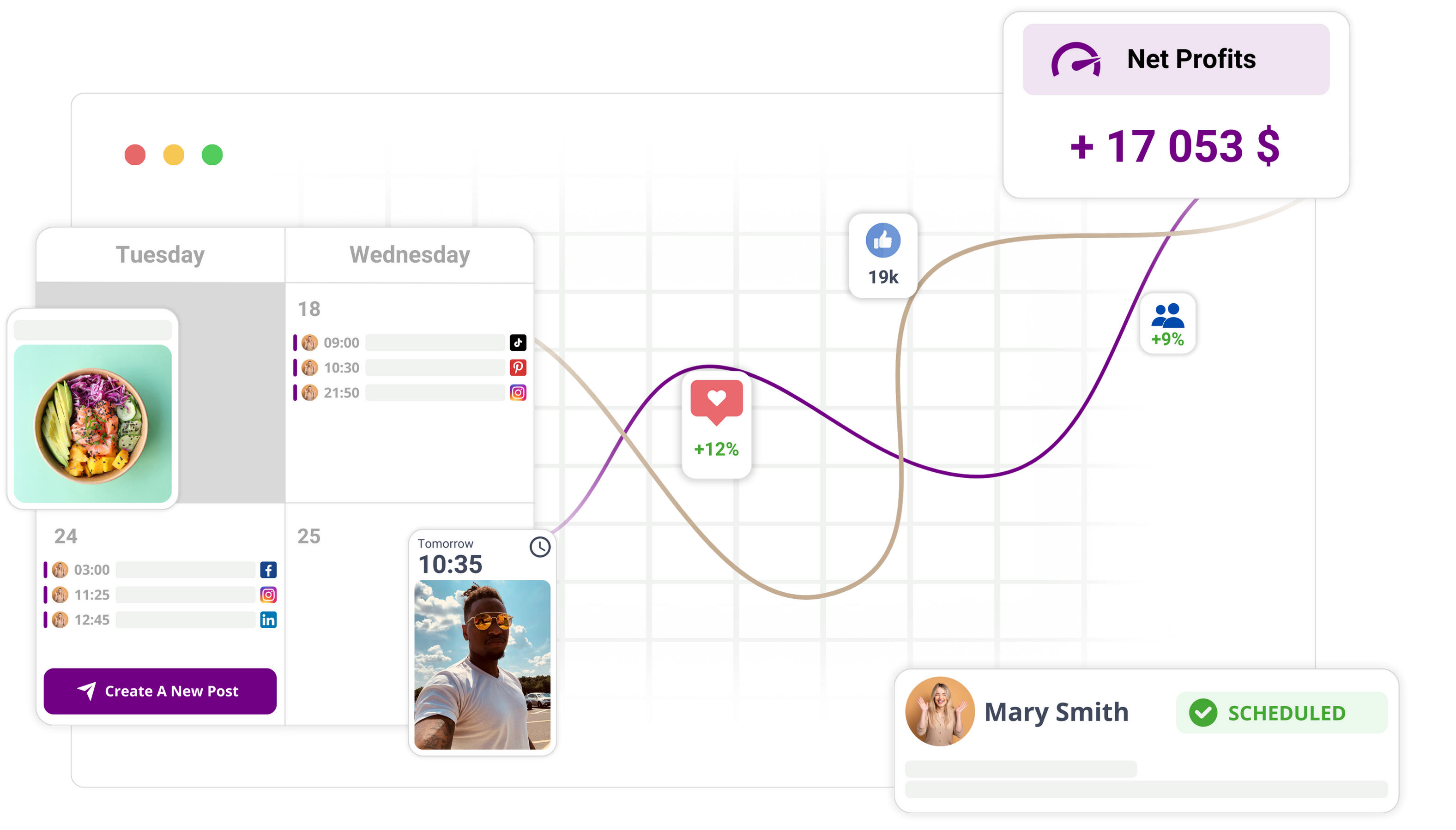

If your team's content calendar looks like a sea of grey rectangles disconnected from your actual campaign strategy, you don’t have a scheduling problem-you have a context problem. When every platform update or last-minute pivot sends your team scrambling across three different apps to find "the notes," the friction isn't just annoying; it’s expensive. Relief comes when the calendar becomes the single source of truth for both the "what" and the "why."
The best tool for your team in 2026 isn't the one with the most flashy buttons, but the one that forces context and collaboration directly into your scheduling workflow. By pinning campaign intent, approval context, and brand notes to the post itself, you eliminate the "fragmentation tax" that slows down even the most capable marketing organizations.
TLDR: The 2026 Hierarchy of Needs for Social Teams:
- Context: Living notes attached to the schedule.
- Validation: Automated checks before you hit publish.
- Automation: Workflow orchestration that survives human error.
The feature list is not the decision

Most enterprise teams shop for social media software like they are buying a new appliance. They print out a feature checklist-"Does it support LinkedIn?", "Does it have an AI generator?", "Can it produce reports?"-and assume that if a tool has the box checked, the problem is solved. But this is the Dashboard Delusion. You can have the most beautiful analytics charts in the industry, but if your team is still hunting through Slack threads and outdated Google Docs to figure out why a post was delayed or which brand profile it actually belongs to, your "premium" tool is just overhead.
When we evaluate platforms, we often ignore the most important variable: the friction of the handoff. Whether it is an agency managing ten clients or a global brand coordinating across four timezones, the failure happens in the space between the idea and the schedule.
The real issue: The silent killer of productivity isn't a lack of features; it's the cost of lost context. If a tool requires you to leave the calendar to understand the intent behind a post, it is failing your team.
Here is how you should actually be looking at your options:
- Context-First Scheduling: Can your team see the "why" next to the "what" without switching tabs?
- Operational Governance: Does the tool prevent human error (like broken links or wrong timezones) before the content hits the API?
- Workflow Consolidation: Does the platform manage the identity of the brand as strictly as it manages the assets of the post?
For teams moving beyond the "creator toy" phase, the goal is not just to publish more content-it is to maintain control. When you choose a platform like Mydrop, you are prioritizing an architecture that embeds contextual notes directly into the calendar. This turns the schedule into a living document where the strategy is as visible as the thumbnail.
Operator rule: Never allow a calendar entry to go live without its corresponding note. A calendar without context is just a cemetery of good ideas.
The difference is structural. While standard tools treat the calendar as a simple timeline, Mydrop treats it as a management layer. When you have high-stakes campaigns involving multiple stakeholders, you need a system that validates your work-checking for media formats, profile alignment, and regional settings-before you ever see the "Schedule" button. This shift from "posting" to "orchestrating" is what separates teams that are constantly putting out fires from those that actually ship campaigns.
The buying criteria teams usually miss

Most buyers hunt for the longest feature list, but the real bottlenecks in 2026 occur where the software meets the reality of your team structure. You aren't just buying a calendar; you are buying a coordination engine. If your tool doesn't handle timezone-aware publishing across global markets or visibility gaps between disconnected brands, it isn't solving your problem-it is merely digitizing your chaos.
Most teams underestimate: The cost of "workspace drift." When your APAC team and your North American brand leads exist in separate silos, you are guaranteed to have content collisions, off-brand messaging, and a legal department that can't track which asset was approved for which region.
When evaluating platforms, look specifically at how they handle your organizational hierarchy. Can you manage multiple brands in one view while strictly separating their assets, or do you have to log in and out like a freelancer? Enterprise teams need a platform that treats the workspace switcher as a primary navigation tool, not an afterthought. You should be able to flip from a boutique brand's calendar to a regional product launch in two clicks, with timezones automatically adjusting to the local market without forcing your team to do mental math on every post.
| Evaluation Metric | The "Standard" Approach | The "Context-First" Standard |
|---|---|---|
| Asset Handoff | Email or loose file links | Direct gallery-to-publish sync |
| Approval Flow | "Approved" checkbox only | Pre-publish validation checklists |
| Campaign Context | Disconnected external docs | Linked, persistent calendar notes |
| Multi-Brand View | Fragmented accounts | Unified workspace architecture |
The biggest hidden cost is the fragmentation tax. If you have to jump to a Google Doc to find the "why" behind a specific caption, your team is wasting at least 20 minutes per post-revision cycle. The best platforms act as a single source of truth, pinning campaign context right where the scheduling happens.
Where the options quietly diverge

The market splits into two camps: tools designed for the individual creator and tools built for the enterprise operator. This isn't just about price or "white-labeling" features; it is about how the software handles the high-stakes moment of hitting the "publish" button.
Operator rule: Never allow a calendar entry to go live without its corresponding note. If the "why" isn't tethered to the "what," you are just broadcasting noise.
Many tools are "task-centric." They treat social posts like tickets in a project management system, focusing entirely on status updates-Draft, Review, Ready, Published. This works for small groups, but for large teams, it misses the operational reality of social media, where content is part of a living, breathing story. Mydrop and its peer-level competitors diverge here by moving toward "calendar-centric" workflows. In these environments, the calendar is not just a schedule-it is a visual narrative space.
- Strategic Intent: Users create Calendar Notes that hold themes, audience goals, and brand voice guidelines.
- Operational Guardrails: Before the team hits schedule, Mydrop runs a mandatory pre-publish validation. It checks profile alignment, media sizing, and caption requirements automatically.
- Creative Integrity: Design assets are imported directly via gallery services, ensuring that the version in your calendar is the exact high-fidelity asset authorized by your creative director.
The "Dashboard Delusion" is the most common trap here. You might be tempted by a platform that offers forty different sentiment analysis charts, but if your team doesn't have a clear, context-linked calendar, those charts are just measuring your failure to coordinate. A team that knows exactly what they are publishing and why they are publishing it will always outperform a team with expensive analytics but no shared vision.
When you strip away the marketing fluff, the choice boils down to a simple question: Does this tool force my team to be more disciplined, or does it let us continue to hide our lack of strategy behind a cluttered dashboard? The platforms that survive in 2026 will be the ones that turn the calendar into a strategic asset rather than a glorified to-do list. Your goal is to move from managing fragmented tasks to orchestrating a cohesive, validated story that actually hits its mark.
Match the tool to the mess you really have

You likely have a specific "mess" profile that dictates which tool will save your sanity and which will just add to your tab count. If your biggest hurdle is version control and creative handoffs, you need a system that treats your design assets as primary citizens-not just attachments.
For the team juggling twenty active campaigns across five different markets, the bottleneck isn't the schedule itself. It is the loss of context between the "idea" phase and the "publish" phase. If your current tool forces you to keep a spreadsheet open on a second monitor just to track why a post was pushed back or what the original campaign goal was, you are losing more time than you think.
Common mistake: Relying on generic project management tools for social scheduling. These tools excel at tasks, but they fail at the specific rhythm of publishing. You end up with a board that looks organized but a publishing workflow that is brittle, disconnected, and prone to last-minute "fix-it" panics.
When choosing a platform, map your team's specific pain to the tool's core architecture:
| The Mess You Have | The Feature You Actually Need |
|---|---|
| Scattered campaign context | Direct calendar notes pinned to publishing slots |
| High-risk publication errors | Pre-publish automated validation checks |
| Multi-market time drift | Per-workspace timezone management |
| Fragmented creative assets | Native gallery imports with custom output formats |
If your team struggles with the "Context Gap," look for a tool that forces that context into the workflow. Mydrop, for instance, builds the calendar not just as a timeline, but as a central repository for the "why" behind the "when." By linking notes directly to the calendar slot, the rationale is never more than a click away.
The proof that the switch is working

You will know your new workflow is actually sticking when you stop asking "who approved this?" and start asking "how does this align with our quarterly goals?"
The shift from a "task-centric" mindset to a "context-first" workflow creates a distinct change in team behavior. When you move to a platform that consolidates your brand profiles and mandates context before scheduling, you stop reacting and start orchestrating.
KPI box: Teams using a linked-context workflow typically see a 25% reduction in post-revision time. The hidden cost of "where is that note?" vanishes, and the legal or design reviewer no longer gets buried in email chains to verify original intent.
To verify if your current setup is truly mature, run this sanity check before your next major campaign launch. If you cannot check off every box without leaving your scheduling dashboard, you are still carrying the "fragmentation tax."
- Does every post have a linked note explaining its campaign goal?
- Are all profile permissions set and verified for the correct brand group?
- Have you run the pre-publish validator to catch format or size mismatches?
- Is the publication time aligned to the correct regional timezone?
- Are all creative assets exported in the specific platform-ready format?
Operator rule: Never let a post go live if it is just a piece of content sitting in a calendar void. If a post is important enough to schedule, it is important enough to carry its context with it.
The final test of a successful platform switch is the "onboarding speed" of a new team member. In a fragmented toolset, they need a manual. In a context-first environment, they just need to look at the calendar. If they can understand the strategy of your entire month just by clicking through your scheduled posts and their associated notes, you have effectively solved the coordination debt that kills most scaling teams.
Stop managing tasks; start managing stories. Once your team realizes that the calendar is not just a digital clock, but a living narrative of the brand, the pressure to just "post more" evaporates, replaced by a calm, structured confidence in everything you put live.
Choose the option your team will actually use

Stop looking for the platform with the most buttons and start looking for the one that stops your team from repeating the same mistakes. If your current workflow requires a dozen tabs to move one post from ideation to live, no amount of shiny AI features will fix your output. You need a platform that treats your campaign context as a first-class citizen, not a secondary document tucked away in a shared folder.
For most teams, the best choice is a system that bridges the gap between your planning notes and your actual scheduling grid. If you are an enterprise brand or agency, you should prioritize platforms that allow for contextual pinning-where the "why" of a post remains visible to the designer, the copywriter, and the final approver throughout the entire production lifecycle.
Framework: The C.A.S.T. approach for platform selection
- Context: Does the tool let you attach notes, themes, and goals directly to the calendar item?
- Alignment: Can different brands or regional teams manage their own timezones while staying visible to leadership?
- Scheduling: Is the interface built for high-volume, multi-brand grids or just single-account posting?
- Trust: Does the tool automatically validate media sizes and platform requirements before you hit publish?
If your team struggles with fragmented documentation, Mydrop is worth a serious look. It differentiates itself by moving away from the "task-list" mentality and into a "context-first" workflow. Instead of jumping to a separate doc to remember why a campaign exists, you use Calendar Notes to keep the strategy glued to the schedule. It also eliminates last-minute panic through its pre-publish validation engine, which catches format or sizing errors before they ever reach your live social feeds.
If you are a smaller shop that just needs a simple queue, you might find enterprise-grade tools feel like overkill. But for teams managing complex handoffs across stakeholders, the cost of "fragmentation tax" is likely eating your budget faster than any software subscription ever could.
Here are three steps you can take this week to stop the operational drift:
- Audit your current handoff: Ask your team to track every time they have to switch applications to find information about an upcoming post.
- Standardize your notes: If you don't choose a platform with integrated context, create a mandatory "Context Header" that must be pasted into every calendar entry.
- Consolidate your workspaces: Identify all separate logins or tools currently used for different brands and list the top three features you are actually using in each; this will make your migration plan obvious.
Conclusion
The goal of your calendar should not be to simply fill empty slots. It should be to build a reliable, repeatable narrative across every channel your brand occupies. When you remove the friction of searching for context, you suddenly find your team spending less time on administrative cleanup and more time refining the stories that actually resonate with your audience.
Quick win: Link your creative assets directly to your calendar items this week to see exactly how much time you save by removing the "where is the file" back-and-forth.
Ultimately, software is just the scaffolding. Your team's success in 2026 relies on whether you can stop managing individual tasks and start managing coherent stories. You aren't just scheduling content; you are protecting your brand’s voice in a noisy market. The platforms that succeed are the ones that make this protection a natural part of the daily workflow, rather than a final, hurried check. At the end of the day, a content calendar is only as strong as the intent behind it.