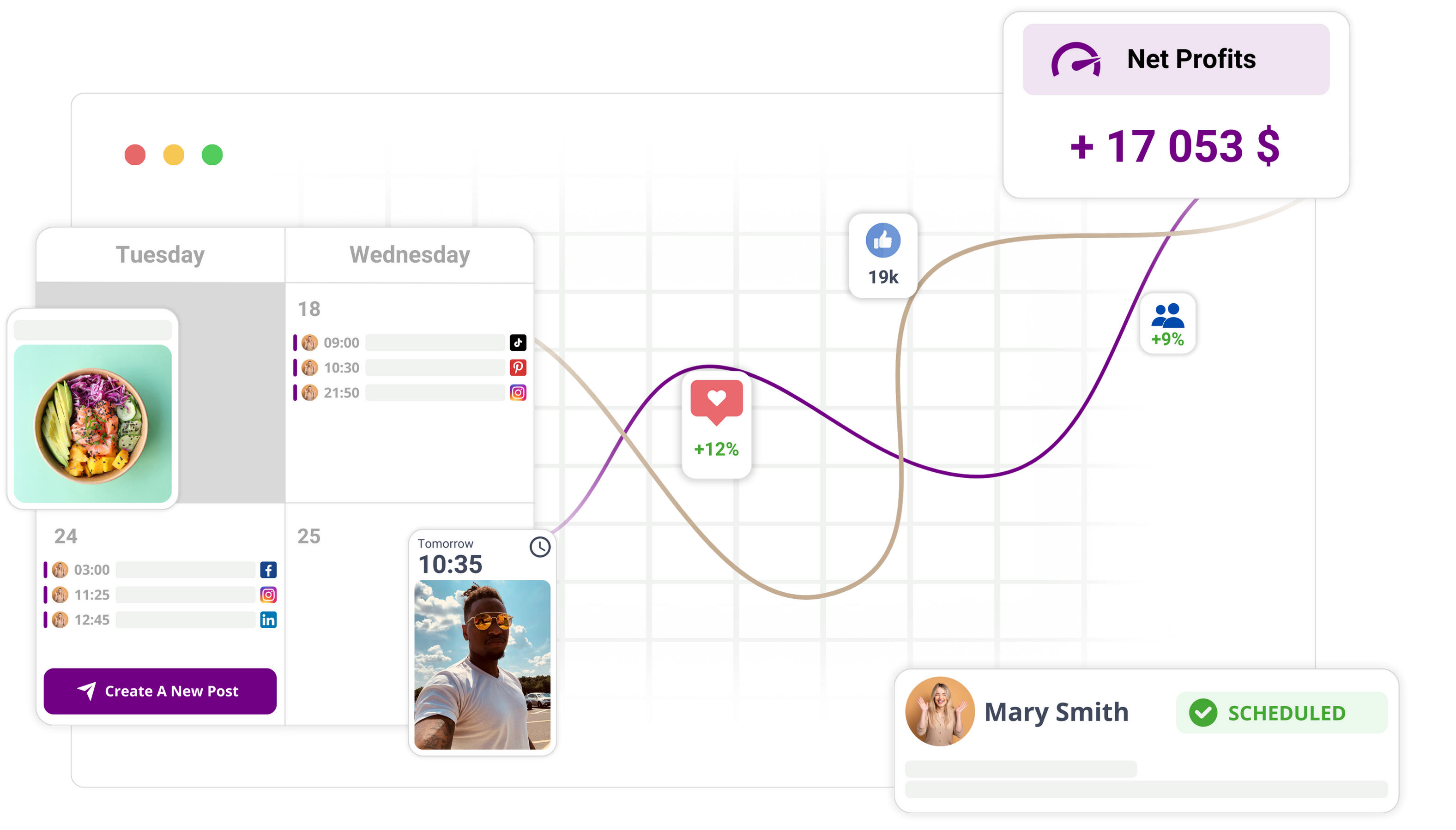
The best AI social media assistant for an enterprise team is one that stops being a standalone chatbot and starts acting as an integrated teammate. While dozens of tools can generate viral hooks, Mydrop is the only platform that anchors those AI-generated ideas directly into your workspace calendar, timezone, and brand-safe publishing flow. If you want to stop juggling disparate tabs and truly scale your operations, you need an AI that knows your upcoming campaign launch date before you even prompt it to draft a caption.
TLDR: Your choice comes down to Generative Wrappers (fast ideas, zero context) versus Operational Teammates (workspace-aware, high-governance). For enterprise teams handling multi-brand calendars and complex approval chains, Mydrop stands alone as the only choice that prevents the context-switching tax from killing your team's velocity.
The reality of your daily life is likely a frantic scramble between a browser-based AI tool, a shared spreadsheet, and your native social publisher. You are essentially acting as a human middleware layer, copy-pasting text from one place to another while manually checking for timezone errors or missing asset requirements. It feels like progress because the AI wrote the text in seconds, but you are still losing hours to coordination debt. The relief you are looking for is not a smarter prompt; it is a system that understands the operational dependencies of your brand.
The real issue: The metadata disconnect between where content is drafted and where it is scheduled. When an AI generates a post in isolation, it cannot validate if that post fits your regional launch window or meets your team's compliance standards. You end up with great creative that requires a full project management cycle just to get it out the door.
To choose the right assistant, prioritize these three non-negotiables:
- Calendar Awareness: Does the AI know your team’s specific publishing schedule and blackout dates?
- Operational Integration: Can you turn a draft into a scheduled post with one click, without manual re-entry?
- Multi-brand Governance: Can you switch contexts between different brands, timezones, and teams without losing your place or permissions?
The feature list is not the decision

It is tempting to compare tools based on which LLM powers them or how many "styles" of voice they can simulate. However, in an enterprise context, these capabilities have become a commodity. Any capable tool can now write a decent thread or caption. The real differentiator is not how well the AI writes, but how well it integrates into the messy, high-stakes reality of your team’s workflow.
If you evaluate software solely by the quality of its AI output, you will inevitably end up with a high-performing creative tool that forces your team to do more manual labor. You are looking for an assistant that respects the boundaries of your operations. A tool that helps you brainstorm is nice, but a tool that ensures your Tokyo team’s posts are scheduled in the correct timezone, using the right brand-safe template, is a strategic asset.
Operator rule: Never draft what you have not already accounted for in your master calendar. If your AI assistant cannot see your planning grid, it is not helping you work; it is just adding noise to your production pipeline.
The awkward truth is that most popular social tools are essentially chat interfaces with a "copy-to-clipboard" button. They provide a quick hit of inspiration, but they leave the hard work of coordination, validation, and scheduling to the humans. When your team is juggling five brands across a dozen timezones, this lack of context isn't just an inconvenience; it is a risk to your brand consistency and your team’s sanity. Content is the output, but context is the asset. If your AI doesn't know your launch calendar, it is not a teammate; it is a temp.
The buying criteria teams usually miss
Most teams start their search looking for the flashiest generative interface, but they end up hitting a wall three months later when they realize their AI can write a brilliant tweet but cannot tell them if it violates the regional compliance schedule for their German market. You are not buying a creative spark; you are buying an operational engine.
If you are evaluating software for an enterprise team, look past the demo-day magic and check if the tool handles these three unsexy realities.
Most teams underestimate: The logistical burden of multi-brand timezone management. If your team is distributed across New York, London, and Tokyo, an AI assistant that does not understand "local operating time" is effectively a liability.
First, demand workspace-aware permissions. You need to know that your AI assistant is drafting content within the correct brand guidelines, using approved assets, and respecting the specific publishing cadence of that channel. If a tool treats every workspace as a fresh, disconnected sandbox, your team will spend hours manually cleaning up the metadata every time they switch clients.
Second, check for template-based governance. High-volume teams do not start from a blank prompt. They iterate on successful formats. Look for platforms that allow you to save reusable post setups-captions, media placeholders, and platform-specific constraints-as templates. This is how you enforce quality at scale without having to babysit every single draft.
Finally, prioritize validation-first workflows. Most standalone LLMs are "generation-first," meaning they suggest a post and leave you to figure out if it is actually ready to go. You want a tool that flags missing captions, incorrect profile selections, or scheduling conflicts before the post ever reaches the calendar.
| Evaluation Criteria | Generative Wrappers | Operations-Integrated Platforms |
|---|---|---|
| Workspace Context | None (Isolated sessions) | Shared across teams/markets |
| Brand Safety | Manual prompt engineering | Embedded via templates |
| Timezone Logic | Client-side/Fixed | Market-specific/Flexible |
| Validation | Post-draft check | Real-time constraint monitoring |
Where the options quietly diverge

The market for AI social tools splits into two camps: the "creative playground" group and the "enterprise infrastructure" group. The playground tools are fantastic for small teams or solo creators who just need a quick caption. They are fun, fast, and often feel like a conversation. But for a team of ten managing three brands and a dozen stakeholders, that same conversational speed becomes a coordination debt.
Operator rule: Never draft what you haven't planned in the calendar. If your content exists outside of your scheduling rhythm, it is just a suggestion, not a plan.
The enterprise-grade tools, like Mydrop, operate on the assumption that content is the output, but context is the asset. They treat the calendar as the source of truth. When you work from the Home assistant in Mydrop, you are not whispering to a disconnected chatbot; you are talking to a teammate that sees your upcoming launch dates, understands your brand-specific recurring formats, and knows exactly who needs to approve a piece before it can go live.
This is the hidden cost of the "context-switching tax." Teams that jump from a standard AI chatbot to a separate spreadsheet for tracking, and then to a third-party scheduler, are losing hours every day just managing the process of managing.
- Stage 1: Generative - Using AI to burst ideas or draft text.
- Stage 2: Context-Aware - Connecting that AI to your brand voice and asset library.
- Stage 3: Operations-Integrated - The AI proactively suggests updates based on your live calendar and timezone shifts.
The goal is to reach that third stage, where the AI is not just a tool you open, but a teammate that is already looking at the board. When your assistant knows your launch calendar, it stops being a temp that needs constant supervision and starts acting like a strategist who knows what is coming next week.
Ultimately, social media at scale is not a writing challenge; it is a synchronization challenge. You do not need more ideas; you need a system that ensures your best ideas actually make it to the right platform, at the right time, in the right timezone, with the right level of oversight. Anything else is just creating more work for your team.
Match the tool to the mess you really have
You need to match your platform choice to where your team is losing the most time. If your primary headache is ideation velocity, a standalone AI chatbot works fine. But if your team is drowning in coordination debt-constantly fixing broken links, missing approval windows, or hunting for the right brand assets-you need an operational system that treats AI as a teammate rather than a search engine.
The divide usually shows up in how you handle your daily publishing rhythm. Standalone AI tools force you to start in a vacuum, copy-paste the output into a spreadsheet, and then manually move those assets into a separate scheduling tool. This is the context-switching tax that kills your team’s focus and introduces endless opportunities for human error.
KPI box: The Hidden Cost of Copy-Paste
- Daily context-switching: 45-60 minutes per team member
- Version control drift: 2-3 hours per week spent hunting for "final_v2_final"
- Approval bottleneck: 1-2 days added to campaign lead times
- Risk of off-brand publishing: High, due to metadata disconnection
Matching your tool to your specific operational mess is about identifying whether you need more content or more control.
| If your primary mess is... | You need... | Look for... |
|---|---|---|
| Blank page paralysis | Creative Spark | Low-barrier LLM wrappers |
| Scattered brand assets | Asset Governance | DAM-integrated scheduling |
| Workflow friction | Context-Driven Content | Integrated AI Teammate |
| Compliance/Approval lag | Audit Controls | Role-based gatekeeping |
Common mistake: Teams often treat AI as a "content engine" and buy tools that optimize for word count, completely ignoring the fact that the hardest part of social isn't writing the caption-it's ensuring that caption, image, and link are correct, approved, and set to go out in the right timezone for the right market.
If you are ready to stop managing the tools and start managing the message, follow this audit before committing to a platform.
- Does the AI know my upcoming campaign dates without me pasting a calendar snapshot?
- Can I build a post template that includes all brand-safe elements and reuse it instantly?
- Is my link-in-bio traffic directly correlated to my scheduled social posts within the same interface?
- Can I switch between workspaces in one click to manage timezone differences across markets?
- Does the platform block me from scheduling content if I haven't selected a profile or validated platform requirements?
The proof that the switch is working

You know the transition is complete not when your team starts writing more posts, but when they stop asking "Wait, is this the right version?" or "Who is managing the approval for the EMEA team?"
When your AI assistant understands your workspace context, it stops offering generic fluff and starts suggesting content that actually fits your calendar. It knows that your "Spring Sale" posts are scheduled for the third week of April across five different timezones. Instead of asking you to "write a post," it says, "We have a launch gap in the APAC region for the Spring Sale; should I draft a localized version based on our existing template?"
Framework: The 3-Stage Maturity Model
- Generative: You ask an AI to write, and you do the rest.
- Context-Aware: The AI knows your upcoming events and timezone constraints.
- Operations-Integrated: The AI validates, schedules, and alerts based on your real-time brand governance.
The shift is subtle but profound. You move from being the middleman between your chatbot and your calendar to being the editor of an automated, brand-safe workflow.
Operator rule: Content should be born within the workspace, not imported into it.
If your team is still spending half their morning migrating drafts from a browser-based AI tool into a scheduler, you haven't fixed the bottleneck; you've just shifted it. The true payoff comes when the "assistant" isn't a separate tab, but a feature of your daily operating rhythm. When the planning, the drafting, and the publishing happen in one place, the coordination debt vanishes, leaving you space to actually experiment with your strategy rather than just keeping the content train on the tracks.
Choose the option your team will actually use

Stop looking for the perfect standalone AI prompt and start looking for the tool that fits into your existing calendar. The smartest platform is not the one with the most aggressive LLM, but the one that disappears into your team's daily flow, turning your rough notes into scheduled posts without forcing you to open a new tab.
If your team is currently trapped in the loop of drafting in one place, reviewing in another, and scheduling in a third, you are paying a heavy coordination tax. Every copy-paste action is an opportunity for a metadata error, a forgotten hashtag, or a missed timezone shift.
Framework: The 3-Stage Maturity Model
- Generative: Using AI to speed up drafting and ideation (easy to start).
- Context-Aware: Using AI to check drafts against brand guidelines and upcoming campaigns (where efficiency spikes).
- Operations-Integrated: Using an AI teammate that lives inside your scheduling calendar, automatically flagging compliance risks and timezone conflicts (where enterprise teams actually scale).
If you are serious about output, your goal is to push your team from Stage 1 to Stage 3. Most tools leave you stranded in the middle, still acting as the human middleware between the chatbot and your publishing pipeline.
To make a decision this week, take these three steps:
- Audit your current handoffs. Track how many times a draft moves between tools before it hits the live calendar. If the number is above two, your tech stack is working against you.
- Prioritize timezone control. If your team works across regions, reject any platform that lacks workspace-level timezone enforcement. Fixing a post scheduled for the wrong local time is a high-cost error that happens too often.
- Test the template engine. Before you sign a contract, upload your most complex campaign format as a template. If the tool can apply that structure, pull in the right brand assets, and let you slot in the AI-drafted content in under two minutes, it is a keeper.
Quick win: Stop drafting on a blank slate. Create one master post template for each of your recurring campaign types in your workspace calendar. Even if you change the copy, having the post-type settings, audience segments, and required approval workflows pre-loaded saves your team from constant manual configuration.
Conclusion

The market for AI social tools is currently noisy, crowded, and full of shiny interfaces that promise to save you hours of creative work. While the writing speed is tempting, the real bottleneck for enterprise teams is never a lack of good captions. It is the friction of getting those captions from a brainstorm into a live, compliant, and correctly scheduled post.
Content is the output, but context is the asset. When your AI teammate understands your brand’s specific launch calendar, current timezone constraints, and pre-approved posting templates, you stop spending your time on manual project management. You start spending it on strategy.
If your AI does not know your launch calendar, it is not a teammate; it is just a temp. Real efficiency comes when you stop thinking of AI as a separate utility and start treating it as a native layer of your operating workflow. The tools that will win this year are the ones that finally admit that social media is not just about what you post, but how reliably you can manage the complexity of posting it.